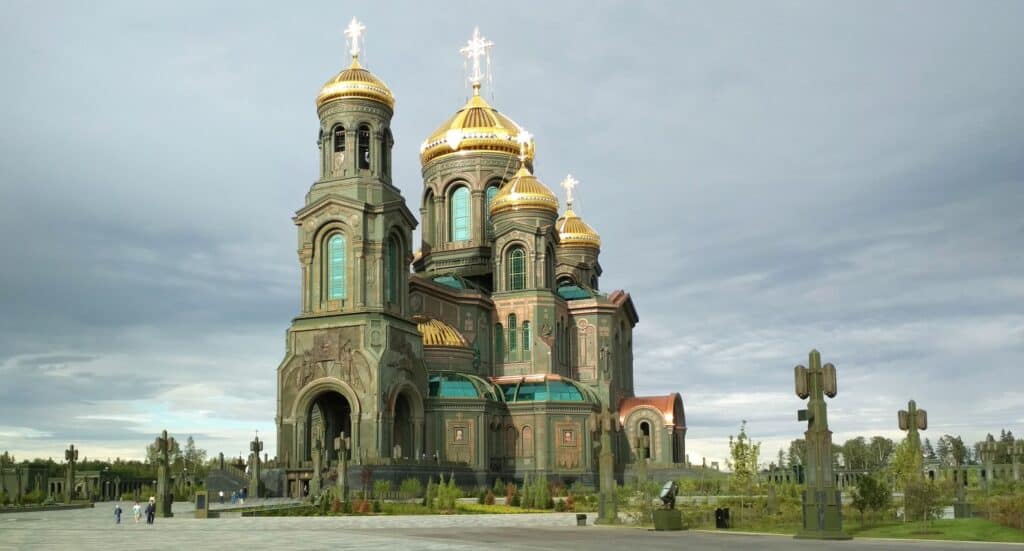
The Patriot Park Cathedral, formally the Main Cathedral of the Russian Armed Forces, is a steel-framed Orthodox church in Kubinka, west of Moscow, completed in 2020. It looks like a traditional Russian church, with onion-like domes, tiered arches and gilded crosses. But it is clad in khaki-green metal, its dimensions encode dates from the Second World War, and its front steps were cast partly from melted-down German tanks. It is a building where religious architecture, war memorial and state monument are fused into one object. That makes it one of the most talked-about pieces of 21st-century sacred architecture, and one of the most debated.
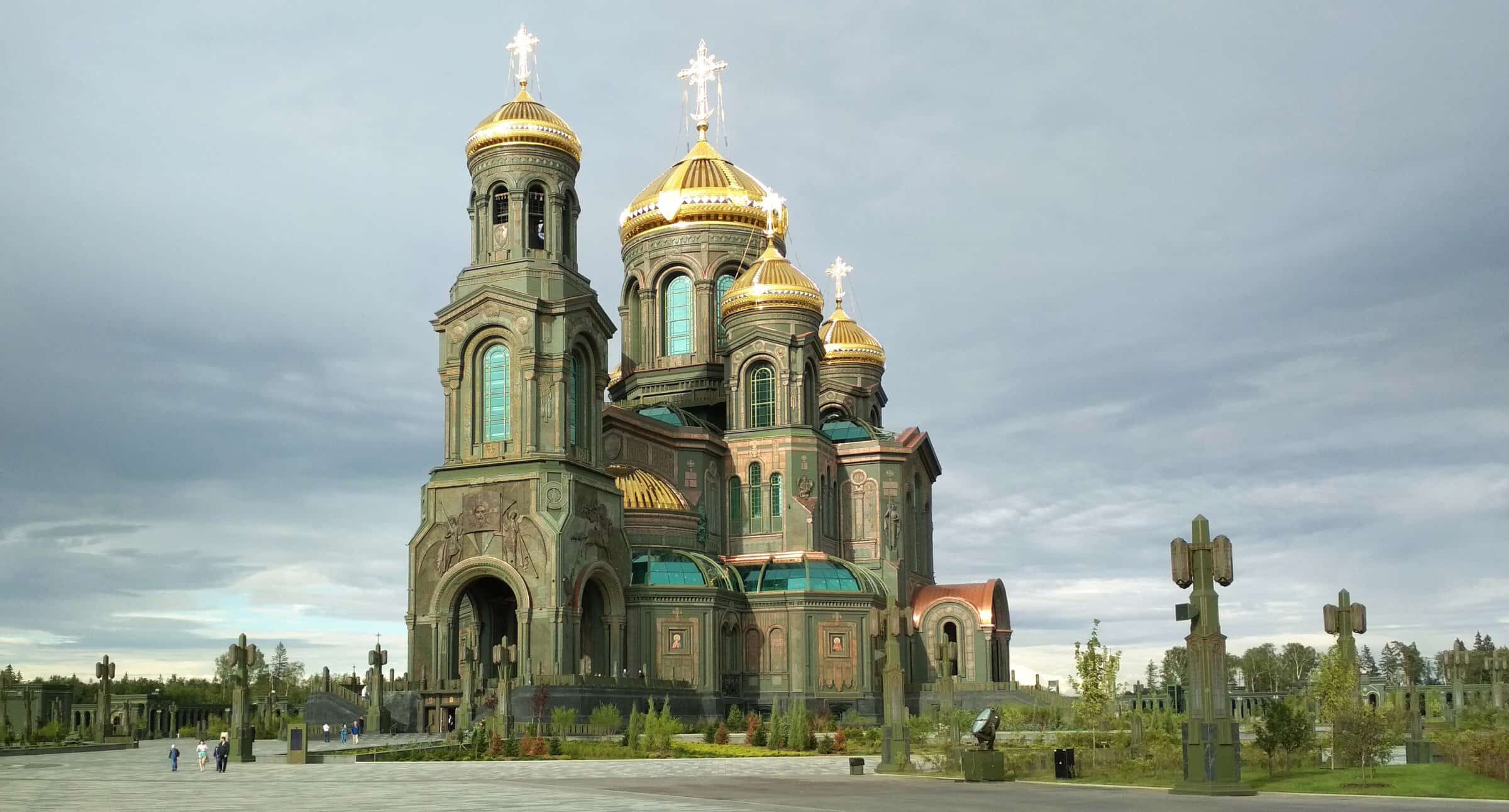
This article looks at the building as a piece of design: its form, materials, symbolism and setting, and how architecture students and design lovers might read it.
Quick facts
- Official name: Cathedral of the Resurrection of Christ, the Main Cathedral of the Russian Armed Forces
- Location: Patriot Park, Kubinka, Moscow Oblast
- Architect: Dmitry Smirnov
- Construction: September 2018 to May 2020
- Consecrated: 14 June 2020
- Opened: 22 June 2020
- Height: about 95 m to the top of the cross (some sources give 96 m)
- Capacity: up to about 6,000 people
- Structure: steel frame with metal façades and glazed arches
- Surroundings: the Road of Memory museum gallery
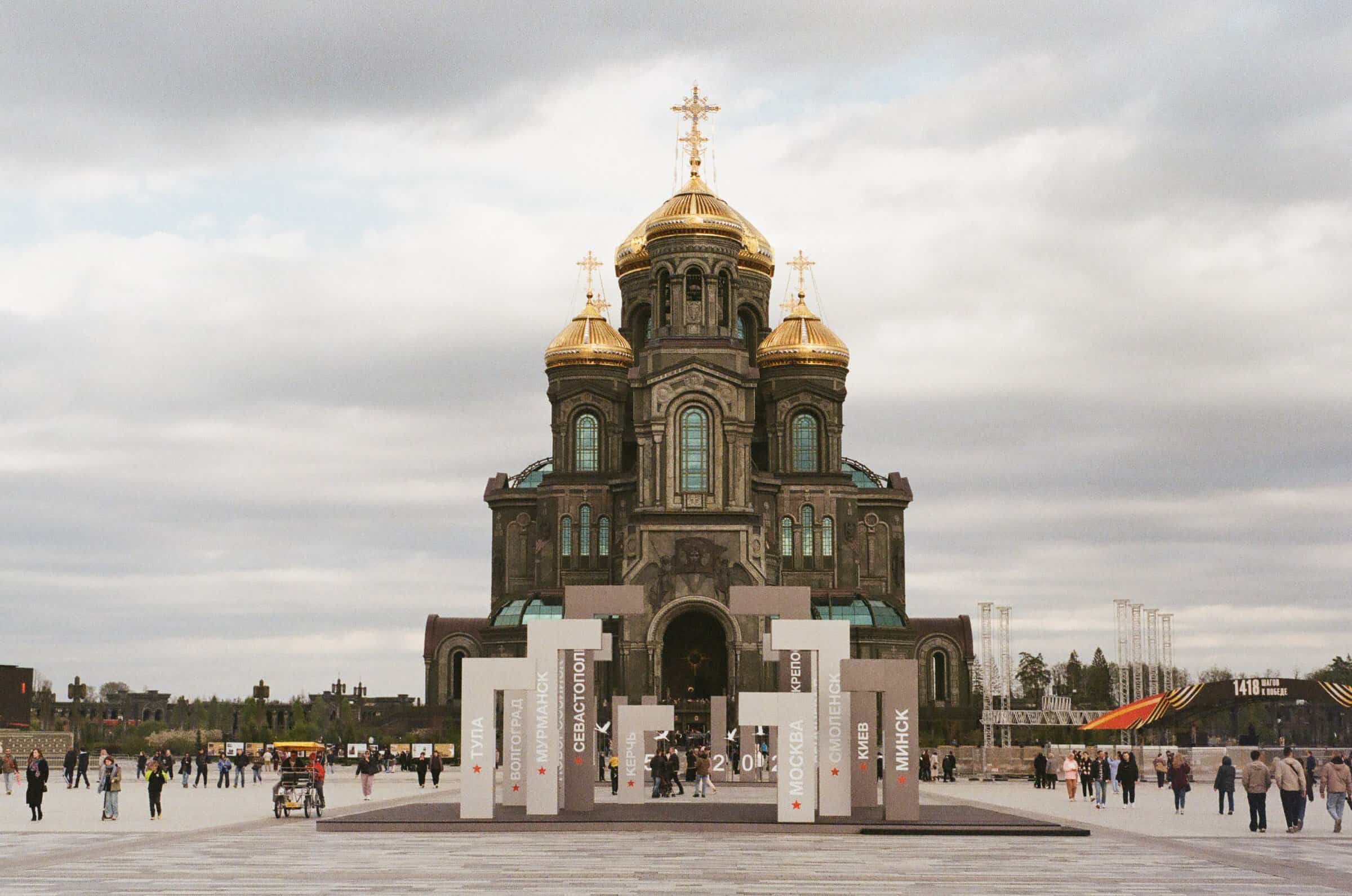
What is the Patriot Park Cathedral?
The Patriot Park Cathedral is the principal church of the Russian military. It was built to mark the 75th anniversary of the Soviet victory over Nazi Germany in 1945, a conflict known in Russia as the Great Patriotic War. It is dedicated to the Resurrection of Christ, and the dedication matters. The building’s central idea is sacrifice followed by triumph, death followed by new life. That theological theme maps neatly onto the national story of the war that the complex tells.
It was consecrated by Patriarch Kirill of Moscow on 14 June 2020 and opened to the public on 22 June. That second date was chosen deliberately. It is the anniversary of Germany’s invasion of the Soviet Union in 1941. Almost every major decision about the building, from its height to its doorstep, is tied to a date, a number or a story from that war.
Who designed the Main Cathedral of the Russian Armed Forces?
The architect was Dmitry Smirnov. Construction moved fast: under two years from the start of work to completion for a structure of this scale. That pace explains a lot about how the building was made, as we’ll see.
Where is it? The setting in Patriot Park Kubinka
The cathedral stands in Patriot Park Kubinka, a large military-themed park run by the Russian Ministry of Defence in the Odintsovo district, west of Moscow. Kubinka has long been associated with the army. The area is home to a military airfield and to the Central Armoured Vehicles Museum, the famous collection of tanks that now forms part of the park.
Setting is central to reading this building. Most great Orthodox churches grow out of a town: they sit at the end of a street, on a hill above a river, or inside a kremlin wall. The Patriot Park Cathedral instead sits in a landscape designed around military display, alongside exhibition halls, hardware parks and ceremonial spaces. It is less a parish church than the focal point of a themed memorial landscape.
The planning reinforces this. The cathedral is approached along formal axes and wrapped by the Road of Memory gallery (more on that below). The result is closer to a monumental memorial ensemble, a tradition the Soviet Union developed strongly in the 20th century, than to a conventional church precinct. In effect, the building merges two Russian traditions that were long kept apart: the Orthodox cathedral and the Soviet war memorial.
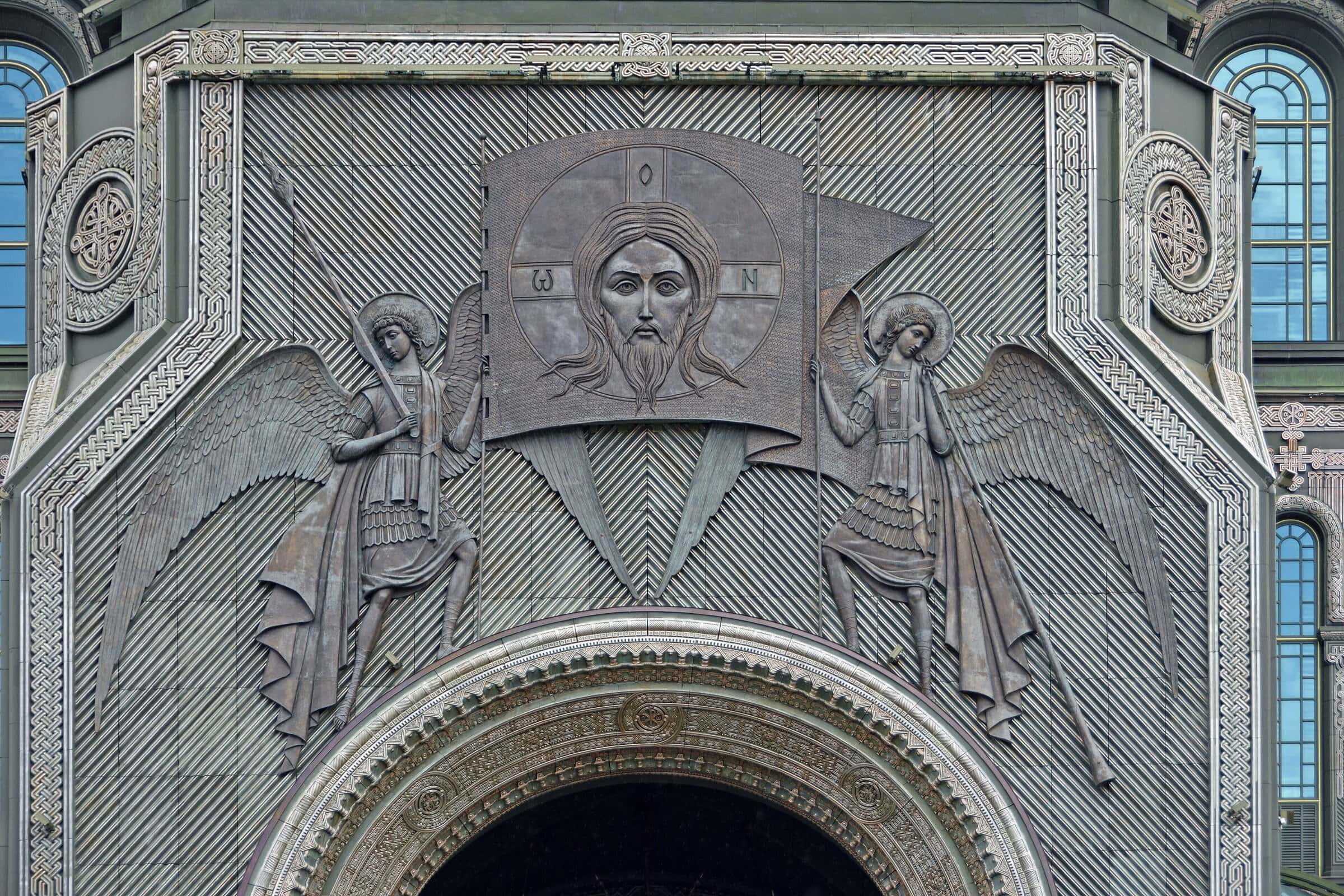
What architectural style is the Patriot Park Cathedral?
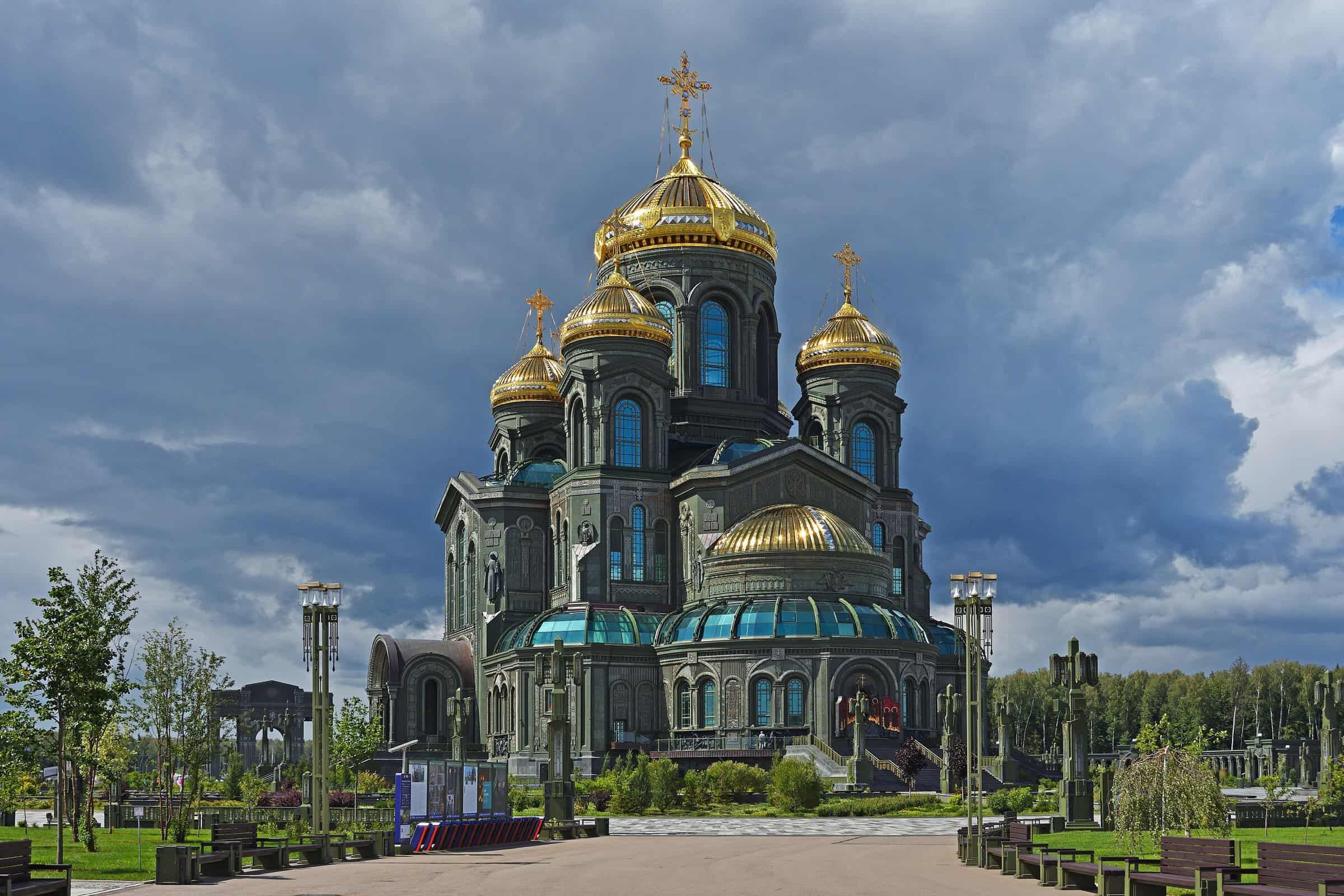
At first glance the cathedral reads as Russian Revival, with Byzantine echoes. Both labels need unpacking.
The Russian Revival lineage
Russian Revival (sometimes called the Russo-Byzantine style) was a 19th-century movement. Architects consciously drew on medieval Russian church forms to express national identity. Its most famous monument is Moscow’s Cathedral of Christ the Saviour, itself built to commemorate a military victory, the defeat of Napoleon in 1812. Demolished in the 1930s and rebuilt in the 1990s, it is still taller than the Patriot Park Cathedral, but the family resemblance is clear.
The Kubinka building borrows from this vocabulary:
- A strongly vertical, stepped silhouette, rising in tiers towards a dominant central drum and dome
- Clusters of smaller domes gathered around the main one
- Rows of rounded arches (in Russian church architecture, curved gable forms called zakomary) that break up the roofline
- Gilded crosses crowning every dome
The aim is instant recognisability. From a distance, nobody could mistake this for anything other than a Russian Orthodox church.
The Byzantine echoes
Russian church architecture descends from Byzantium. The Byzantine influence shows in the emphasis on a great central dome, the idea of a heavenly vault hovering over the congregation. Inside, the Byzantine tradition is even clearer in the use of mosaic, the signature art form of Constantinople’s churches.
Why the domes look like helmets
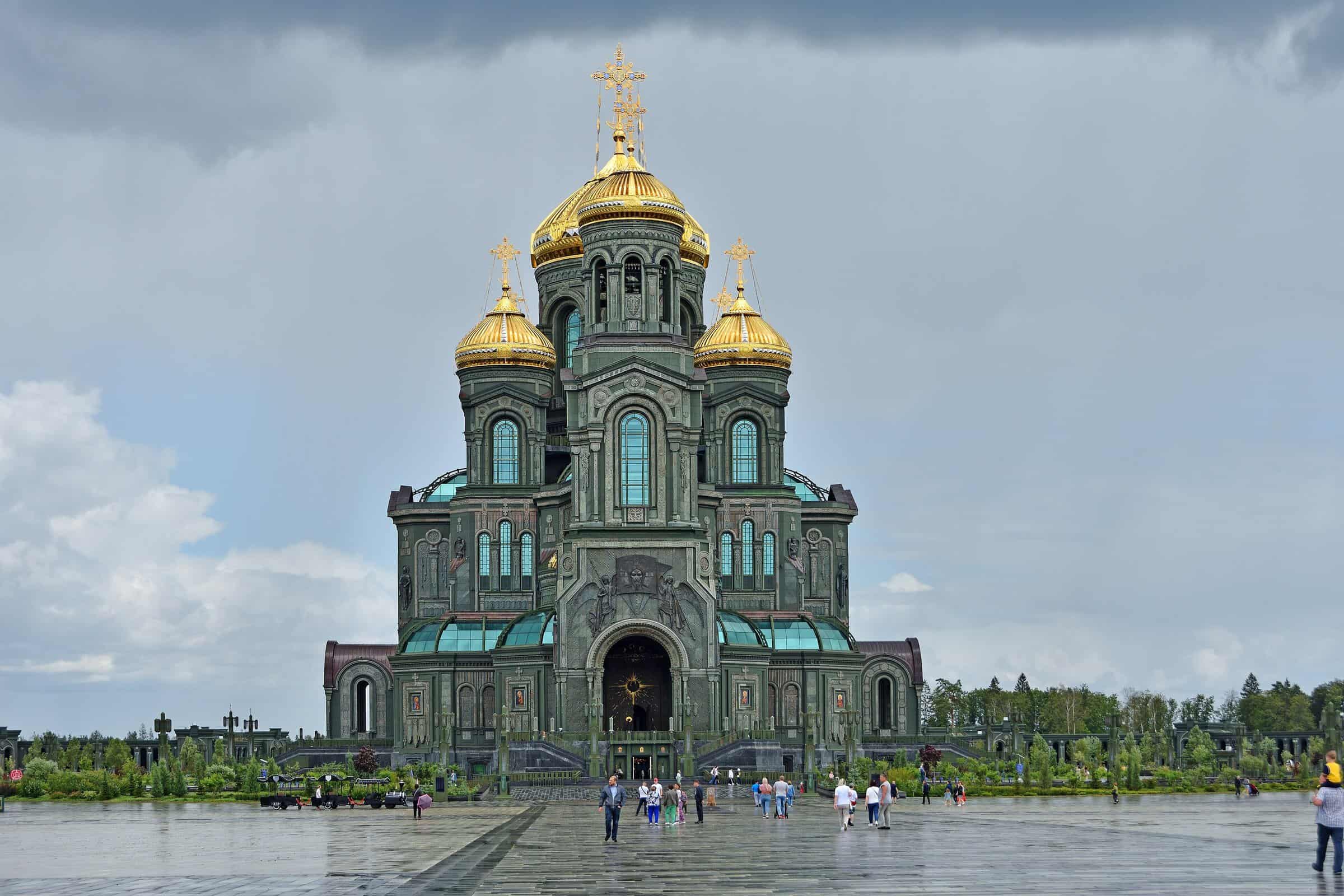
The domes are one of the cathedral’s most distinctive features. They are said to reference the helmet of Alexander Nevsky, the 13th-century prince venerated as a saint and national military hero. The traditional Russian onion dome is often explained as a flame or a candle. Here the shape is pushed towards armour.
This is an important design move. The single most recognisable element of Russian church architecture is reinterpreted as military equipment. The dome is still a dome, but it is also a helmet. Throughout the building, sacred forms are given martial meanings in this way.
What is the cathedral made of?
This is where the Patriot Park Cathedral departs most sharply from tradition, and where it gets most interesting for students of construction.
A steel frame dressed as a historic church
Medieval Russian churches were built of brick, stone or timber. The Kubinka cathedral is built on a steel frame, with metal façades and large glazed arches. In other words, it uses the language of historic masonry architecture but is constructed as a modern framed building.
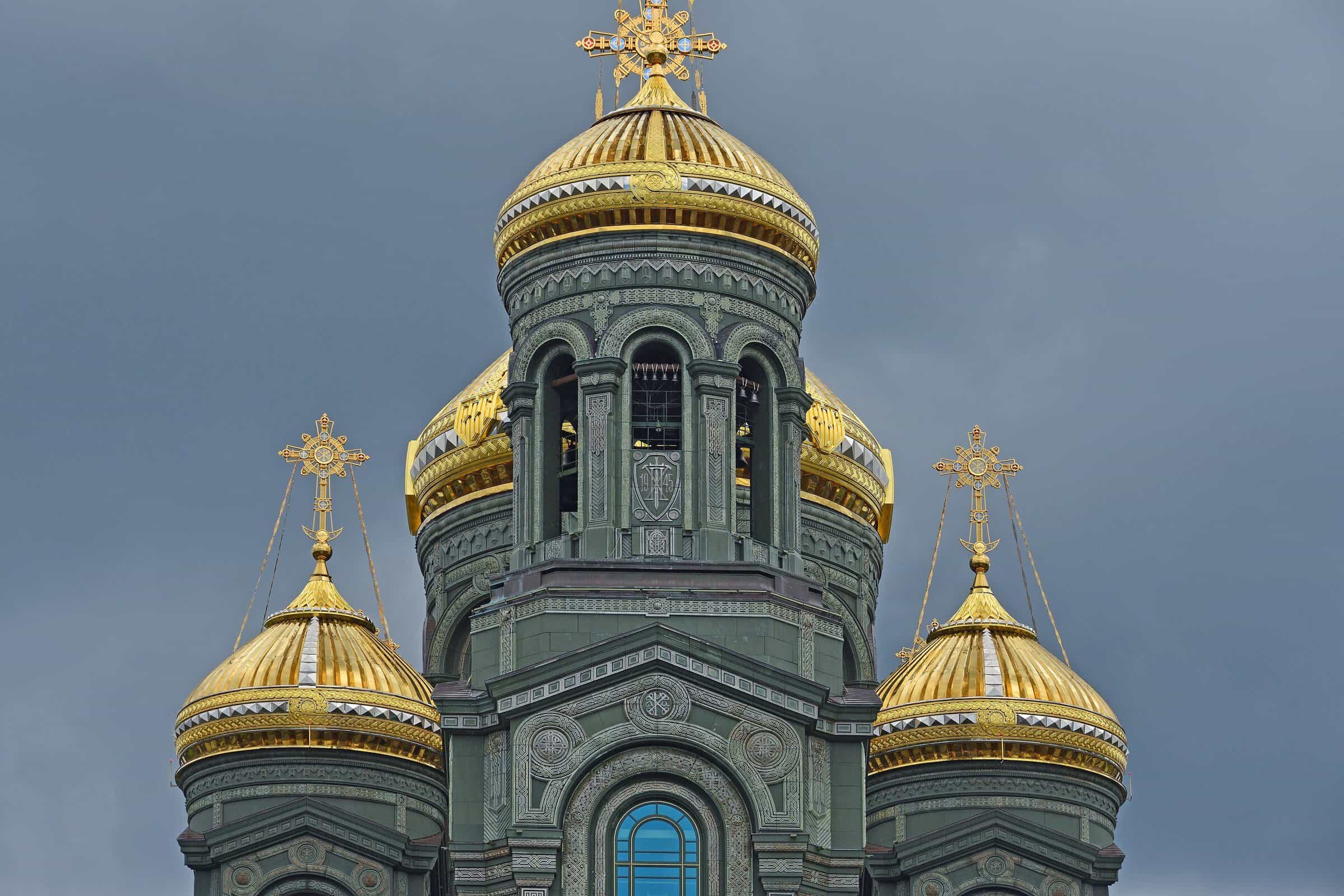
That choice suits the fast construction programme and the building’s sheer height. It also creates a tension worth noticing. The silhouette says “ancient”, but the skin and structure say “industrial”. Traditional Russian Revival churches were usually built in masonry and plastered or faced to look solid and permanent. Here, metal panels form the surfaces. They give the building a crisp, machined precision that no hand-laid masonry could achieve. Depending on your view, that is either a confident modern reading of tradition or a kind of large-scale stage set.
The glazed arches matter too. They allow daylight deep into the interior and lighten what would otherwise be a heavy mass. On the exterior, they turn the classic arched forms into something closer to curtain-wall elements.
Why is the cathedral green?
Russian churches are often white, with gold or blue domes, or sometimes painted in bright colours. The Patriot Park Cathedral is clad in khaki green, the colour of military uniforms and equipment. Combined with the gold of the crosses and detailing, the palette is unmistakably martial.
Colour is often the most underrated tool in architecture, and here it does an enormous amount of work. Change the cladding to white and the building would read as a fairly conventional, if very large, Revival church. In khaki, it reads as a military object. For students, it is a striking demonstration of how a single material decision can shift a building’s meaning.
The trophy steps
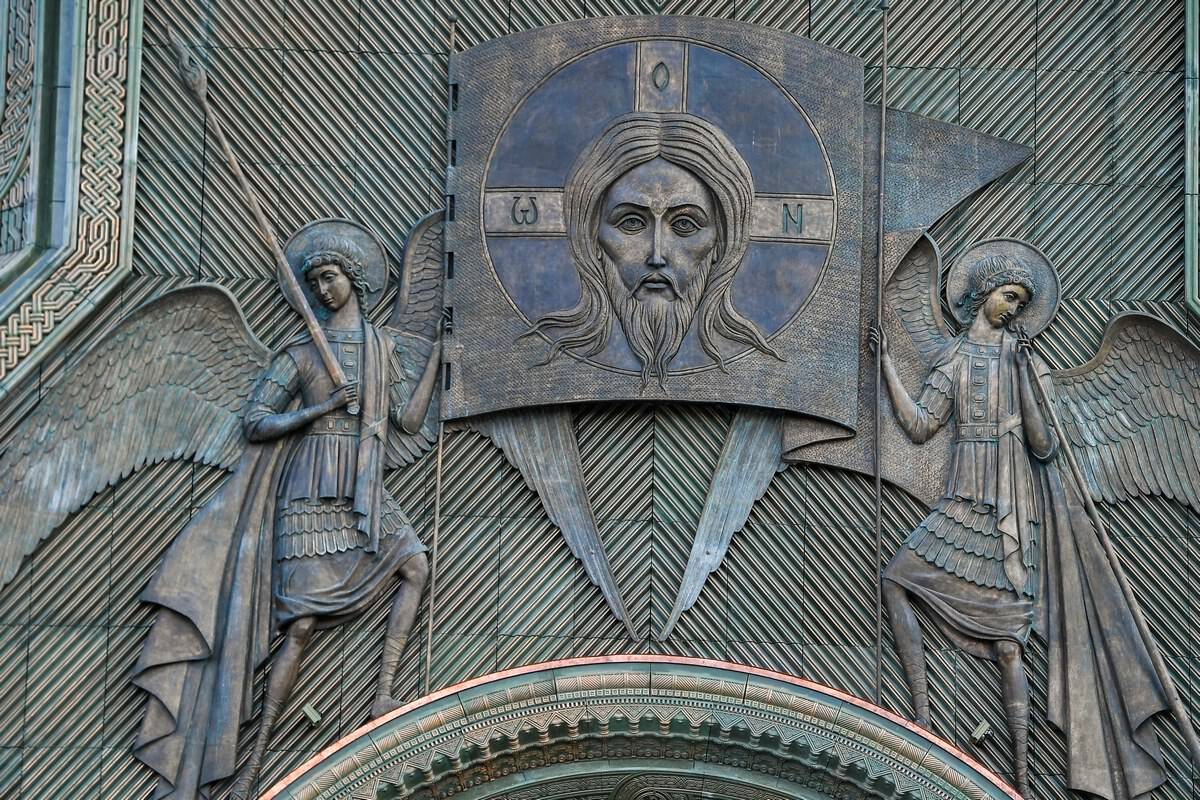
The most discussed material detail is underfoot. The steps leading into the cathedral are cast partly from captured German Second World War tanks and weaponry, melted down and reformed.
The gesture is deliberate. Visitors physically walk over the metal of the defeated enemy on their way into the church. It turns the old tradition of displaying war trophies into something literally structural. Supporters see it as a powerful act of remembrance. Critics see it as uncomfortable triumphalism at the threshold of a place of worship. Either way, it is a rare case of material provenance being the whole point of a building element.
Why do the cathedral’s dimensions matter?
The Patriot Park Cathedral is a building of encoded numbers. Its key measurements were chosen to commemorate the war:
| Element | Dimension | Meaning |
|---|---|---|
| Diameter of the main drum | 19.45 m | 1945, the year of victory |
| Main dome | about 22.43 m | 22:43, the time the German surrender was signed in Berlin on 8 May 1945 |
| Belfry | 75 m | 75 years since victory |
| Small dome | 14.18 m | 1,418 days of war, from June 1941 to May 1945 |
The 22:43 figure is worth a note. The instrument of surrender was signed late on 8 May in Berlin, when it was already 9 May in Moscow. That is why Russia celebrates Victory Day a day later than much of Western Europe.
Numerical symbolism in sacred architecture
Encoding meaning in proportion and measurement is ancient. Medieval builders loaded their churches with symbolic numbers: three for the Trinity, twelve for the apostles, thirteen domes for Christ and the apostles. The Patriot Park Cathedral follows this habit, but with a twist. Its numbers are mostly historical and national rather than theological. The building’s dimensions are, in a sense, a calendar of the war.
It is worth being realistic about how this works in practice. No visitor can perceive the difference between a 19.45 m drum and a 20 m one. The symbolism lives in the explanation, in guidebooks, tours and articles like this one, rather than in direct experience. This is common in contemporary memorial design, where meaning is often conveyed through narrative as much as through form.
How tall is the Patriot Park Cathedral?
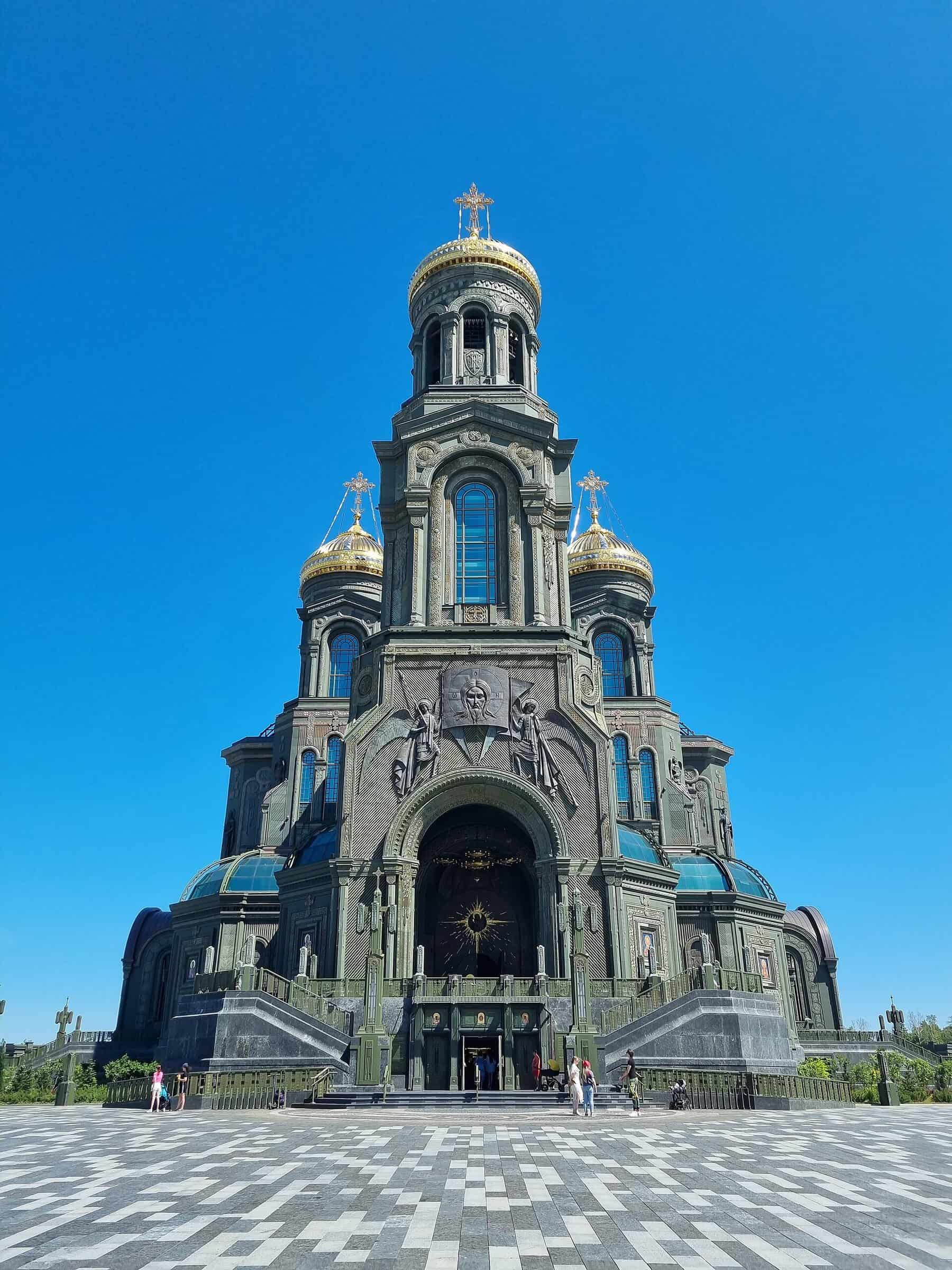
The building is about 95 m tall including the cross, though some sources quote 96 m. That puts it among the tallest Orthodox churches anywhere, alongside landmarks such as the Cathedral of Christ the Saviour in Moscow. In the flat landscape around Kubinka, it reads as a landmark visible from a long way off.
Inside the cathedral: mosaics, iconostasis and the lower church
The interior can hold up to about 6,000 people, an enormous capacity for an Orthodox church, where congregations traditionally stand. The interior design continues the exterior’s fusion of the sacred and the military.
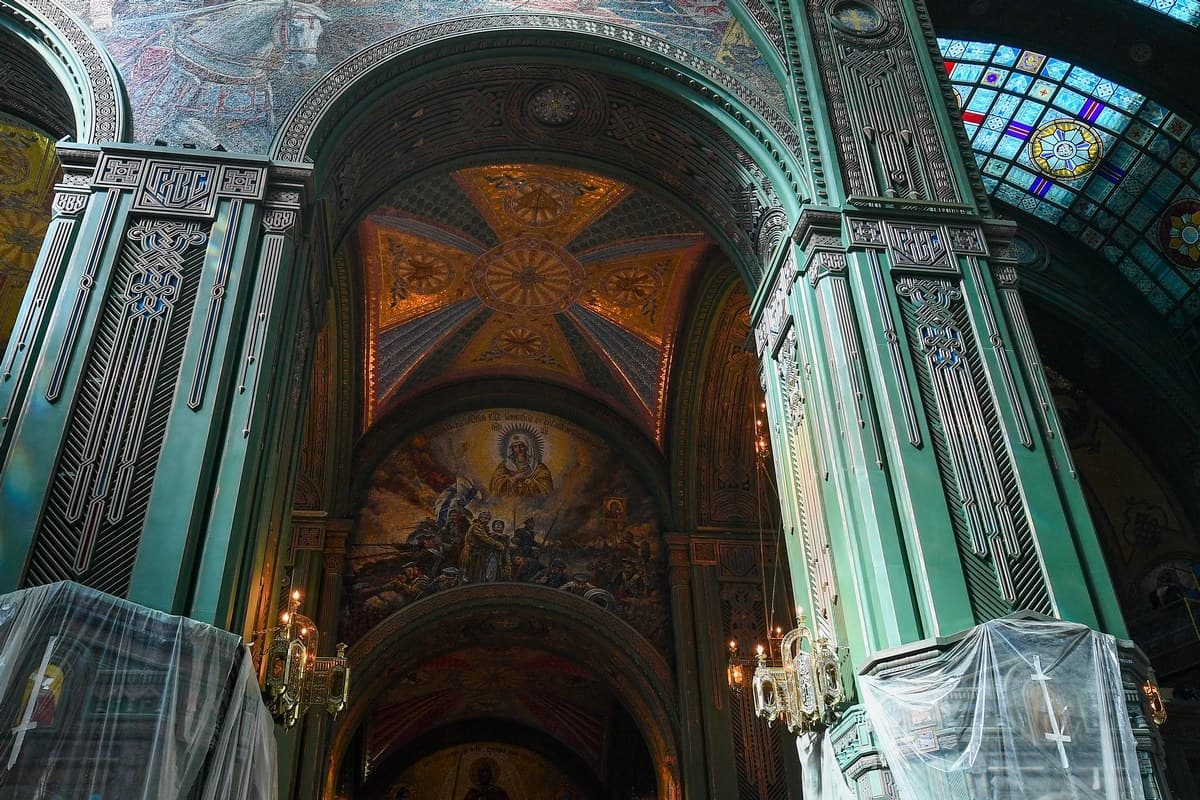
The mosaic programme
The walls carry extensive mosaics combining biblical scenes with episodes from Russian military history. In traditional Orthodox iconography, a church interior is a carefully ordered image of the cosmos. Christ is at the top, then the Mother of God, the prophets and apostles, then the saints, descending towards the people. At Kubinka, that ordered sacred world is extended to include battles and soldiers. The nation’s military history is set within the story of salvation.
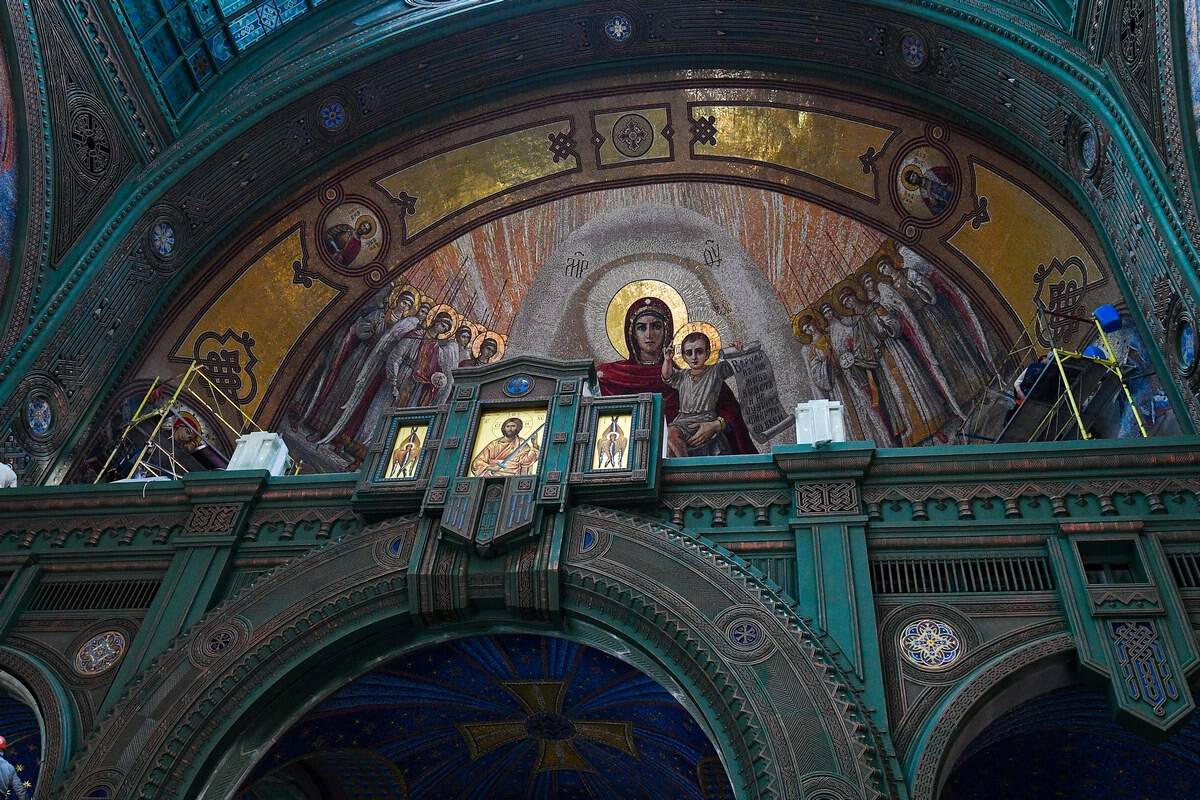
This is the most significant iconographic decision in the building. It is also the point where opinion divides most sharply. To some viewers it honours those who died. To others, including some within the Orthodox world, it blurs the line between worship and the glorification of the state’s wars.
The face of Christ in the central dome
Looking up into the central dome, visitors see a huge mosaic face of Christ. Placing Christ in the highest dome is entirely traditional, as the image of Christ as ruler of all, gazing down from heaven, has been central to Orthodox church decoration for over a thousand years. The scale here is exceptional, though, and it anchors the whole interior. Whatever the military imagery below, the building’s vertical axis still rises to a conventional sacred climax.
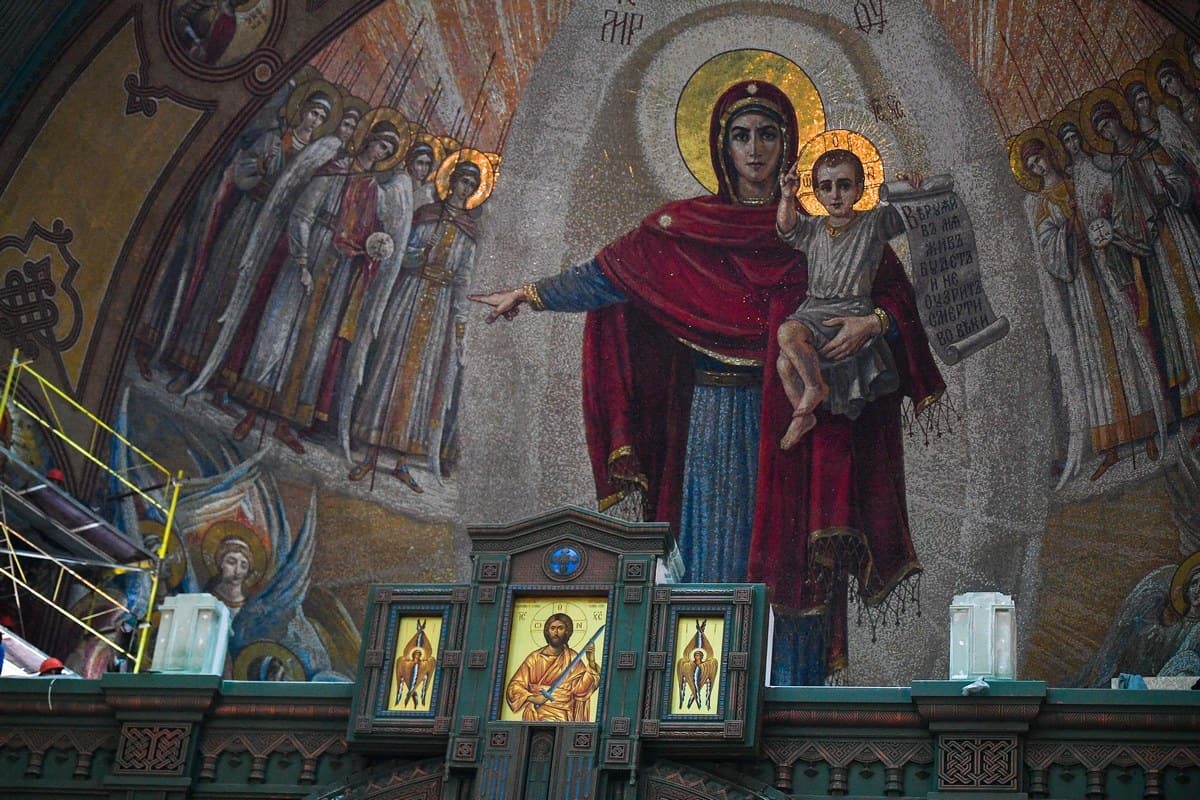
A copper-and-enamel iconostasis
The iconostasis, the screen of icons separating the sanctuary from the nave and the focal point of any Orthodox interior, is made of copper and enamel. It is an unusual material choice for an element usually associated with carved and gilded wood. It fits the building’s metallic character, with metal on the outside, metal on the steps and metal at the liturgical heart.
The lower church of St Vladimir and its Gzhel ceramics
Beneath the main space is a lower church dedicated to St Vladimir, the prince credited with bringing Christianity to Kyivan Rus’ in 988. It is decorated with Gzhel ceramics, the distinctive blue-and-white porcelain associated with the Gzhel area near Moscow and one of Russia’s best-known folk crafts.
The lower church offers a striking change of mood. Upstairs is vast, metallic and monumental. Downstairs uses a domestic, decorative craft tradition. The contrast between the two levels is one of the more subtle and interesting aspects of the design.
The mosaics that were removed
During construction, images emerged of proposed mosaics that included Vladimir Putin and Stalin-era imagery. They drew significant criticism, including within Russia, over the appropriateness of depicting a living political leader, and the Soviet era’s persecution of the church, inside a cathedral. The mosaics were removed before consecration.
The episode is a useful case study. It shows how contested the cathedral’s iconography was, even before it opened, and how the boundary between commemoration and political messaging was being negotiated in real time.
A short overview of the building and its wartime symbolism also circulates on TikTok:
The Road of Memory: what surrounds the Patriot Park Cathedral?
The cathedral is encircled by the Road of Memory, a museum gallery dedicated to the war. Its length is measured as 1,418 steps, echoing the 1,418 days of the conflict and the dimension of the small dome.
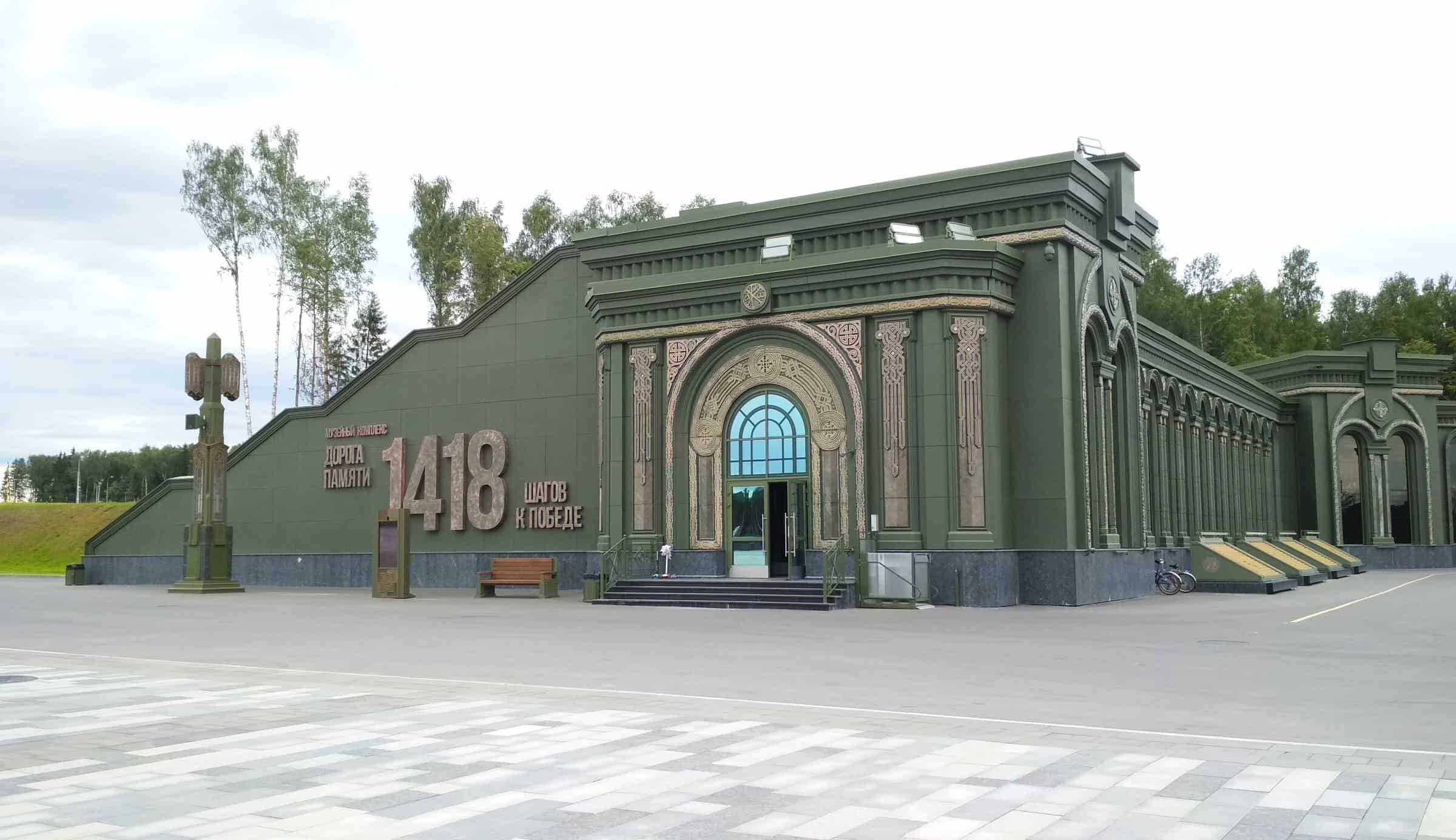
The gallery turns the visit into an act of procession. Rather than arriving at a church, visitors move through a measured sequence of space and time, where every step stands for a day of the war. The route builds anticipation before the cathedral itself, much as a cloister, a processional way or a long ceremonial approach does in other sacred traditions.
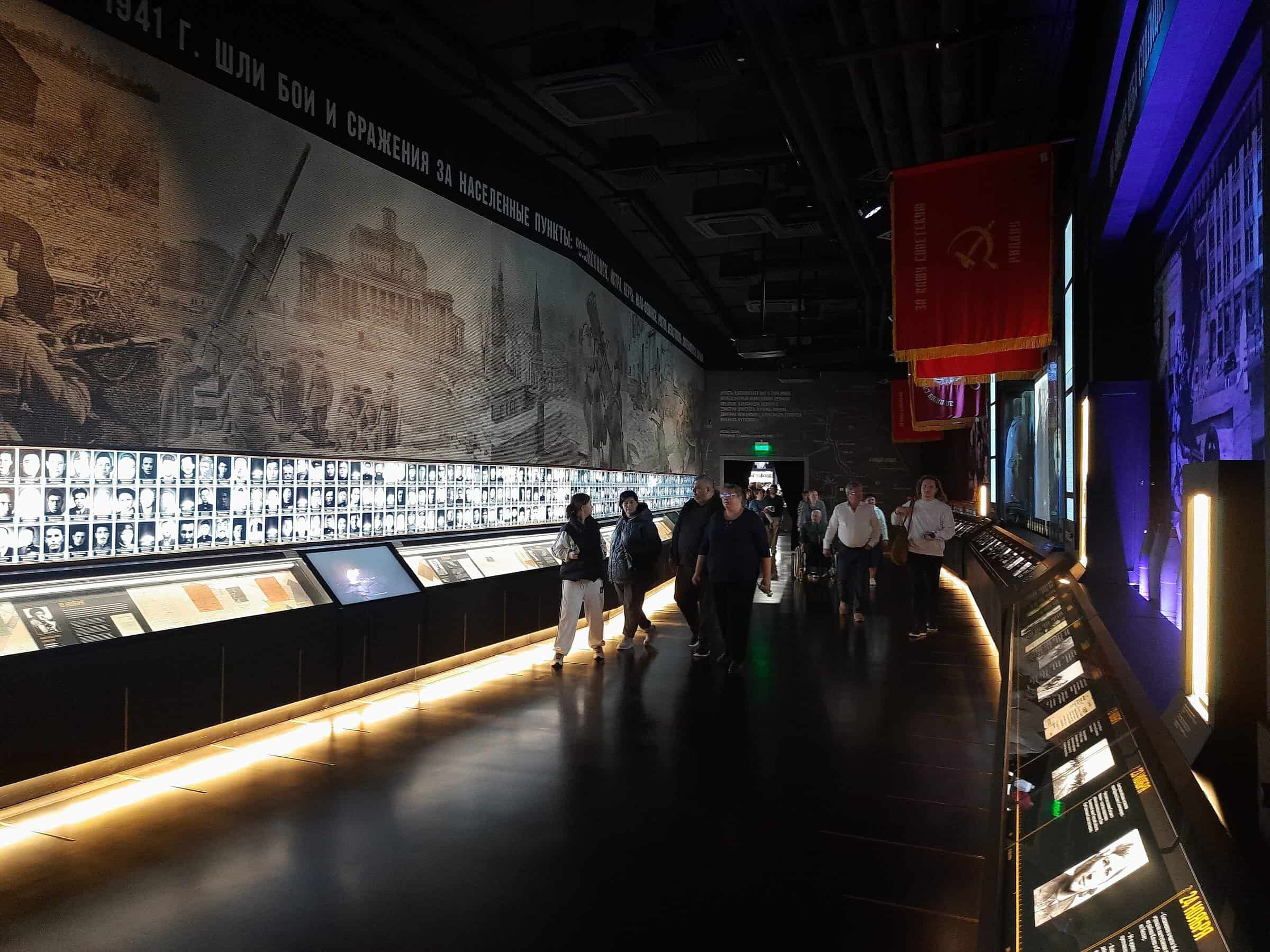
This is the clearest link between the complex and Soviet memorial design. Large war memorials from that era often relied on choreographed movement, guiding visitors along axes, through gateways and past sequences of sculpture and inscription towards a climactic focal point. At Kubinka the climax is a church rather than a monumental statue or an eternal flame. The underlying spatial logic, though, is familiar. The Road of Memory turns the cathedral from a standalone building into the end point of a narrative journey.
It also reinforces the numerical system. The 1,418 steps of the gallery and the 14.18 m small dome tie the landscape and the building together through a single figure. The architecture and the exhibition are designed to be read as one continuous text.
How to read the Patriot Park Cathedral as a piece of design
Whatever you think of its message, the Patriot Park Cathedral is a useful building to study. It raises questions that apply well beyond Russia.
Tradition rebuilt with modern means
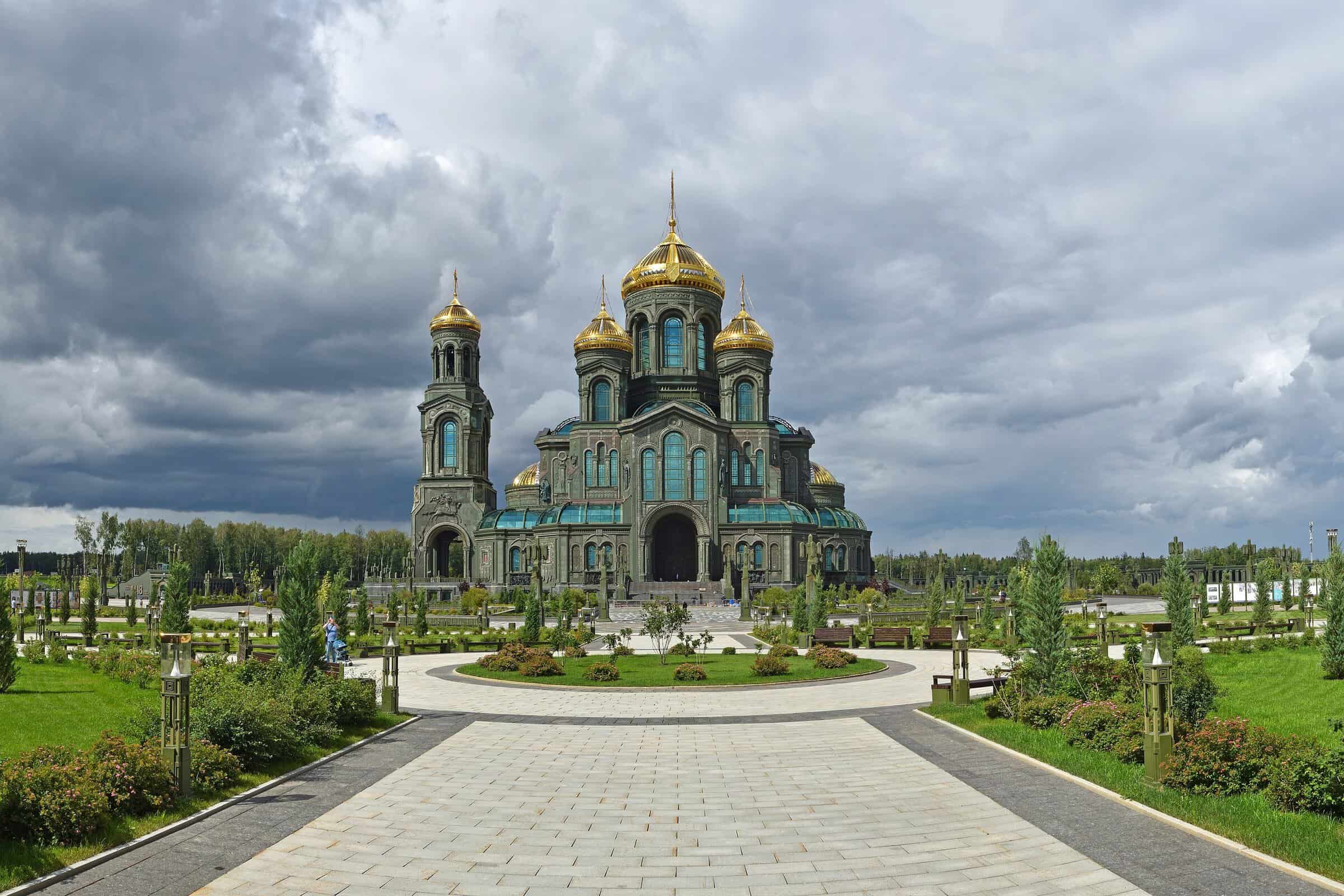
The cathedral is a clear example of a familiar contemporary challenge: how to build in a historic style using modern structure and materials. Its steel frame, metal skin and glazing allowed a very large, very tall building to go up in under two years. The cost is a certain loss of the weight, texture and irregularity that give historic churches their character. Students might compare it with other recent revivalist buildings and ask where the line falls between faithful continuation, reinterpretation and pastiche.
Meaning carried by material, colour and number
Few buildings load so much meaning onto specific design decisions. The khaki cladding, the helmet-shaped domes, the trophy-metal steps and the encoded dimensions each carry a message. Some of these messages are immediate, like the colour, which anyone can read at a glance. Others, like the 19.45 m drum, depend entirely on being explained. The building is a strong case study in the difference between symbolism that is seen and symbolism that is told.
The fusion of church and memorial
Above all, the cathedral merges building types. It is at once a place of worship, a war memorial, a museum centrepiece and a state monument. That fusion is the source of both its power and the controversy around it. Supporters see a fitting tribute to the millions who died. Critics, including some Orthodox commentators, argue that a church should not wear the colours of an army. A balanced reading acknowledges that the building was designed to make exactly this connection, and that its success or failure depends largely on whether you accept the premise.
Scale and visibility
At about 95 m, the cathedral is designed to dominate its setting. Its height, stepped massing and strong silhouette make it legible from a distance, a landmark in a relatively flat landscape. Inside, its capacity of around 6,000 makes it suited to large state and military ceremonies as much as to everyday worship.
If you are sketching or rendering a building like this — metal cladding, encoded geometry, strong silhouette — Archtene’s free architectural textures are a handy reference for metal, stone and glazed surfaces.
FAQ
What is the Patriot Park Cathedral?
It is the Cathedral of the Resurrection of Christ, the Main Cathedral of the Russian Armed Forces, an Orthodox church in Patriot Park, Kubinka, near Moscow. It was built to mark the 75th anniversary of victory in the Second World War.
When was the Patriot Park Cathedral built?
Construction ran from September 2018 to May 2020. The cathedral was consecrated on 14 June 2020 and opened on 22 June 2020, the anniversary of the 1941 German invasion of the Soviet Union.
Who was the architect?
The cathedral was designed by architect Dmitry Smirnov.
Why is the cathedral green?
The khaki-green cladding echoes the colour of military uniforms and equipment. It reflects the building’s role as the principal church of the armed forces.
What are the cathedral’s steps made from?
The steps were cast partly from captured German Second World War tanks and weaponry, so visitors walk over the metal of the defeated enemy as they enter.
How tall is the Patriot Park Cathedral?
It stands about 95 m high including the cross, though some sources give 96 m. Its belfry is 75 m tall, marking 75 years since victory.
What is the Road of Memory?
The Road of Memory is a museum gallery surrounding the cathedral and dedicated to the war. Its length is measured as 1,418 steps, one for each day of the conflict.
Were there mosaics of Putin and Stalin?
Proposed mosaics showing Vladimir Putin and Stalin-era imagery were revealed during construction. They drew criticism and were removed before the cathedral was consecrated.

Recent Posts
Patriot Park Cathedral: How to Read Russia’s Most Militarised Church
Architecture Portfolio Layouts: 15 Real Examples and Tips
Stirling Prize 2026: Lion Green Road Wins, Plus the Full Shortlist