Art Deco architecture is the glamorous, geometric style of the 1920s and 1930s, the look of stepped skyscraper crowns, sunburst motifs, chrome, coloured terracotta and bold lettering across a cinema front. It took its name from a 1925 exhibition in Paris and within a decade had spread to New York, Shanghai, Mumbai, Sydney and a small New Zealand city rebuilt after an earthquake.
This guide explains where Art Deco came from, the features that define it, how to spot it on the street and how it differs from Streamline Moderne and Art Nouveau, then walks through 11 landmark buildings worth studying. If you are drawing one of these buildings for a studio project, our free architectural cutouts add period-appropriate people and planting to elevations and renders. For the bigger picture, our overview of architectural styles from ancient to modern times shows where Art Deco sits in the timeline.
Art Deco architecture at a glance
- When: roughly 1920 to 1940, peaking in the late 1920s and early 1930s.
- Where it began: Paris, then the United States, Britain, Australia, New Zealand, India, China, Latin America and colonial Africa.
- Key features: vertical emphasis, setbacks and stepped forms, geometric ornament (zigzags, chevrons, sunbursts), rich materials, stylised relief sculpture and decorative lettering.
- Typical buildings: skyscrapers, cinemas, hotels, department stores, factories, banks, apartment blocks and war memorials.
- Famous examples: the Chrysler Building, Miami Beach’s Ocean Drive, Napier, Sydney’s Anzac Memorial and Melbourne’s Manchester Unity Building.
What Is Art Deco Architecture?
Art Deco architecture is a decorative, modern style that combines streamlined geometry with luxurious materials and crafted ornament. Where earlier styles borrowed columns and pediments from the past, Art Deco looked forward: to the machine, the motor car, the aeroplane and the cinema. Yet it was never as stripped back as the Modernism that followed. Art Deco architects still loved ornament, they simply made it sharp, flat and geometric.
The name is a later label. People at the time called the style “moderne”, “jazz modern” or simply “modernistic”. The term Art Deco, short for arts décoratifs, came into wide use only in the late 1960s, helped along by the historian Bevis Hillier’s 1968 book Art Deco of the 20s and 30s.
A Short History of Art Deco
Paris, 1925
The style first appeared in Paris in the 1910s, drawing on the bold geometry of the Vienna Secession and Cubism, the vivid colour of the Ballets Russes and art from ancient Egypt, Mesoamerica and Asia. The International Exhibition of Modern Decorative and Industrial Arts, held in Paris from April to November 1925, gave it a stage. It drew more than 16 million visitors and admitted only work with “clearly modern tendencies”, with no copies of historic styles. The exhibition later gave the whole movement its name.
Skyscrapers and the machine age
In the United States, Art Deco met the skyscraper. New York’s 1916 zoning rules forced tall buildings to step back as they rose so that light could reach the street, and architects turned those setbacks into ziggurat silhouettes. The late 1920s building boom produced the Chrysler Building, the Empire State Building and Detroit’s Guardian Building, each racing upwards with the confidence of the motor and finance industries that paid for them.
Depression, Streamline and decline
After the 1929 crash, budgets shrank and ornament became leaner. In the 1930s a smoother branch called Streamline Moderne appeared, with rounded corners and long horizontal lines inspired by ocean liners and trains. Art Deco remained the go-to style for cinemas, hotels and civic buildings through the decade, from Mumbai to Melbourne, but after the Second World War it gave way to the unornamented International Style.
Key Features of Art Deco Architecture
Most Art Deco buildings show several of these traits at once.
- Vertical emphasis. Continuous piers run up the facade between recessed window bays, pulling the eye skywards.
- Setbacks and stepped forms. Towers and parapets step in like a ziggurat, often finishing in a crown or spire.
- Geometric ornament. Zigzags, chevrons, sunbursts, fans, stylised fountains and frozen-fountain motifs replace classical mouldings.
- Rich and new materials. Polished stone, terracotta, faience tiles, bronze and the new stainless steels and chrome sit side by side.
- Stylised sculpture. Figures in low relief, often heroic workers, soldiers or mythological figures, are simplified into strong planes.
- Exotic references. Egyptian, Mayan and Aztec motifs were popular, boosted by the discovery of Tutankhamun’s tomb in 1922.
- Decorative lettering. Building names are part of the design, in tall, crisp capitals or neon.
- Theatrical interiors. Lobbies, foyers and lift doors get the richest treatment, with patterned floors, mirrored surfaces and concealed lighting.
How to Spot an Art Deco Building
Standing on a footpath, run through this quick checklist. Three or more ticks and you are probably looking at Art Deco.
- Look up: is there a stepped parapet, a tower that narrows in stages, or a central “fin” above the entrance?
- Check the vertical lines: do piers or ribs run unbroken past several floors?
- Look for flat, sharp-edged ornament such as zigzags, chevrons or a sunburst over a door.
- Read the signage: a name moulded into the facade in tall geometric capitals is a strong clue.
- Check the date: most Art Deco buildings went up between the mid-1920s and about 1940.
- If the corners are rounded, with horizontal bands and porthole windows, you are probably looking at its sibling, Streamline Moderne.
11 Famous Art Deco Buildings Around the World
These landmarks show how one style adapted to very different cities, climates and budgets.
1. Chrysler Building, New York (1930)
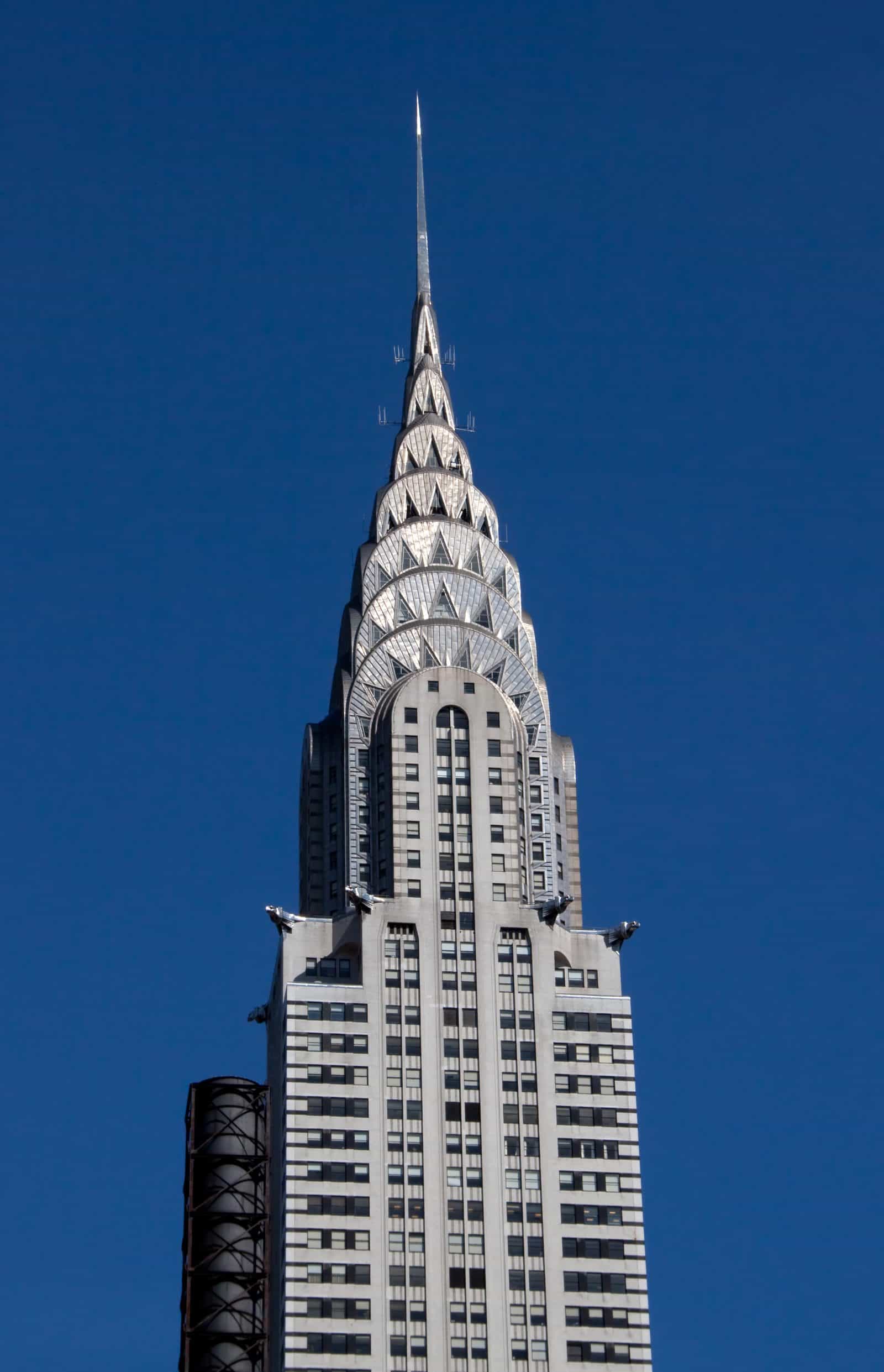
William Van Alen’s tower for Walter Chrysler is the building most people picture when they hear “Art Deco”. At 319 metres, it was briefly the tallest building in the world when it was completed in 1930, helped by a spire assembled in secret inside the crown and then hoisted into place. The crown’s seven radiating arches are clad in Nirosta stainless steel, the 31st floor carries a frieze of hubcaps and replica radiator caps, and steel eagles project from the 61st floor.
2. Guardian Building, Detroit (1929)
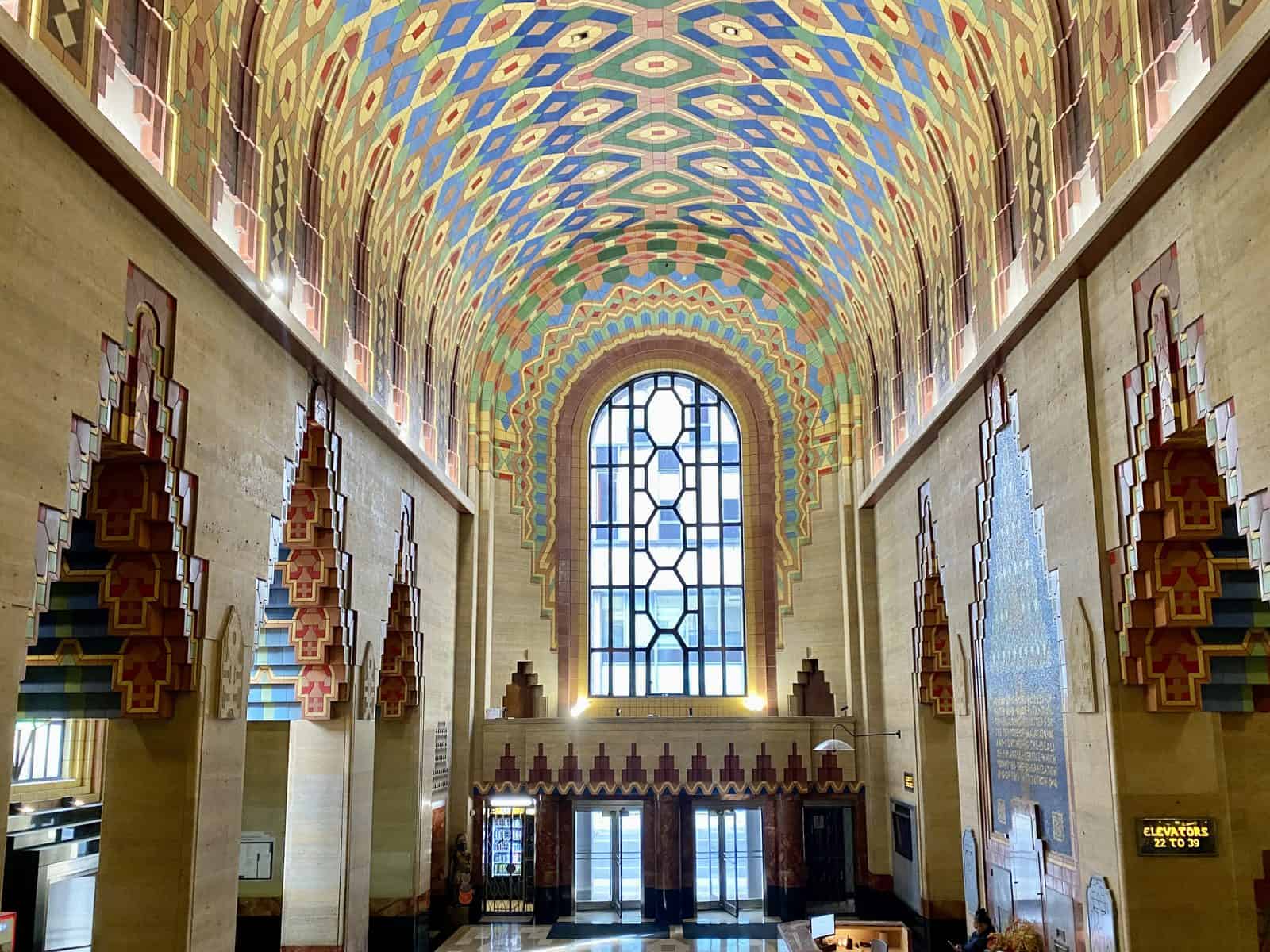
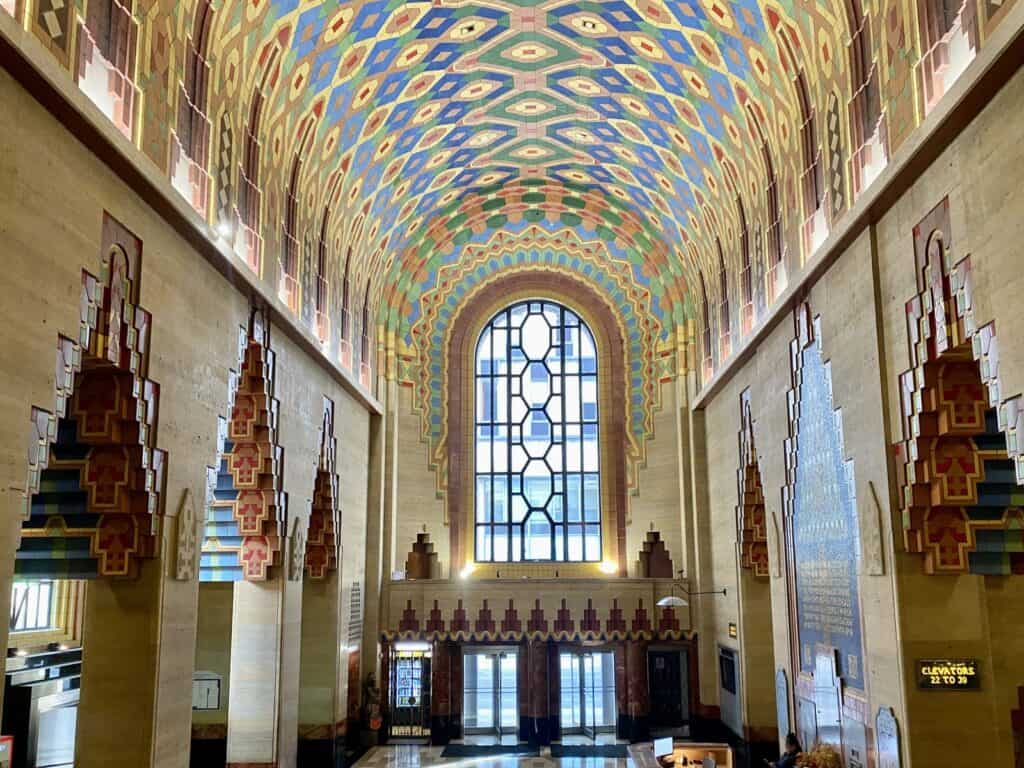
Built in 1928 and 1929 as the Union Trust Building, Detroit’s “Cathedral of Finance” was designed by Wirt C. Rowland of Smith, Hinchman & Grylls. Rowland used coloured brick, stone and terracotta set in geometric patterns instead of applied carving, and lined the three-storey vaulted lobby with Pewabic and Rookwood tile. Native American patterns run through the interior. He also specified Monel metal for exposed metalwork, a choice later echoed at the Chrysler Building. The tower was designated a National Historic Landmark in 1989.
3. Ocean Drive, Miami Beach (1930s)
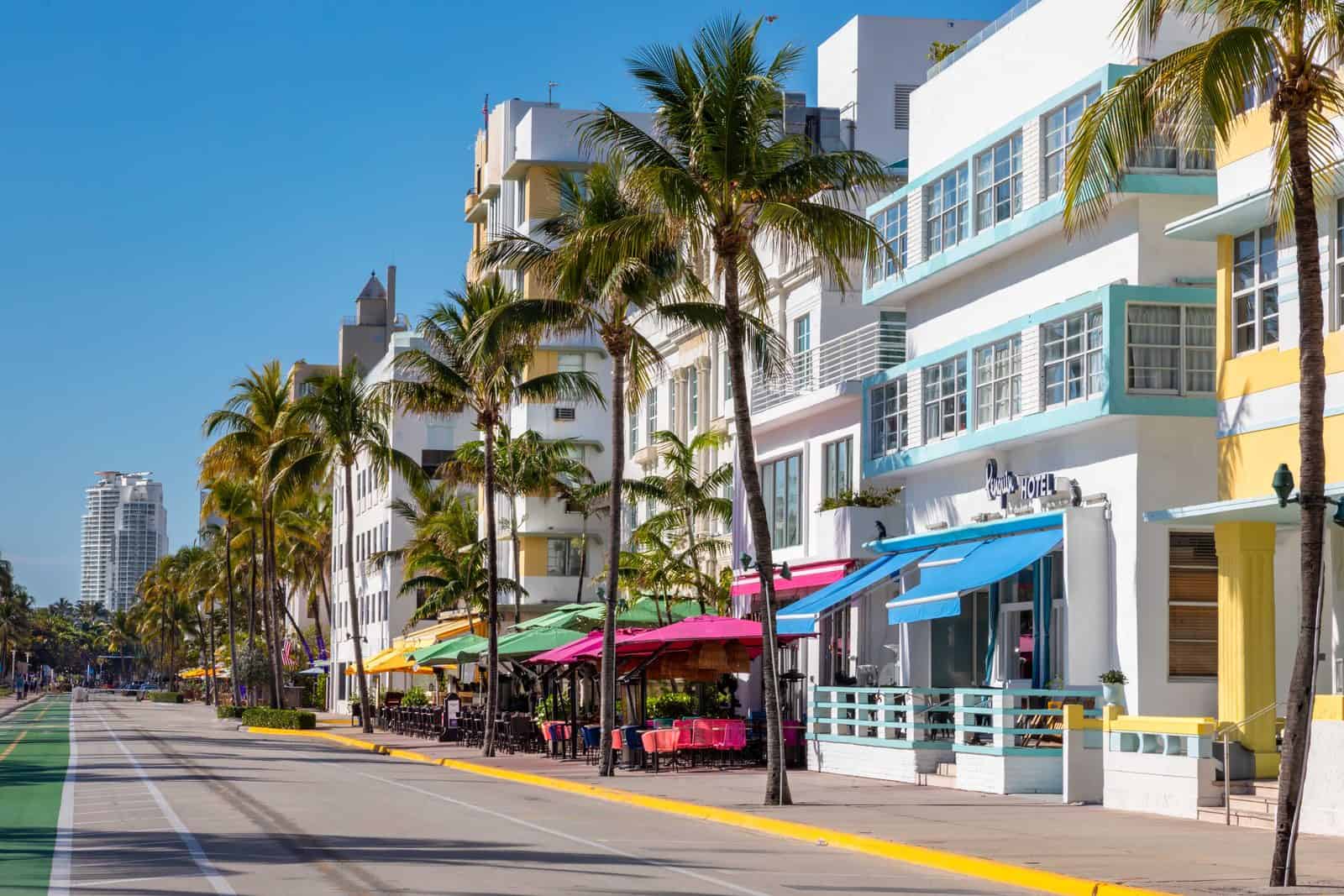
South Beach holds the largest collection of Art Deco buildings in the world. The Miami Beach Architectural District, listed in 1979 after a campaign led by preservationist Barbara Baer Capitman, contains around 960 historic buildings, most of them small hotels and apartment blocks from the 1930s and early 1940s. Architects such as Henry Hohauser and L. Murray Dixon mixed Art Deco and Streamline forms with tropical touches: eyebrow sunshades, porthole windows, neon signs and the pastel paint schemes that came with 1980s restorations.
4. Hoover Building, London (1933)
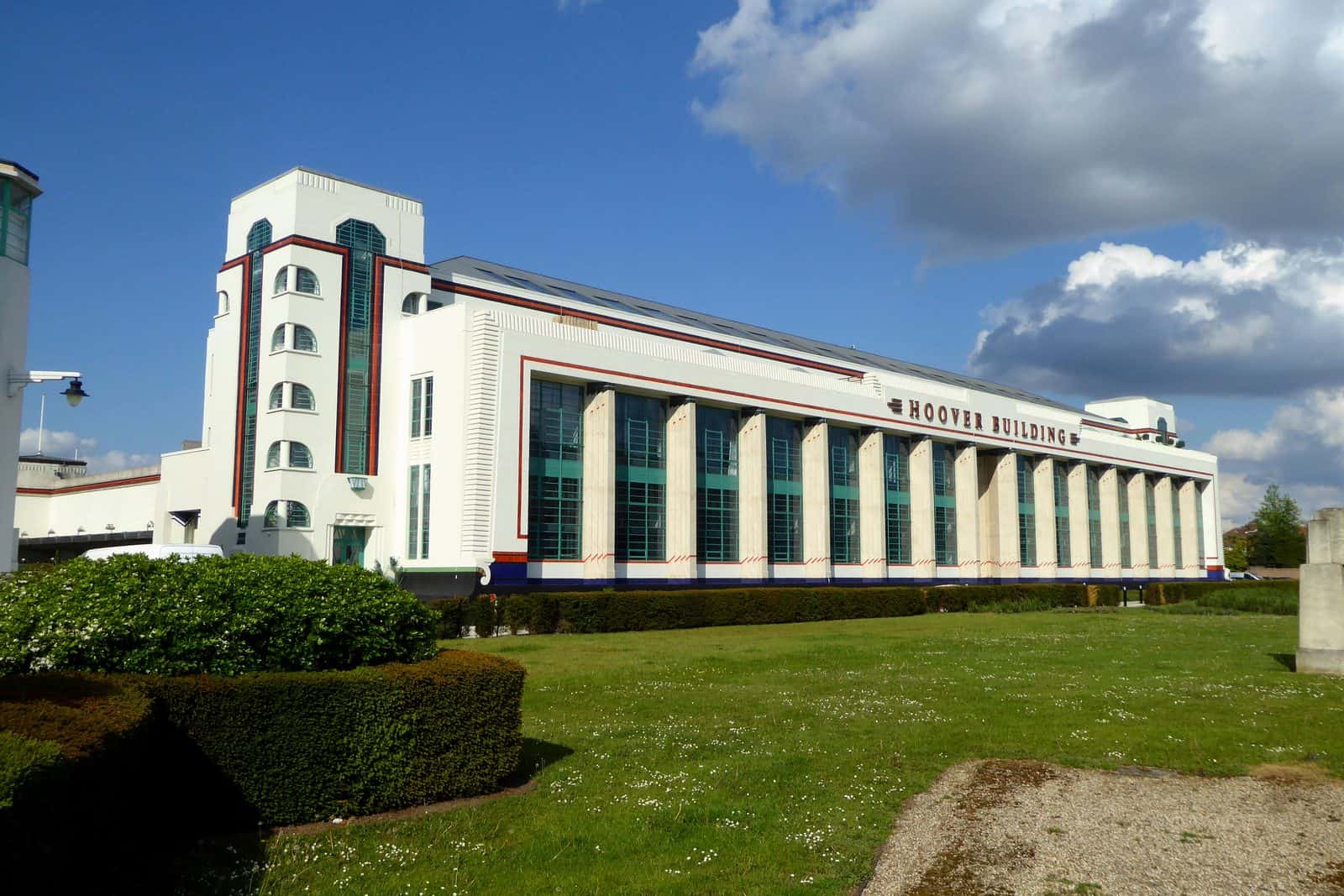
Wallis, Gilbert and Partners designed the Hoover Building in Perivale as the British headquarters and factory of the vacuum cleaner company, and it opened in 1933. Its white facade, green glazing and bright red and blue trim made a factory look like a palace beside the new arterial road. John Betjeman later called it “a sort of Art Deco Wentworth Woodhouse”. The building is Grade II* listed and was converted into apartments in 2017 and 2018.
5. Park Hotel, Shanghai (1934)
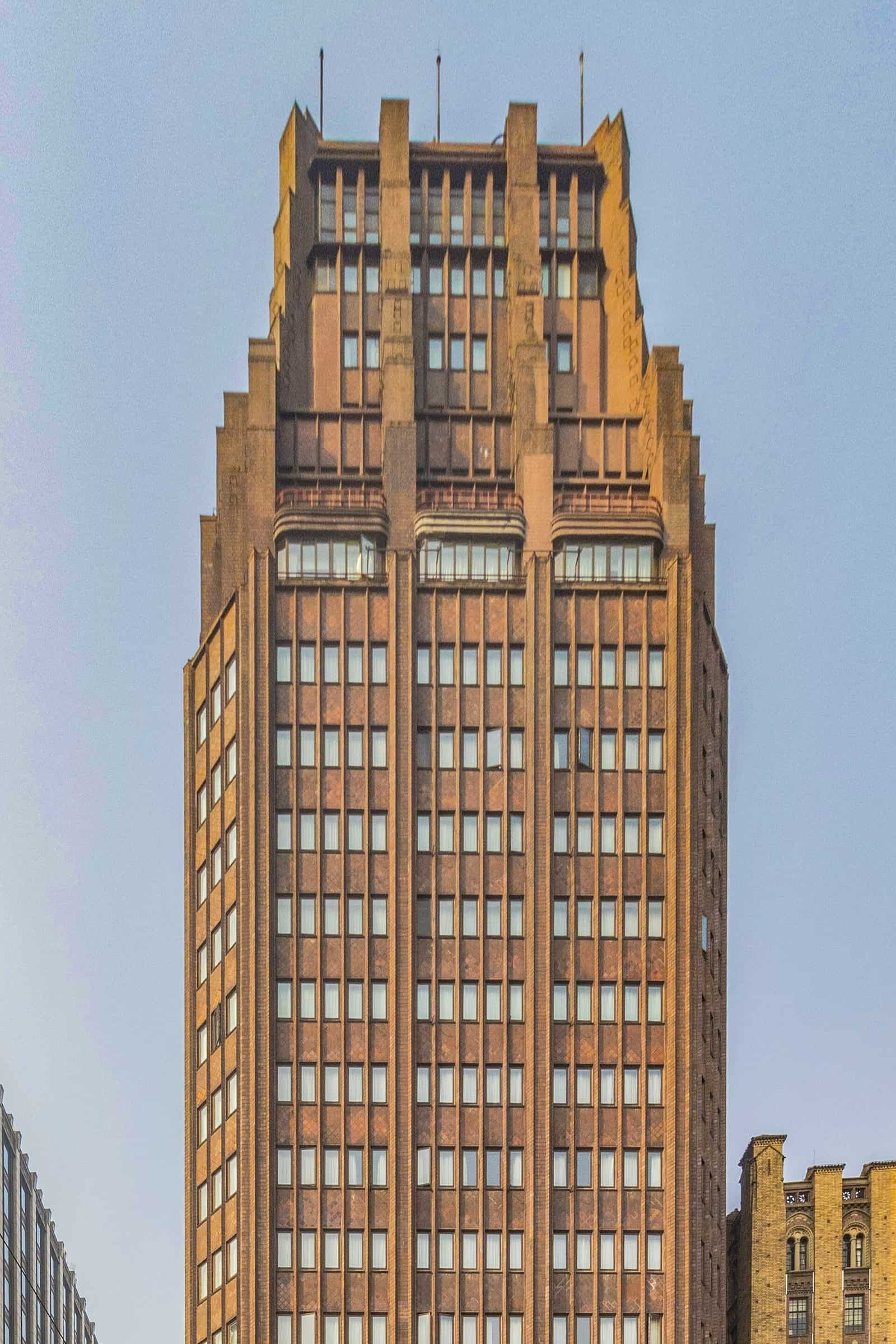
Shanghai in the 1930s was one of the great Art Deco cities, and the Park Hotel was its tallest statement. The Hungarian-Slovak architect László Hudec designed it for the Joint Savings Society, and it was completed in 1934. At 83.8 metres and 22 storeys above ground, clad in dark brown brick above a base of black granite, it was the tallest building in Asia until 1963. Its vertical piers and stepped crown show the influence of New York’s American Radiator Building.
6. Eros Cinema and Marine Drive, Mumbai (1938)
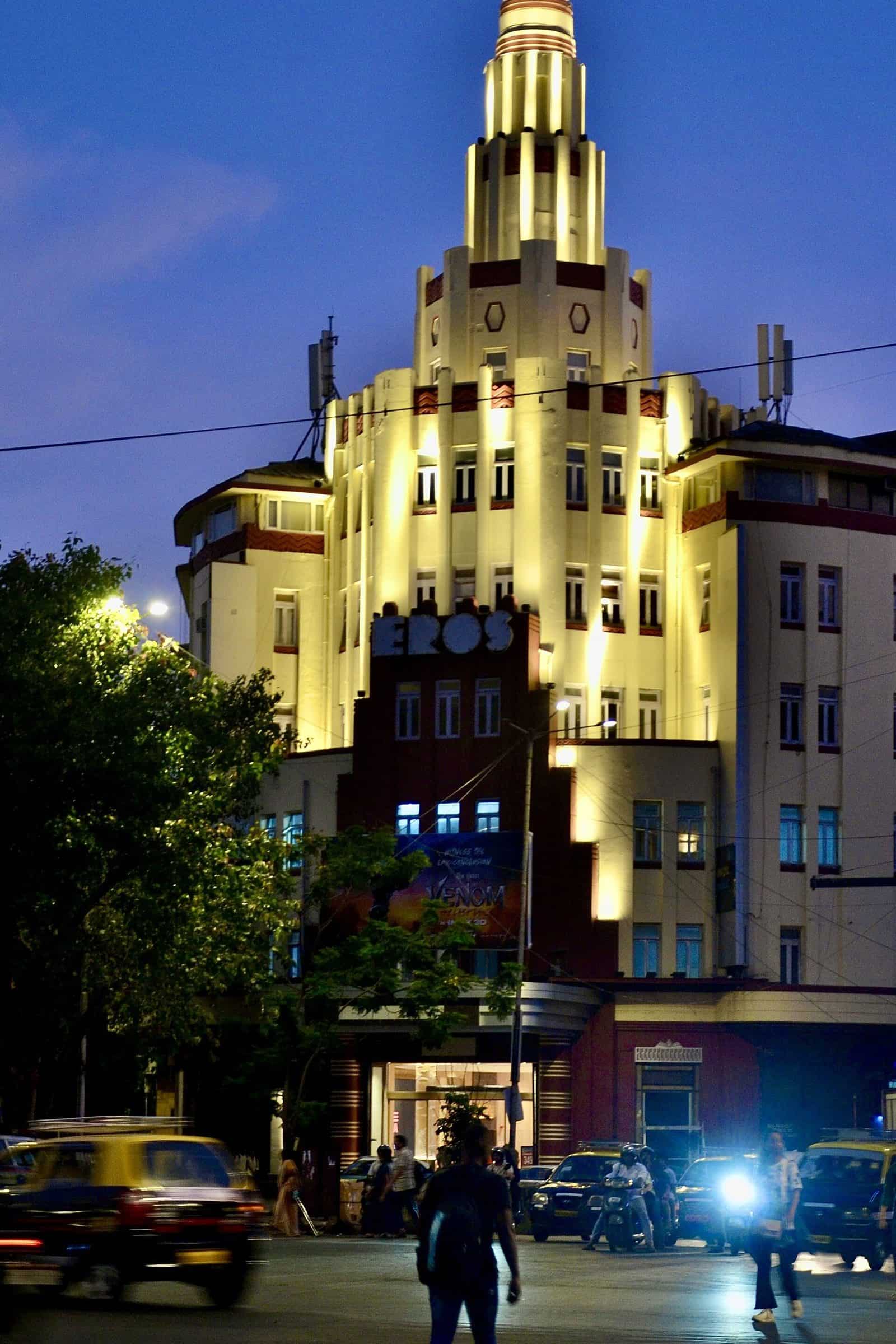
Mumbai has one of the largest groups of Art Deco buildings anywhere, much of it on land reclaimed from Back Bay in the 1930s. The apartment blocks along Marine Drive and around the Oval Maidan, with their curved balconies and “eyebrow” sunshades, became part of the UNESCO World Heritage Site “Victorian Gothic and Art Deco Ensembles of Mumbai” in 2018. The Eros Cinema, designed by Shorabji Bhedwar and opened in 1938, is the ensemble’s showpiece, with a cream facade partly faced in red Agra sandstone and a tiered tower over the corner. It reopened in 2024 after restoration.
7. Cinema Impero, Asmara (1937)
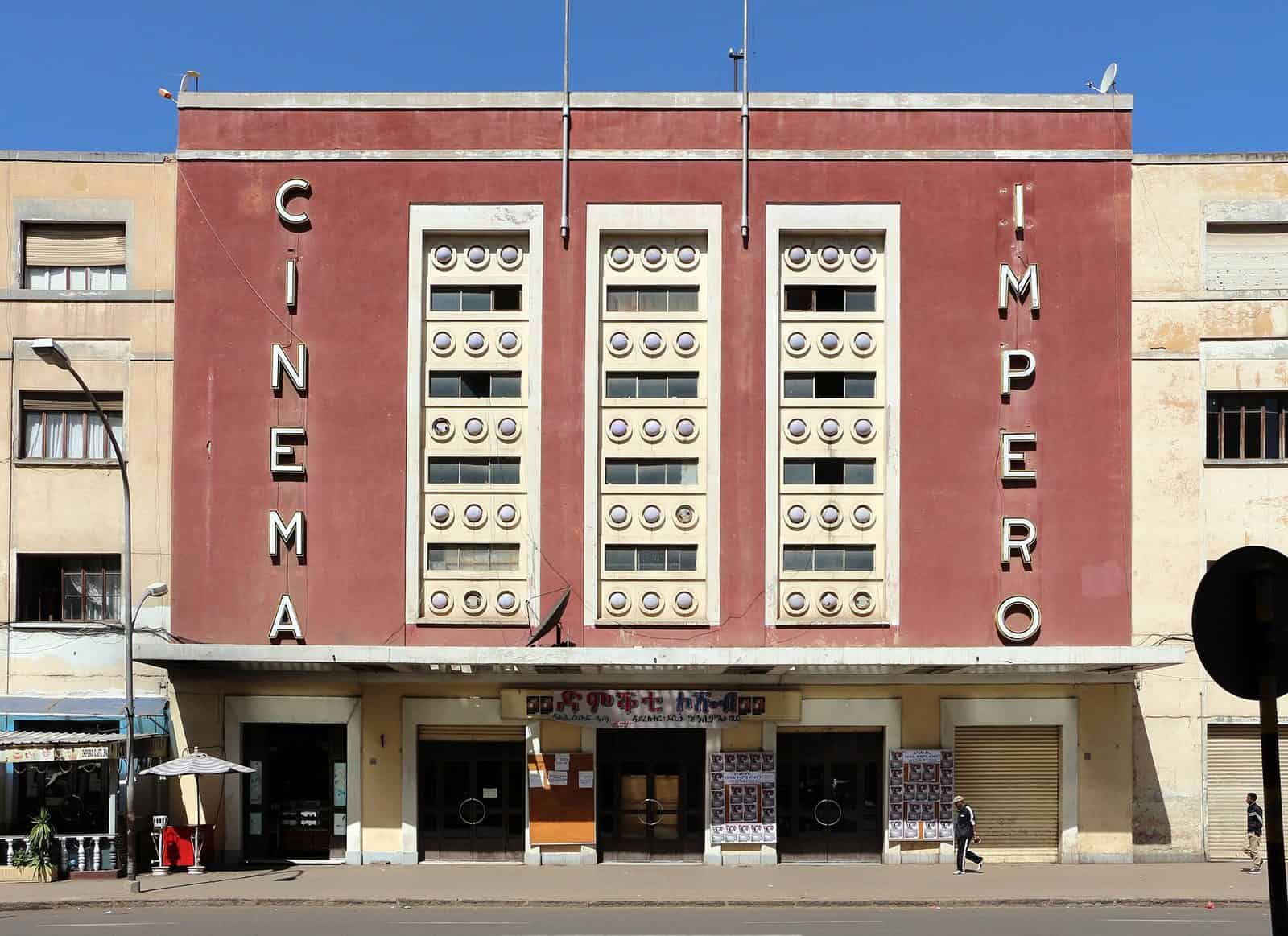
Asmara, the capital of Eritrea, grew rapidly under Italian colonial rule in the 1930s and became a testing ground for modern design, and in 2017 UNESCO listed it as “Asmara: A Modernist African City”. Its buildings range from Art Deco to Futurism and Rationalism. Cinema Impero, designed by Mario Messina and built in 1937, is the purest Art Deco piece: a flat red facade with three panels of round lights, 45 in all, and the name spelled out in vertical letters. It still operates as a cinema with much of its original fit-out.
8. Daily Telegraph Building, Napier (1933)
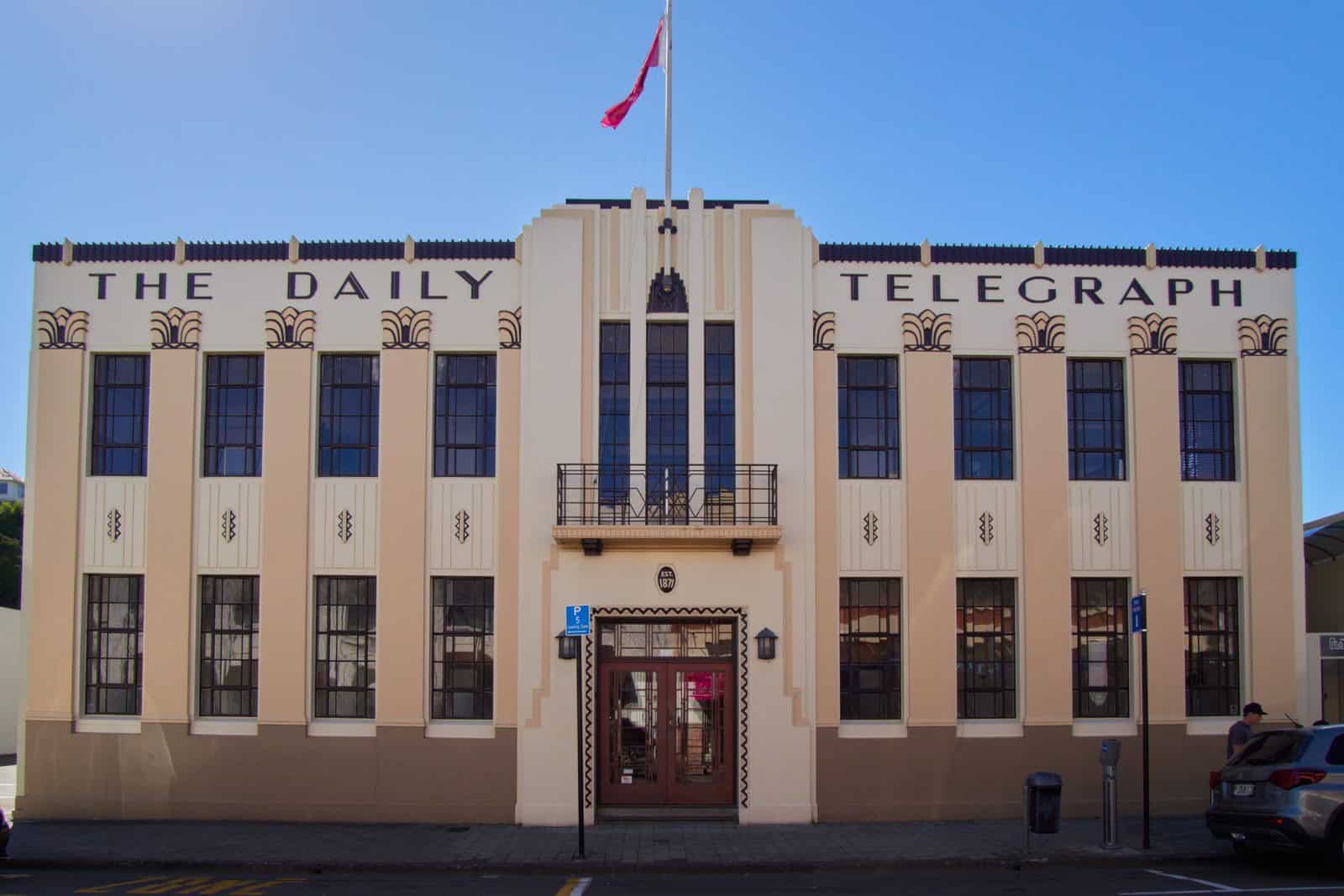
On 3 February 1931 the Hawke’s Bay earthquake and the fires that followed destroyed most of central Napier and killed more than 250 people. The city was rebuilt in the styles of the moment, chiefly Art Deco and Spanish Mission, and the result is one of the most complete Art Deco townscapes in the world. The Daily Telegraph Building on Tennyson Street, designed by E. A. Williams and finished in 1933, is a classic: reinforced concrete, low-relief zigzag and fan motifs and stepped central piers. Shallow ornament was cheaper during the Depression and less likely to fall in another quake.
9. Anzac Memorial, Sydney (1934)
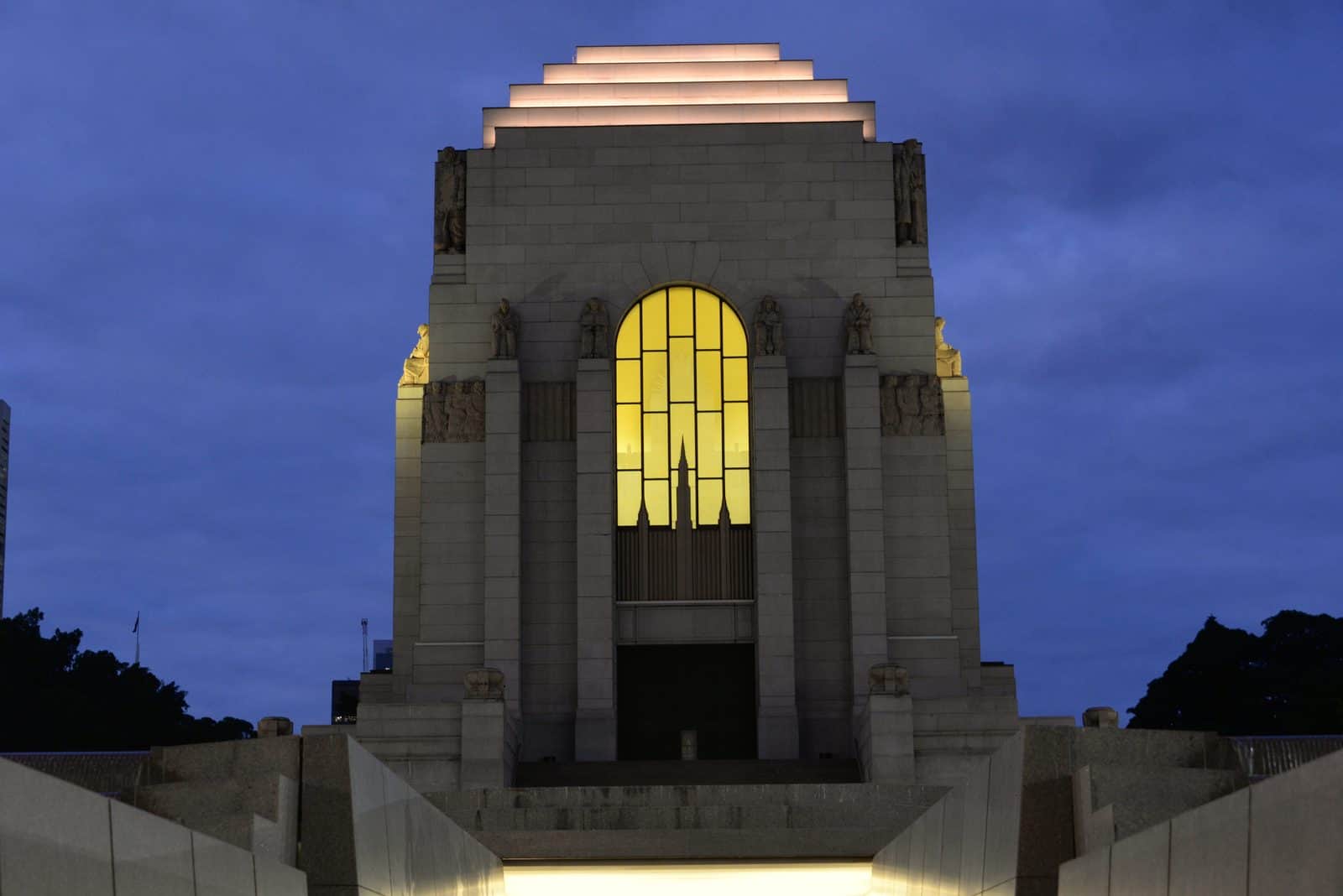
Sydney’s Anzac Memorial is one of Australia’s great Art Deco monuments. Architect C. Bruce Dellit designed it, sculptor Rayner Hoff created its monumental figures and reliefs, and it was built between 1932 and 1934 before opening on 24 November 1934. The memorial uses Art Deco’s language of setbacks, tall vertical windows and stylised figures to honour the Australian Imperial Force of the First World War. A major expansion was completed in 2018, and the memorial is listed on the NSW State Heritage Register.
10. Grace Building, Sydney (1930)
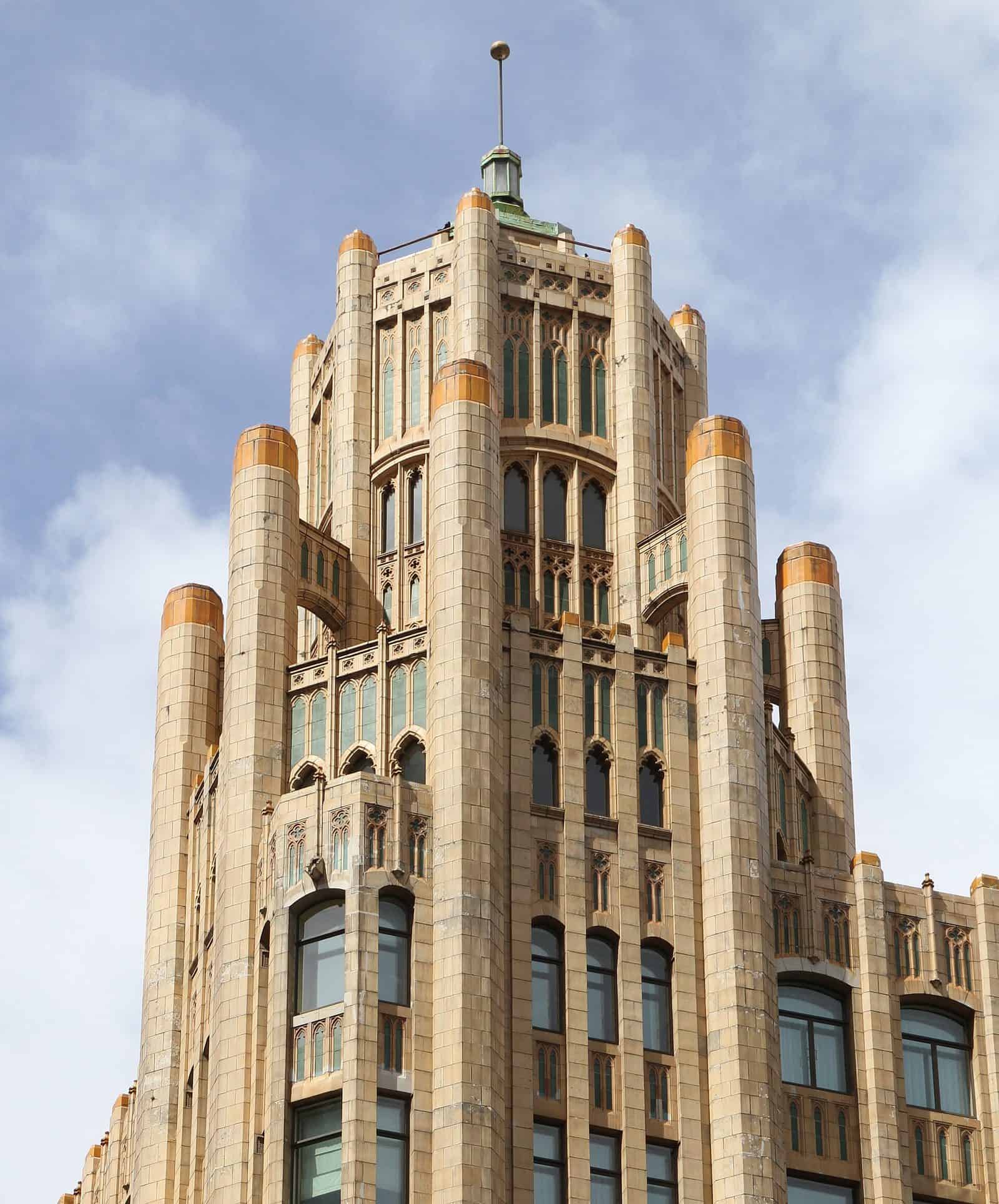
Opened in 1930 as the headquarters of the Grace Bros department store, the Grace Building on York Street was designed by Morrow and Gordon and inspired by the Chicago Tribune Tower. It blends Art Deco with Gothic detail, which is why its style is often described as “Federation Skyscraper Gothic”. During the Pacific War it served as the Sydney headquarters of the US forces under General Douglas MacArthur. Since 1997 it has operated as The Grace Hotel, with its marble floors, pressed-metal ceilings and lifts restored.
11. Manchester Unity Building, Melbourne (1932)
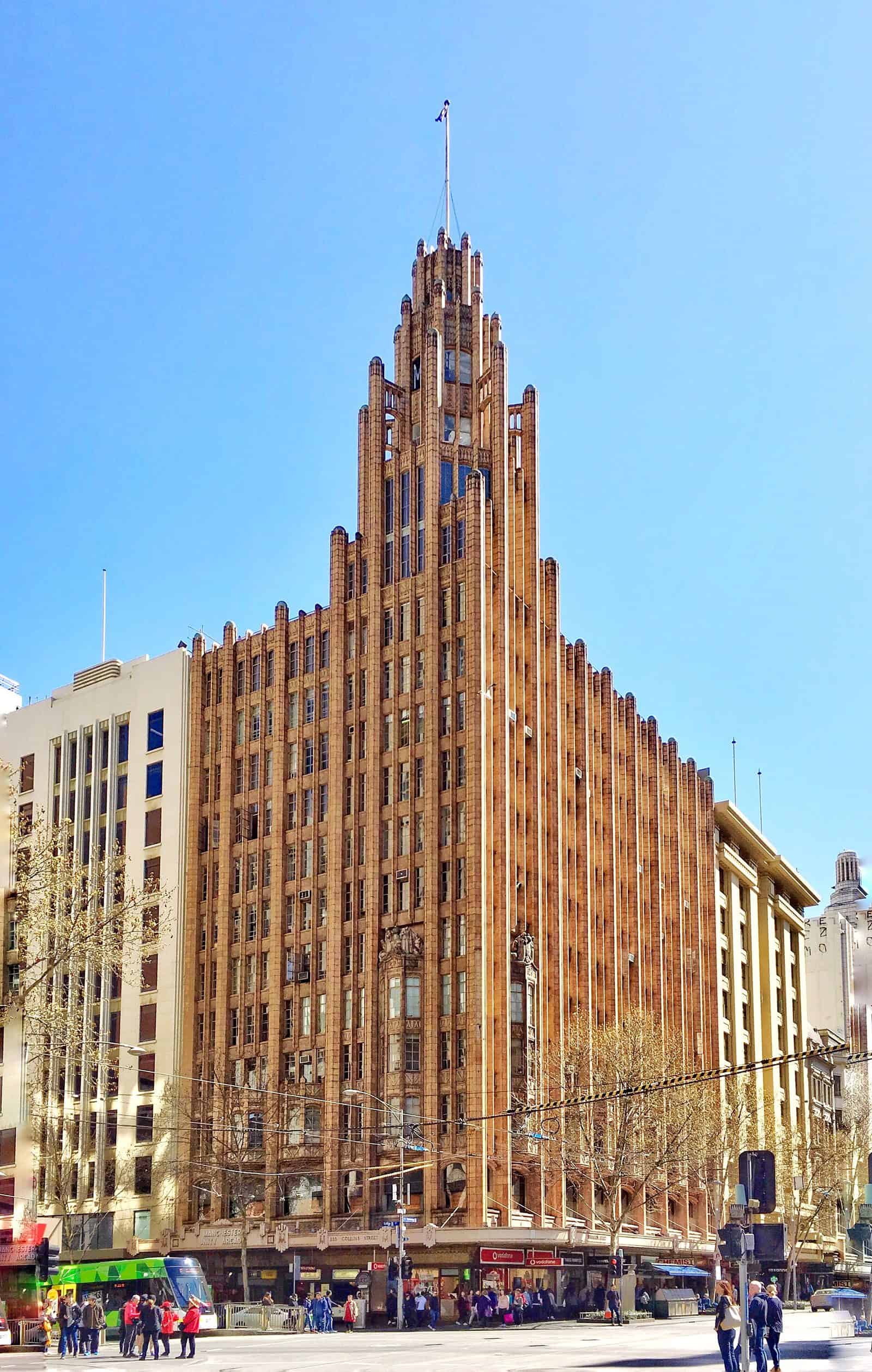
Marcus Barlow’s tower for the Manchester Unity Independent Order of Oddfellows went up at astonishing speed during the Depression. Demolition began at midnight on 1 January 1932, crews worked around the clock in eight-hour shifts, and the building opened that December. Its stepped corner tower and ribbed terracotta facade face Melbourne Town Hall, and inside, a marble-lined arcade leads to copper lift doors and what were Melbourne’s first escalators.
Art Deco vs Streamline Moderne vs Art Nouveau
These three styles are often confused, and they do overlap in time. Art Nouveau came first, Art Deco replaced it in the 1920s, and Streamline Moderne grew out of Art Deco in the 1930s. The simplest test is the line: Art Nouveau curves like a plant stem, Art Deco is sharp and geometric, and Streamline Moderne is smooth and horizontal. For more on the earlier style, see our guide to Art Nouveau architecture.
| Art Nouveau | Art Deco | Streamline Moderne | |
|---|---|---|---|
| Dates | About 1890 to 1914 | About 1920 to 1940 | About 1930 to 1945 |
| Inspiration | Plants, flowers, the human figure | Machines, skyscrapers, ancient Egypt and Mesoamerica | Ocean liners, trains, aircraft |
| Line | Flowing, asymmetric whiplash curves | Straight, vertical, zigzag and stepped | Rounded corners, long horizontals |
| Ornament | Organic, hand-crafted, everywhere | Geometric, stylised, concentrated at entries and tops | Minimal: speed lines, porthole windows, glass block |
| Materials | Wrought iron, stained glass, ceramics | Terracotta, marble, bronze, chrome, stainless steel | Smooth render, glass block, chrome, steel tube |
| Example | Victor Horta’s Hôtel Tassel, Brussels (1893) | Chrysler Building, New York (1930) | Eros Cinema’s curved wings and many Miami Beach hotels |
Why Art Deco Still Matters
Art Deco showed that a modern building could be both efficient and joyful. Its architects used new structure and materials but kept craft, colour and a sense of occasion, especially at the street entrance and the skyline. That balance is why the style keeps coming back, from postmodern towers in the 1980s to the new skyscrapers covered in our post on the revival of Art Deco in 21st-century skyscrapers. For another city where Art Deco mixes with older layers, read our guide to Havana’s colonial, Art Deco and revolutionary architecture.
Art Deco Architecture FAQs
What is Art Deco architecture in simple terms?
Art Deco architecture is a decorative modern style from about 1920 to 1940. It uses strong vertical lines, stepped shapes, geometric ornament such as zigzags and sunbursts, and rich materials like terracotta, marble and chrome. It was used for skyscrapers, cinemas, hotels, shops and civic buildings around the world.
When was Art Deco architecture popular?
Art Deco first appeared in Paris in the 1910s, took its name from the 1925 Paris exhibition of decorative arts, and was most popular from the mid-1920s to the late 1930s. It faded after the Second World War, when the plainer International Style took over.
What is the difference between Art Deco and Art Nouveau?
Art Nouveau (about 1890 to 1914) is based on flowing, natural curves taken from plants and flowers. Art Deco (about 1920 to 1940) replaced those curves with straight lines, geometry and machine-age motifs. Art Nouveau feels organic and hand-made; Art Deco feels sleek and modern.
Where is the largest collection of Art Deco buildings?
The Miami Beach Architectural District in Florida holds the largest collection of Art Deco buildings in the world, with around 960 historic buildings. Napier in New Zealand and Mumbai in India also have exceptionally large, well-preserved Art Deco areas.
Where can I see Art Deco architecture in Australia?
Good starting points are the Anzac Memorial and the Grace Building in Sydney, the Manchester Unity Building in Melbourne, and the many interwar cinemas, hotels and shopfronts in Australian city centres and country towns. Across the Tasman, Napier is the region’s best Art Deco city.


Recent Posts
Art Deco Architecture: History, Key Features and 11 Famous Examples
Axonometric Drawing: 15 Styles and Examples
Architectural Elevation Drawing: 15 Styles and Examples