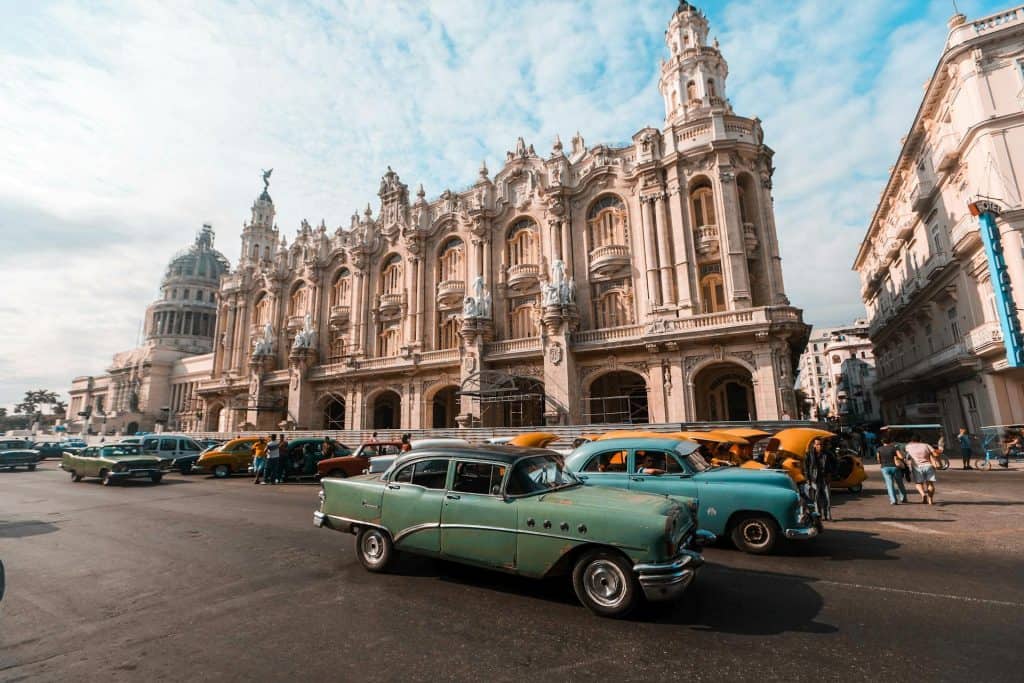
Havana’s Crumbling Grandeur: Colonial, Art Deco, and Revolutionary Architecture
Few cities on earth compress so many centuries of architectural ambition into such a compact urban footprint — and fewer still have preserved that layering through sheer economic standstill. Havana is not a museum. It is a living city where colonial palaces, Art Deco towers, Modernist slabs, and Soviet prefab housing blocks coexist in various states of grandeur and collapse, often on the same street.
For architects and architecture students, Havana offers something rare: an uninterrupted record of Havana architecture styles spanning nearly five hundred years, largely unedited by the speculative demolition cycles that have reshaped most other Latin American capitals. Old Havana (La Habana Vieja) earned UNESCO World Heritage status in 1982, but the architectural interest extends well beyond that historic core — into the Beaux-Arts boulevards of Centro Habana, the Art Deco apartments of Vedado, and the sprawling concrete estates on the city’s eastern fringe.
This article traces Havana’s built environment chronologically, from its sixteenth-century colonial foundations through to present-day decay and restoration. Each section identifies key design characteristics, notable buildings, and practical takeaways for precedent research.
At a glance — Havana’s principal architectural periods:
- Colonial (16th–19th century) — Courtyards, thick masonry, mediopunto fanlights
- Eclecticism & Beaux-Arts (late 19th–early 20th century) — Monumental civic buildings, French-influenced planning
- Art Deco & Streamline Moderne (1920s–1940s) — Geometric ornament, tropical Deco motifs
- Mid-Century Modern (1950s) — Brise-soleil, shell structures, reinforced concrete
- Revolutionary & Soviet-influenced (1960s–1980s) — Prefabricated panel housing, institutional brutalism
- Decay & Restoration (1990s–present) — Conservation, informal adaptation, uncertain futures
—
Colonial Havana: Courtyards, Masonry, and Climatic Intelligence (16th–19th Century)
Havana was founded in 1519 and quickly became Spain’s most important port in the Americas — the staging point for treasure fleets returning to Seville. That strategic wealth funded a dense urban fabric of fortifications, churches, palaces, and merchant houses built to last.
Key Characteristics
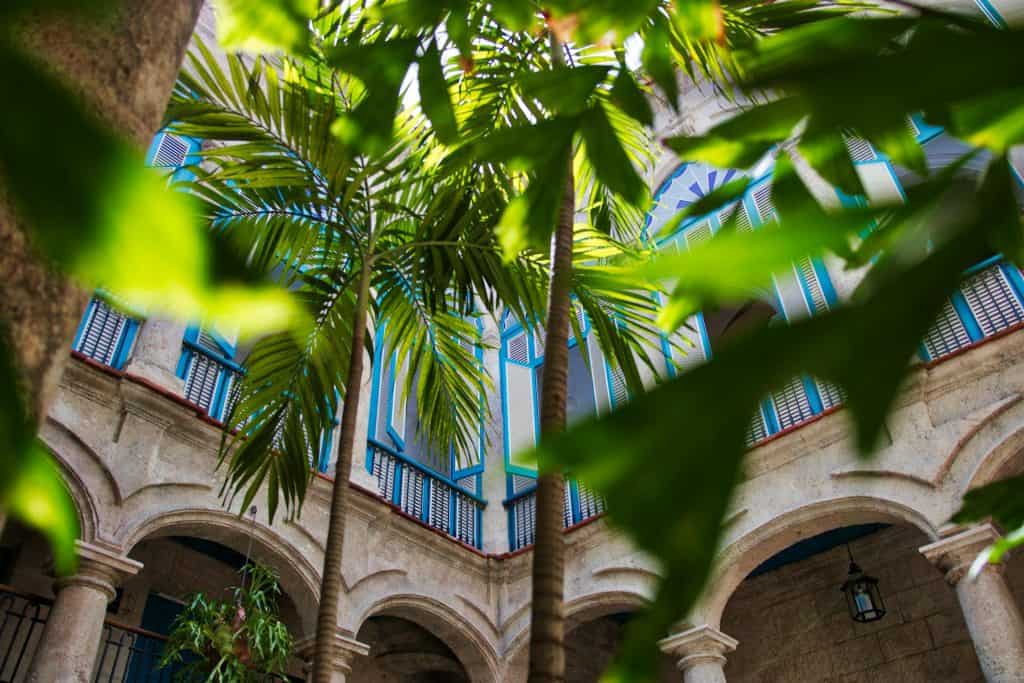
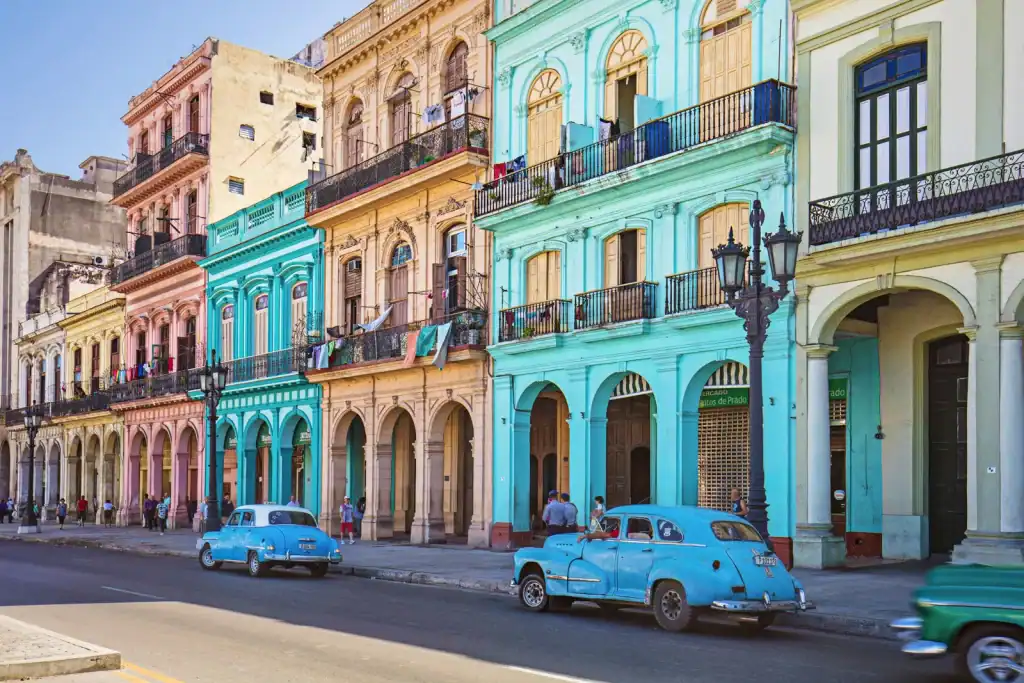
Colonial Havana’s architecture responded directly to climate and available materials. Buildings used thick coral limestone and rubble masonry walls that provided thermal mass against tropical heat. Plans were organised around interior courtyards (patios) that drew air through the building via stack effect, creating passive ventilation long before mechanical systems existed.
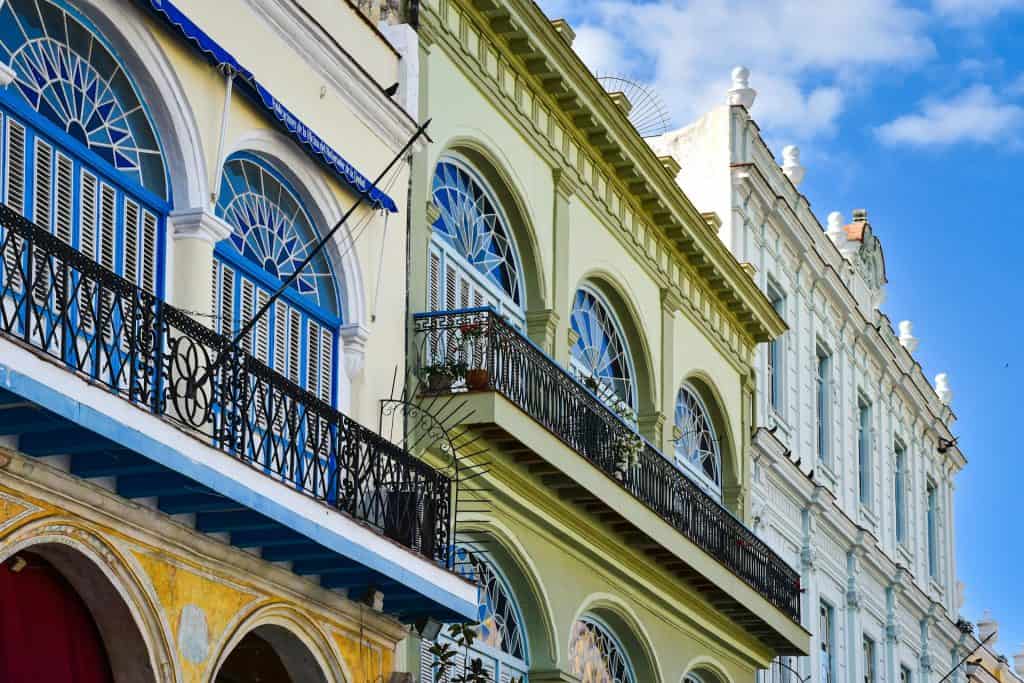
Street-facing facades featured arcaded ground floors providing shade for pedestrians, timber balconies with turned balusters projecting over narrow streets, and the distinctive mediopunto — a semicircular stained-glass fanlight above doorways, typically in vivid blues, reds, and ambers, that filtered harsh sunlight into coloured interior light.
Notable Buildings and Spaces
- Catedral de San Cristóbal (completed 1777) — Cuban Baroque facade with asymmetrical bell towers in coral limestone.
- Palacio de los Capitanes Generales (1776) — The seat of Spanish colonial government, organised around a grand arcaded courtyard with a central fountain.
- Plaza Vieja (established 1559) — A domestic square surrounded by merchant houses showing the evolution from early colonial simplicity to later Baroque elaboration.
- Castillo de la Real Fuerza (1577) — One of the oldest stone fortifications in the Americas, demonstrating military engineering adapted from European models.
Design Takeaway
For students researching passive cooling strategies, colonial Havana is an exceptional precedent. The combination of deep plans, courtyard ventilation, louvred timber shutters (persianas), and high ceilings created habitable interiors in a hot-humid climate without any mechanical intervention. These principles remain directly applicable to contemporary sustainable design in tropical regions.
—
Eclecticism and Beaux-Arts: Sugar Wealth and Grand Ambition (Late 19th – Early 20th Century)
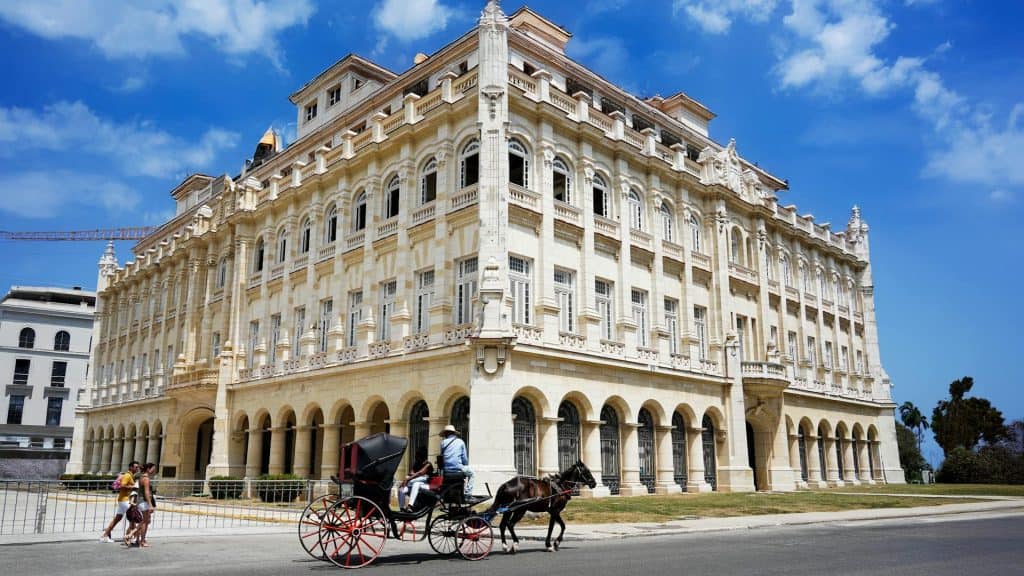
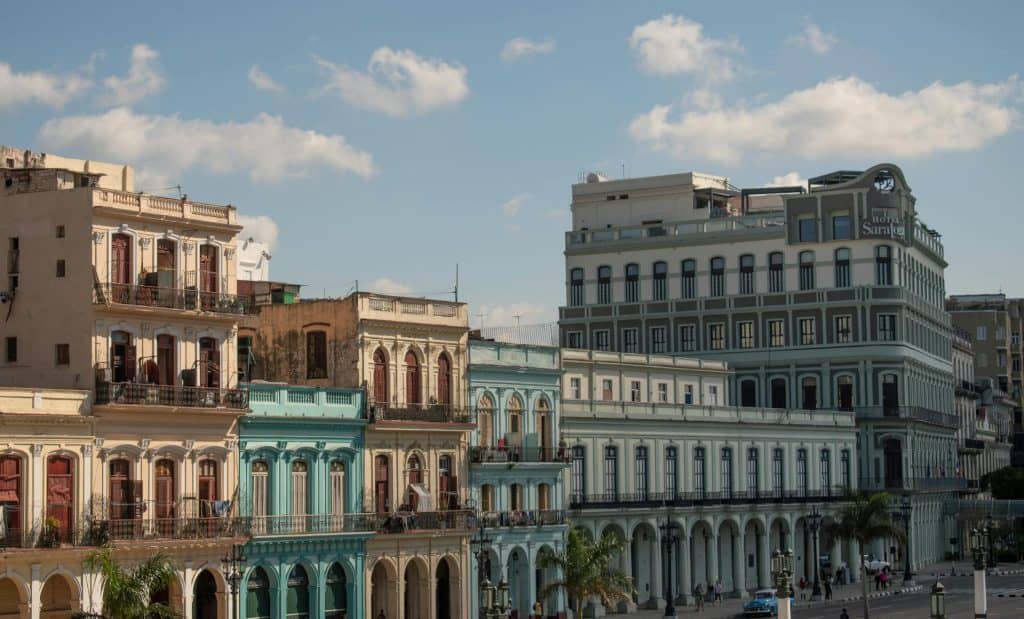
By the late nineteenth century, Cuba’s sugar economy had generated enormous private wealth, and Havana’s elite looked to Europe — particularly Paris — for architectural inspiration. The city expanded westward along grand boulevards, and a new generation of civic and commercial buildings adopted Neoclassical, Renaissance Revival, and Beaux-Arts vocabularies at monumental scale.
Key Characteristics
This period introduced monumental colonnades, elaborate sculptural programmes, grand staircases, and symmetrical planning derived from the École des Beaux-Arts tradition. Buildings were larger and more formally composed than their colonial predecessors, using imported materials (marble, iron, decorative tiles) alongside local stone.
The Paseo del Prado (completed in its current form in 1929) became Havana’s principal promenade — a tree-lined boulevard modelled on European precedents, flanked by eclectic facades in varying states of ornamental ambition.
Notable Buildings
- Capitolio Nacional (1929) — Modelled loosely on the US Capitol but with distinct proportional differences, this was Cuba’s seat of government and remains one of the most imposing Neoclassical buildings in Latin America.
- Gran Teatro de La Habana (1915, facade rebuilt 1930s) — An exuberant Baroque Revival composition with corner towers, sculptural groups, and balconied facades facing the Parque Central.
- Hotel Nacional de Cuba (1930) — Eclectic design by the New York firm McKim, Mead & White, blending Spanish Colonial Revival with Art Deco detailing, sited dramatically on a bluff above the Malecón.
Neighbourhood Focus
Centro Habana and the early grid of Vedado contain the densest concentration of eclectic-period buildings. Vedado’s planned street grid — with setbacks, front gardens, and generous plot sizes — represented a deliberate departure from the dense colonial core, influenced by North American suburban planning ideals.
—
Art Deco and Streamline Moderne: Tropical Geometry (1920s–1940s)
Havana’s Art Deco heritage is often overlooked in favour of its colonial fabric, but the city contains one of the most significant concentrations of Deco buildings in the Caribbean. The style arrived via the United States and was enthusiastically adopted for commercial buildings, cinemas, and apartment towers during the 1920s–1940s boom.
Key Characteristics
Havana’s Art Deco adapted international geometric vocabularies to tropical conditions. Buildings featured stepped massing, vertical piers, and stylised ornamental panels — but also incorporated deep overhangs, ventilation grilles integrated into decorative facades, and shaded loggias that addressed solar gain and humidity.
Decorative motifs drew on both international Deco conventions (zigzags, sunbursts, chevrons) and local tropical references — palm fronds, marine life, indigenous geometric patterns. Interior finishes frequently used patterned terrazzo floors and etched glass panels.
Notable Buildings
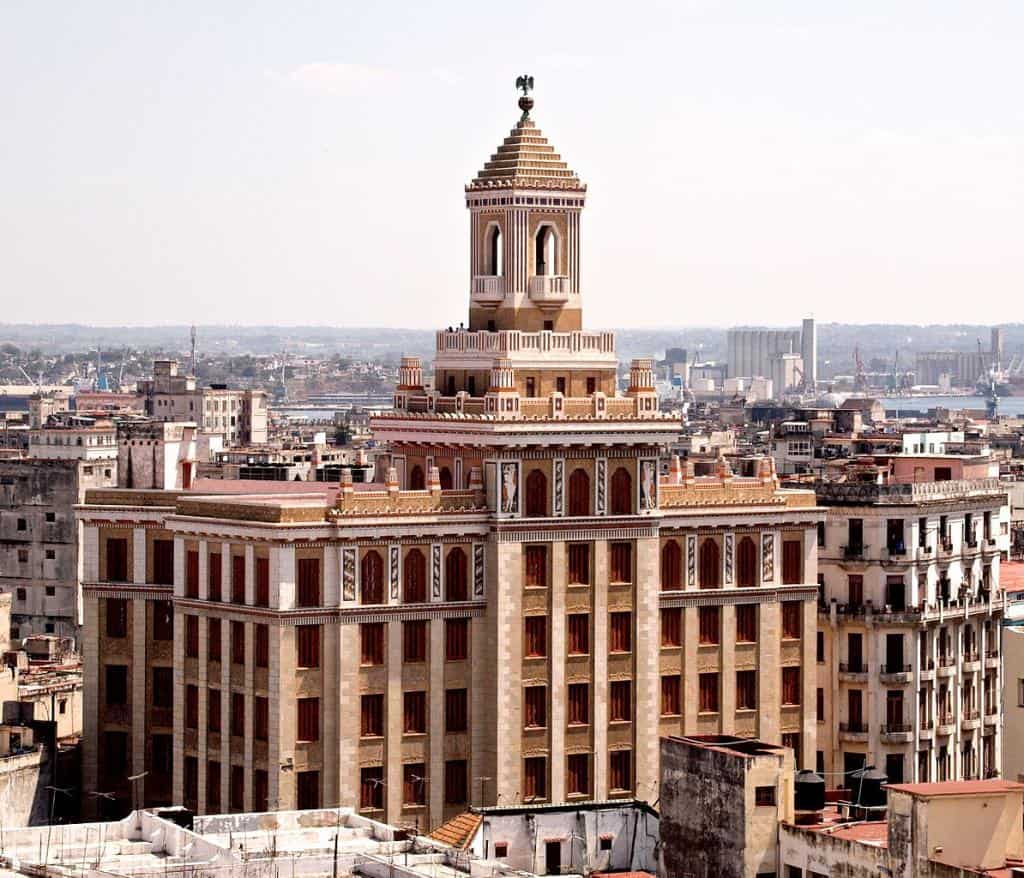
- Edificio Bacardí (1930) — Arguably the finest Art Deco building in the Caribbean. A twelve-storey office tower clad in Swedish granite and local limestone, crowned with a stepped ziggurat top sheathed in terracotta tiles featuring bats (the Bacardí logo) and tropical flora. The polychrome facade and lavish interior lobby make it an essential precedent for decorative Deco.
- López Serrano (1932) — A residential tower in Vedado modelled on New York setback skyscrapers, with streamlined massing and geometric terracotta ornament. At fourteen storeys, it was Havana’s tallest building for two decades.
- Cine-Teatro Fausto (1938) — A Streamline Moderne cinema with curved corners, horizontal banding, and a dramatic vertical sign tower — a textbook example of the style’s application to entertainment architecture.
Design Takeaway
Havana’s Deco buildings demonstrate how an imported style was modified for climate. The integration of ventilation into ornamental screens — where a decorative grille simultaneously provides pattern, shade, and airflow — offers a useful model for architects seeking to combine environmental performance with facade expression.
—
Mid-Century Modern: The Pre-Revolution Boom (1950s)
The 1950s were Havana’s most architecturally ambitious decade. Under the Batista government, massive foreign (primarily American) investment poured into hotels, casinos, apartment towers, and infrastructure. Cuban architects — many trained in the United States — seized the opportunity to experiment with Modernist ideas, producing work that synthesised the International Style with a distinctly tropical sensibility.
Key Characteristics
Mid-century Havana embraced reinforced concrete as both structure and expression. Buildings featured brise-soleil (sun-breakers), pilotis, cantilevered floor plates, and integrated public art (murals, mosaics, sculptural screens). Plans were often open and flowing, with indoor-outdoor thresholds blurred by covered terraces and perforated walls.
Notable Buildings and Architects
- FOCSA Building (1956, Ernesto Gómez Sampera) — A 39-storey residential tower that was, at completion, the second-tallest concrete structure in the world. Its Y-shaped plan maximises cross-ventilation to all apartments.
- Tropicana Cabaret (1951–1956, Max Borges Jr) — A series of thin-shell concrete vaults arching over an open-air nightclub set within tropical gardens. The shell structures — parabolic arches only 7.5 centimetres thick — remain a remarkable demonstration of structural expressionism.
- Hotel Habana Riviera (1957, Philip Johnson, interior; Irving Feldman, architecture) — A curved-facade Modernist slab on the Malecón, notable for its lobby murals and integration of art with architecture.
- Radiocentro CMQ (1947, Junco, Gastón & Domínguez) — A broadcasting complex in Vedado combining studios, offices, and a theatre, with a curtain-wall facade that was among the first in Latin America.
Mario Romañach and Nicolás Quintana produced significant residential work during this period — houses with deep overhangs, perforated concrete screens, and spatial fluidity between interior and garden that deserve wider recognition in Modernist historiography.
Design Takeaway
Cuban Mid-Century Modernism is a valuable precedent for contemporary architects working in tropical climates. These buildings demonstrate how brise-soleil, cross-ventilation strategies, and shading devices can be integrated as primary architectural expression rather than applied afterthoughts. The work predates — and in many cases outperforms — current “sustainable” approaches to facade design in hot-humid regions.
—
Revolutionary and Soviet-Influenced Architecture (1960s–1980s)
After the 1959 Revolution, architectural priorities shifted dramatically. Private commissions ceased. The state became the sole client, and the programme shifted from luxury hotels and private houses to mass social housing, schools, hospitals, and industrial facilities.
Key Characteristics
Soviet technical assistance introduced prefabricated concrete panel construction systems — standardised, industrialised, and efficient, but aesthetically blunt. The most visible result is Alamar, a vast housing estate east of central Havana comprising hundreds of identical apartment blocks arranged on a grid. Built between the 1970s and 1990s, Alamar housed over 100,000 people but offered minimal architectural variation or urban quality.
Institutional buildings of this period tended toward a utilitarian concrete brutalism — functional but rarely distinguished.
The Exception: Escuelas Nacionales de Arte
The most extraordinary architectural project of revolutionary Cuba contradicts every generalisation about the period. The National Art Schools (begun 1961), designed by Ricardo Porro, Vittorio Garatti, and Roberto Gottardi on the grounds of a former country club, are a masterwork of organic Modernism. Using Catalan vaulting techniques (thin-tile domes built without formwork), the schools created flowing, sensuous spaces from the simplest materials — brick and terracotta tile — because Cuba lacked steel and timber after the US embargo.
The project was politically suppressed before completion and left to decay for decades, but it remains one of the most significant architectural works in Latin America and a powerful example of how material constraint can drive formal innovation.
—
Decay, Survival, and Restoration (1990s–Present)
Havana’s current condition is defined by a paradox: the same economic isolation that prevented demolition and redevelopment also prevented maintenance. Buildings that have stood for centuries are now at critical risk of structural collapse. An estimated three buildings per day collapsed in Havana during the worst years of the 1990s Special Period.
The Restoration Effort
Since the 1990s, the Office of the City Historian (Oficina del Historiador de la Ciudad), led for decades by the late Eusebio Leal Spengler, pioneered a self-funding conservation model. Revenue generated from tourism in restored areas of Old Havana — hotels, restaurants, museums — was reinvested directly into further restoration and community services (clinics, schools, elderly care) within the historic centre.
This model achieved significant results in the UNESCO zone, but it also created a visible disparity: meticulously restored plazas for tourists adjacent to crumbling residential blocks where families live in subdivided colonial mansions (solares) with failing roofs and no running water.
Informal Adaptation
Away from official restoration, Havana’s residents have practised their own form of adaptive reuse for decades. Grand houses have been subdivided into multiple dwellings using improvised partitions. Rooftop extensions (barbacoas — internal mezzanines inserted into high-ceilinged colonial rooms) have doubled usable floor area. Structural repairs use whatever materials are available — rebar, timber salvaged from collapsed neighbours, concrete mixed on site.
This informal architecture is not picturesque — it is survival. But it demonstrates a resourcefulness and spatial ingenuity that formal architecture can learn from: how to extend the life of existing buildings with minimal resources, how to adapt rigid typologies to changing needs, and how communities self-organise spatial solutions when institutions cannot provide them.
Uncertain Futures
As Cuba’s economic situation evolves, Havana faces familiar preservation questions with unfamiliar constraints. Will foreign investment fund sensitive restoration or speculative demolition? Can the self-funding model scale beyond the tourist core? How do you balance the heritage value of a building with the right of its residents to safe, dignified housing?
These are not abstract questions. They are playing out in real time across Havana’s neighbourhoods, and they offer lessons — both cautionary and hopeful — for architects and planners working in heritage contexts worldwide.
—
Havana as a Living Precedent Study
Havana is not a ruin to be aestheticised. It is a working city whose architecture encodes five centuries of climatic response, material innovation, political ideology, and human adaptation. For architects and students, it offers three particularly rich areas of study:
Climate-responsive design without technology. From colonial courtyards to mid-century brise-soleil, Havana’s buildings demonstrate passive strategies for hot-humid climates that remain directly relevant to sustainable design practice today.
Adaptive reuse under extreme resource constraints. Both the formal restoration programme and the informal adaptations of residents show how existing buildings can be extended, repurposed, and maintained with minimal material inputs — a critical skill as the profession grapples with embodied carbon and circular economy principles.
The politics of preservation. Havana makes visible the tensions inherent in all heritage conservation: whose history is valued, who benefits from restoration, and what is lost when buildings are frozen as monuments rather than allowed to evolve as living fabric.
Like Buenos Aires, Havana is a Latin American city whose architecture tells a story of colonial imposition, imported European ambition, local adaptation, and twentieth-century upheaval. But where Buenos Aires rebuilt and modernised continuously, Havana’s enforced stasis created something unique — a city where every layer remains visible, peeling back like the paint on its own facades to reveal the one beneath.
For precedent research, design studio references, or simply understanding how architecture absorbs and expresses political and economic forces, Havana remains one of the most instructive cities in the world.
Recent Posts
Architectural Section Drawing: 14 Styles to Inspire You
Romanesque Architecture Explained: Arches, Mass, and Monastic Power
Neoclassical Architecture Explained: Order, Symmetry, and Democratic Ideals