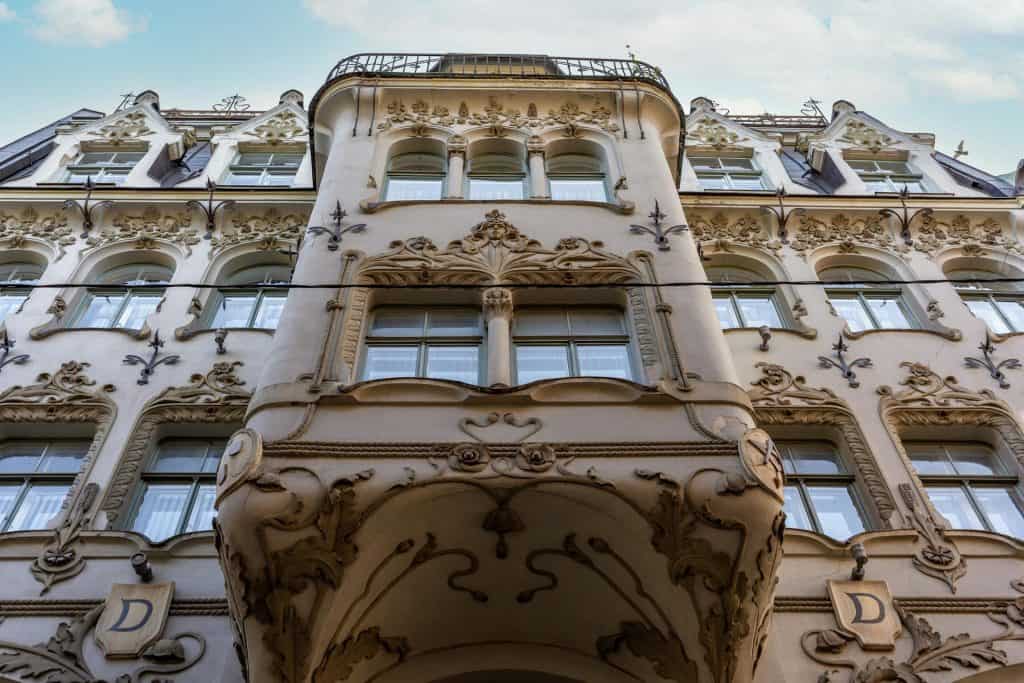
Art Nouveau Architecture: Key Features and 7 Design Lessons Still Relevant Today
Most architectural movements get remembered for what they looked like. Art Nouveau architecture deserves to be remembered for what it argued — that structure, ornament and craft are not separate disciplines but a single, integrated design problem.
Emerging in the 1890s and fading by around 1910, Art Nouveau was brief but transformative. It rejected the recycled classicism that dominated nineteenth-century European cities and proposed something radical: an architecture that grew from its materials, drew from natural systems, and treated every element — from the structural column to the door handle — as part of one coherent vision.
For architects and students today, Art Nouveau is far more than a style to admire in precedent books. Its core principles — material honesty, total design integration, expressive structure — remain deeply relevant to contemporary practice. This article breaks down the key features of Art Nouveau architecture and draws out seven design lessons that still hold up.
What Is Art Nouveau Architecture?
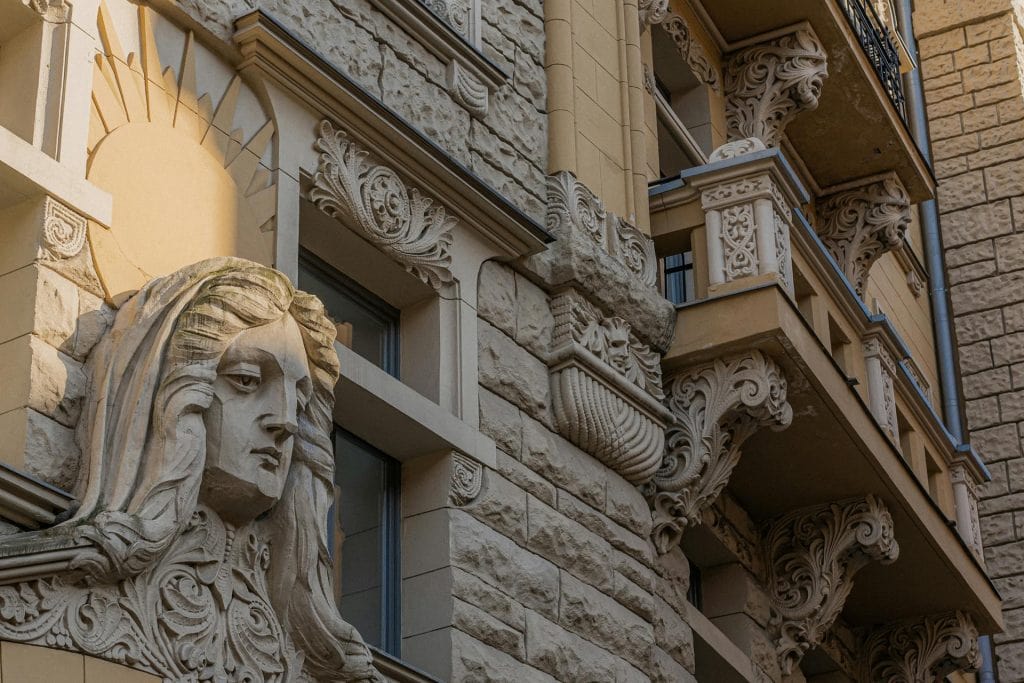
Art Nouveau (literally “new art”) was an international movement that swept across Europe and beyond between roughly 1890 and 1910. It appeared under different names in different countries — Jugendstil in Germany, Sezessionstil in Austria, Modernisme in Catalonia, Stile Liberty in Italy — but the underlying ambition was consistent: create a genuinely modern architecture that owed nothing to historical pastiche.
The movement grew out of the Arts and Crafts tradition’s emphasis on handcraft and honest materials, but it embraced industrialisation rather than rejecting it. Iron, glass and reinforced concrete were not problems to be hidden behind stone facades — they were opportunities for new forms of expression.
What made Art Nouveau architecturally significant, rather than merely decorative, was this insistence on integration. The best Art Nouveau buildings don’t have ornament applied to structure. The structure is the ornament. The facade, the plan, the furniture, the light fittings — everything participates in a single design logic. That’s what separates it from the surface-level historicism it replaced, and it’s what makes it worth studying seriously.
Key Features of Art Nouveau Architecture
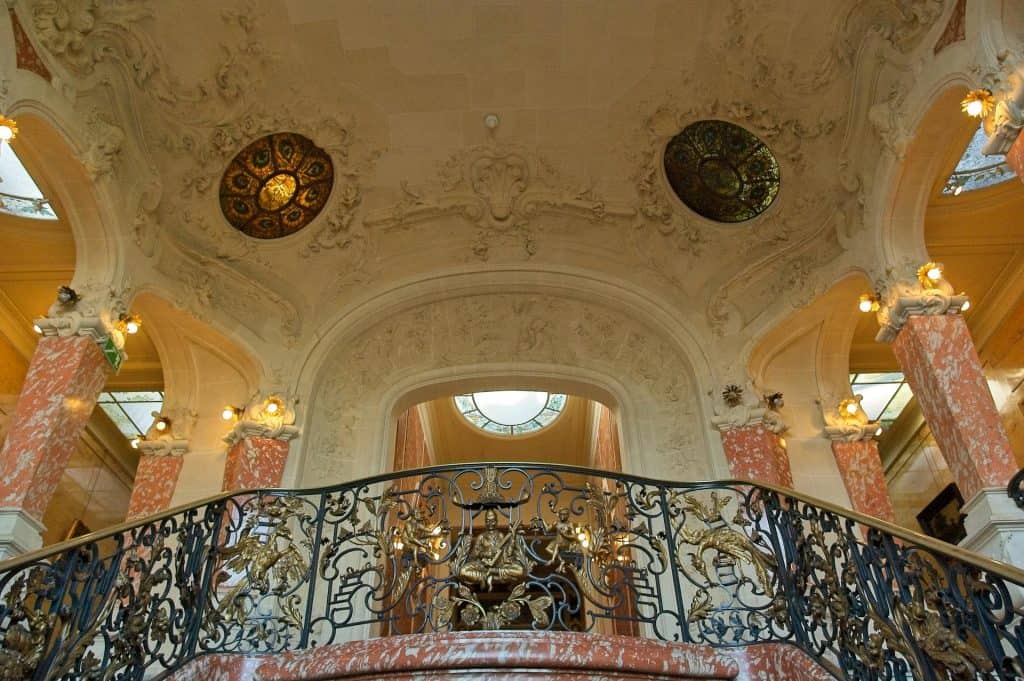
Art Nouveau buildings are instantly recognisable, but the features that define them go well beyond aesthetics. Each characteristic reflects a deliberate design decision about how buildings should be made and experienced.
Organic and Curvilinear Forms
The most obvious feature of Art Nouveau architecture is its rejection of straight lines and rigid geometry in favour of flowing, organic curves. Facades undulate. Staircases spiral. Rooflines ripple. These forms were not arbitrary — they were drawn from close observation of natural growth patterns: the way a vine climbs, a wave breaks, or a bone distributes load.
Whiplash Lines and Asymmetry
The so-called “whiplash curve” — a long, sinuous line that accelerates and snaps back on itself — became the signature motif of the movement. Combined with deliberate asymmetry, it gave Art Nouveau buildings a sense of dynamic energy that classical symmetry could never achieve. Facades were composed, but they were not mirrored.
Ornamental Ironwork and Exposed Structure
Art Nouveau architects were among the first to celebrate iron as a visible, expressive material rather than concealing it behind masonry. Victor Horta’s exposed iron columns and beams in Brussels are structural elements that simultaneously function as decoration — their curves and joints are designed to be seen and admired. This was a genuinely radical move in the 1890s.
Stained Glass, Mosaics and Surface Decoration
Art Nouveau embraced rich surface treatments: stained glass skylights flooding interiors with coloured light, ceramic tile mosaics wrapping facades, and carved stone or plaster reliefs integrating with the building envelope. These were not afterthoughts. They were designed alongside the architecture, often by the same hand.
Integration of Interior and Exterior Design
A hallmark of Art Nouveau was the architect’s control over the entire experience. Victor Horta, Hector Guimard and Antoni Gaudí all designed furniture, light fittings, floor tiles and hardware for their buildings. The interior was not a separate commission — it was the continuation of the same design logic that shaped the facade and the plan. If you’re interested in how this principle plays out in interior spaces specifically, our guide to Art Nouveau interior design explores the trend’s modern resurgence in detail.
Use of New Materials
Art Nouveau architects were early adopters. Iron allowed slender columns and wide spans. Glass could fill entire walls. Reinforced concrete enabled the fluid, sculptural forms that Gaudí pushed to their structural limits. The movement treated new materials not as substitutes for traditional ones but as generators of new architectural possibilities.
Nature-Derived Motifs
Flowers, leaves, insects, birds, flowing water, tendrils, roots — Art Nouveau drew constantly from the natural world. But the best examples went beyond surface decoration. Gaudí studied the geometry of hyperboloid structures found in natural forms. Horta’s ironwork follows the branching logic of trees. The nature reference was structural as much as visual.
Landmark Art Nouveau Buildings Every Architect Should Study
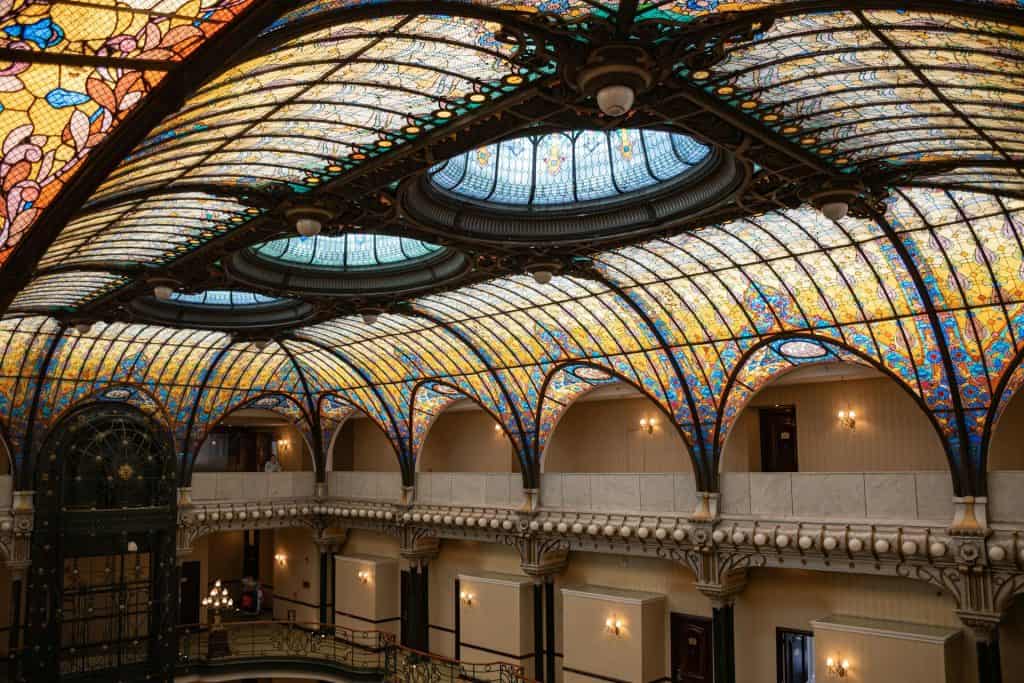
Art Nouveau was an international movement, and its regional variations are part of what makes it architecturally rich. These buildings represent different expressions of the same underlying philosophy.
Hôtel Tassel, Brussels (Victor Horta, 1893)
Often cited as the first true Art Nouveau building. Horta’s design for this private townhouse introduced exposed iron structure as interior ornament, with sinuous columns and railings that flow seamlessly into mosaic floors and painted walls. The staircase hall remains one of the most photographed interiors in architectural history.
Casa Batlló, Barcelona (Antoni Gaudí, 1906)
Gaudí’s renovation of an existing apartment block on Passeig de Gràcia is Art Nouveau at its most sculptural. The facade’s bone-like columns, skull-shaped balconies and iridescent tile cladding create a building that appears almost biological. Structurally, Gaudí eliminated load-bearing interior walls to create free-flowing floor plans — anticipating modernist open planning by decades.
Casa Milà (La Pedrera), Barcelona (Antoni Gaudí, 1912)
Gaudí’s last secular work pushes further. The undulating stone facade is entirely self-supporting, freeing the interior from structural walls. The rooftop, with its sculptural ventilation shafts and chimneys, is architecture as landscape. The building’s nickname — “the stone quarry” — was originally an insult, but it captures the raw materiality Gaudí intended.
Paris Métro Entrances (Hector Guimard, 1900)
Guimard’s cast-iron Métro entrances brought Art Nouveau into the public realm at city scale. Their organic, almost insect-like forms demonstrated that infrastructure could be expressive. Several survive today and remain among the most recognisable pieces of urban design in the world.
Secession Building, Vienna (Joseph Maria Olbrich, 1898)
The Viennese variant of Art Nouveau was more geometric and restrained than its Belgian or Catalan counterparts. Olbrich’s exhibition hall — with its cubic massing, clean white walls and golden openwork dome of laurel leaves — shows how the movement’s principles could produce radically different formal outcomes depending on context.
Municipal House, Prague (Osvald Polívka and Antonín Balšánek, 1912)
Prague’s Municipal House is one of the most lavish Art Nouveau civic buildings in Europe, with interiors decorated by leading Czech artists including Alfons Mucha. It demonstrates how Art Nouveau could operate at an institutional scale, integrating architecture, painting, sculpture and decorative arts into a single civic statement. Prague’s broader architectural landscape — spanning Gothic, Baroque, Cubist and Art Nouveau — is worth exploring in its own right; our guide to Prague’s architectural styles covers the full range.
Majolica House, Vienna (Otto Wagner, 1899)
Wagner’s apartment building on the Linke Wienzeile uses a facade of colourful floral majolica tiles over a straightforward structural grid. It’s a useful study in how Art Nouveau surface treatment can transform a conventional building type without altering its fundamental organisation.
Art Nouveau vs Art Deco: Understanding the Difference
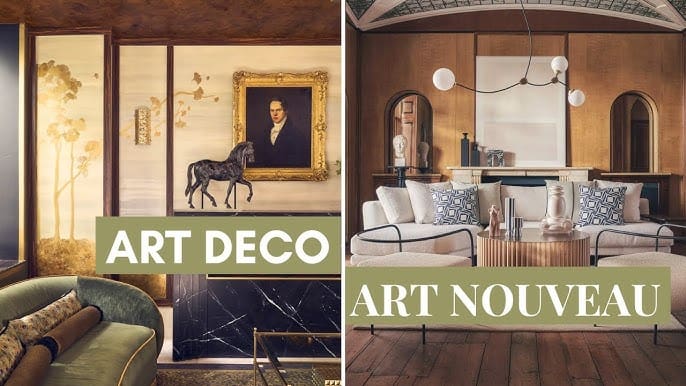
These two movements are frequently confused, partly because their names sound similar and partly because both embraced decorative richness. But their design philosophies are fundamentally different.
Art Nouveau (c. 1890–1910) drew from nature. Its forms are organic, curvilinear and asymmetric. Materials are celebrated for their inherent qualities — the flexibility of iron, the translucency of glass. Ornament grows from structure.
Art Deco (c. 1920–1940) drew from industry and geometry. Its forms are angular, symmetrical and streamlined. Materials are often luxurious — chrome, marble, exotic timbers — and used for their surface effect. Ornament is applied to structure.
The simplest way to distinguish them: Art Nouveau curves like a vine. Art Deco steps like a ziggurat.
Both movements valued craft and visual richness, but Art Nouveau was fundamentally about dissolving the boundary between structure and decoration, while Art Deco was comfortable keeping them separate. For architects, this is not a trivial distinction — it reflects completely different attitudes to how buildings are assembled.
7 Design Lessons from Art Nouveau That Still Apply Today
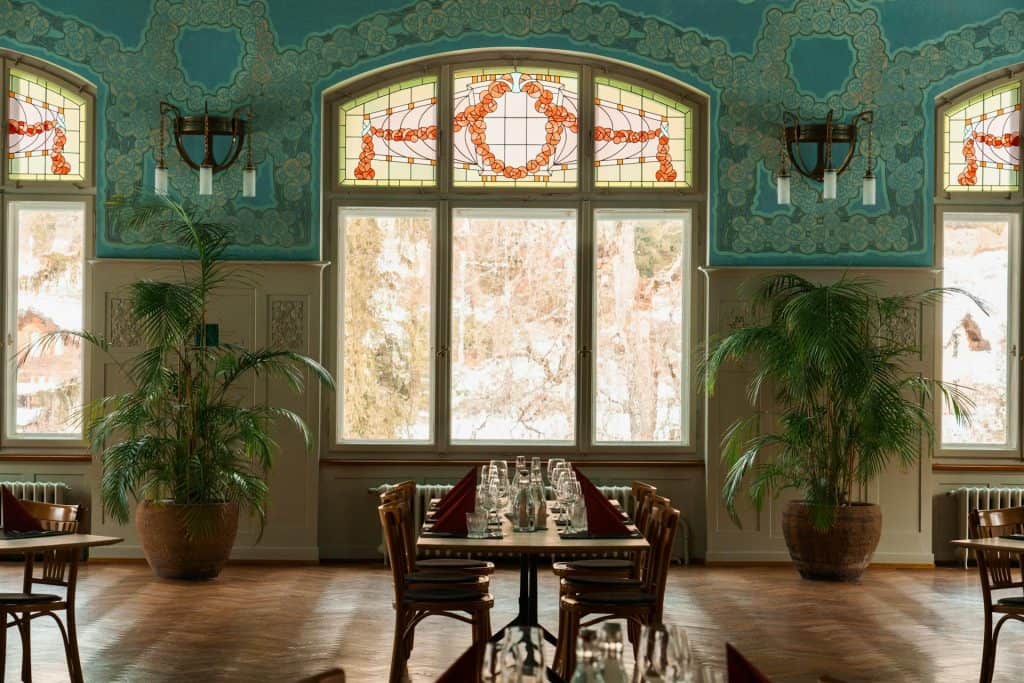
Art Nouveau’s formal language belongs to its era, but the design thinking behind it translates directly to contemporary practice. These are the lessons worth carrying forward.
1. Let Structure Be Expressive, Not Hidden
Art Nouveau architects refused to treat structure as something to conceal behind cladding. Horta’s exposed iron columns are the most famous example, but the principle is broader: when you let the structural system participate in the spatial and visual experience, the building gains coherence. This is the same logic behind the best exposed-timber, exposed-concrete and exposed-steel buildings being designed today.
2. Design Across Scales — From Door Handle to Facade
The Art Nouveau commitment to Gesamtkunstwerk (total work of art) meant that architects designed at every scale. The curve of a balustrade echoed the curve of the facade. The pattern on a floor tile related to the pattern in a skylight. This cross-scale consistency is what gives the best Art Nouveau interiors their immersive quality — and it’s a discipline that contemporary practice, with its tendency to hand off interiors and details to separate consultants, often loses.
3. Embrace Material Honesty
Art Nouveau celebrated what materials could actually do. Iron was thin and could curve — so let it curve visibly. Glass was transparent — so use it in vast sheets. Ceramic tile was colourful and weather-resistant — so wrap facades in it. The lesson is not about using the same materials, but about designing with a material’s properties rather than against them.
4. Draw from Natural Systems, Not Just Natural Shapes
It’s easy to stick a leaf motif on a facade and call it nature-inspired. Art Nouveau at its best went deeper. Gaudí studied catenary curves and hyperboloid geometry — forms that occur in nature because they are structurally efficient. The lesson for contemporary architects, particularly those working with parametric and computational tools, is that biomimicry is most powerful when it engages with natural logic, not just natural imagery.
5. Treat Interiors and Exteriors as One Design Problem
Art Nouveau architects understood that a building is experienced as a continuous sequence, not as separate inside and outside conditions. The facade sets expectations that the interior fulfils (or deliberately subverts). This principle is especially relevant for residential and hospitality projects where the transition from street to interior is a critical part of the design. For a deeper look at how Art Nouveau principles translate to interior spaces, see our piece on Art Nouveau interior design and its modern resurgence.
6. Resist Pure Repetition — Asymmetry Creates Visual Energy
Classical architecture relies on symmetry and repetition for its sense of order. Art Nouveau demonstrated that asymmetric compositions can be equally ordered — just more dynamic. Horta’s facades are carefully balanced without being mirrored. Gaudí’s plans are organised around structural logic, not bilateral symmetry. For contemporary architects working on facade design, this is a useful reminder that rhythm does not require identical repetition.
7. Context Matters — Adapt the Language to the City
Art Nouveau looked radically different in Brussels, Barcelona, Vienna and Prague because its architects responded to local materials, climate, craft traditions and urban conditions. Gaudí’s stone and ceramic work belongs to Catalonia. Horta’s ironwork belongs to industrial Belgium. The Viennese Secession’s geometric restraint belongs to a city already shaped by classical rigour. The lesson is timeless: good architecture is specific to its place. The way Amsterdam’s canal houses respond to their narrow plots and waterfront context is a different expression of the same principle — design shaped by the real conditions of a city.
How to Reference Art Nouveau in Contemporary Projects
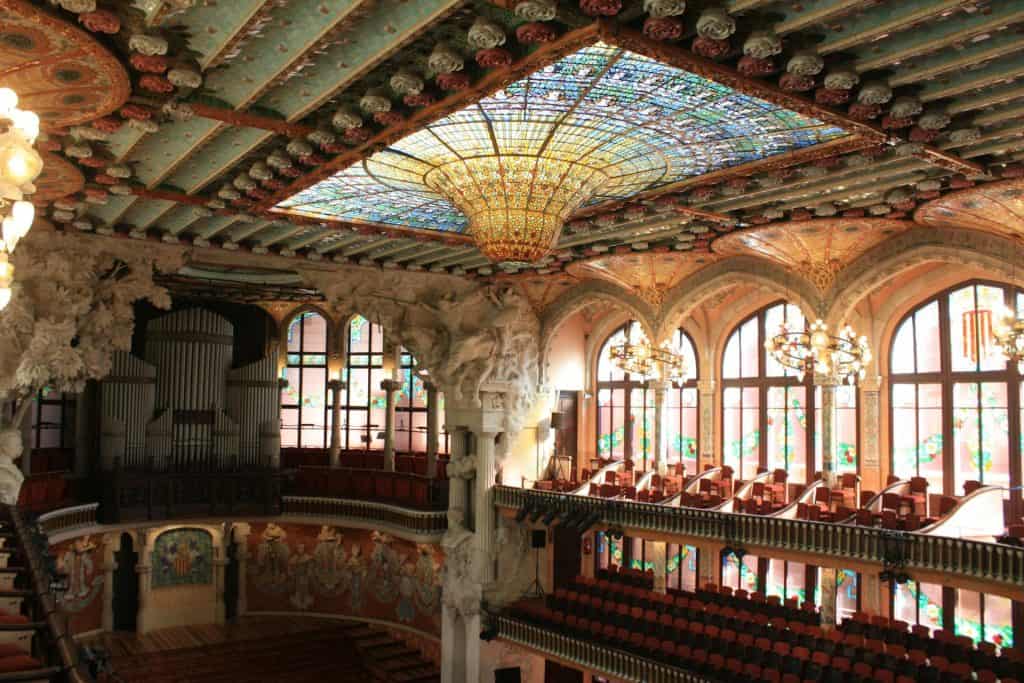
Referencing Art Nouveau in new work is a balancing act. Literal reproduction — sticking whiplash ironwork on a contemporary facade — almost always reads as pastiche. The more productive approach is to absorb the principles and express them through current materials and methods.
Computational design tools now make it straightforward to generate the kind of complex organic geometries that Art Nouveau architects could only achieve through extraordinary craft skill. If you’re exploring how AI-assisted visualisation can help test these kinds of forms early in the design process, our guide to using ChatGPT to create architectural renders is a practical starting point.
At the urban scale, Art Nouveau’s emphasis on facade richness and street-level detail is a useful counterpoint to the flat, repetitive envelopes that dominate much contemporary development. But ornamental facades need supportive site planning — setbacks, sightlines and pedestrian-scale street sections that allow the detail to be seen and appreciated. Getting the site plan fundamentals right is what creates the conditions for that kind of architectural expression to work.
The most successful contemporary references to Art Nouveau tend to share three qualities: they engage with natural geometry at a structural level (not just as surface pattern), they maintain cross-scale design consistency, and they use materials expressively rather than generically. The style is historical. The thinking is not.
Final Thoughts
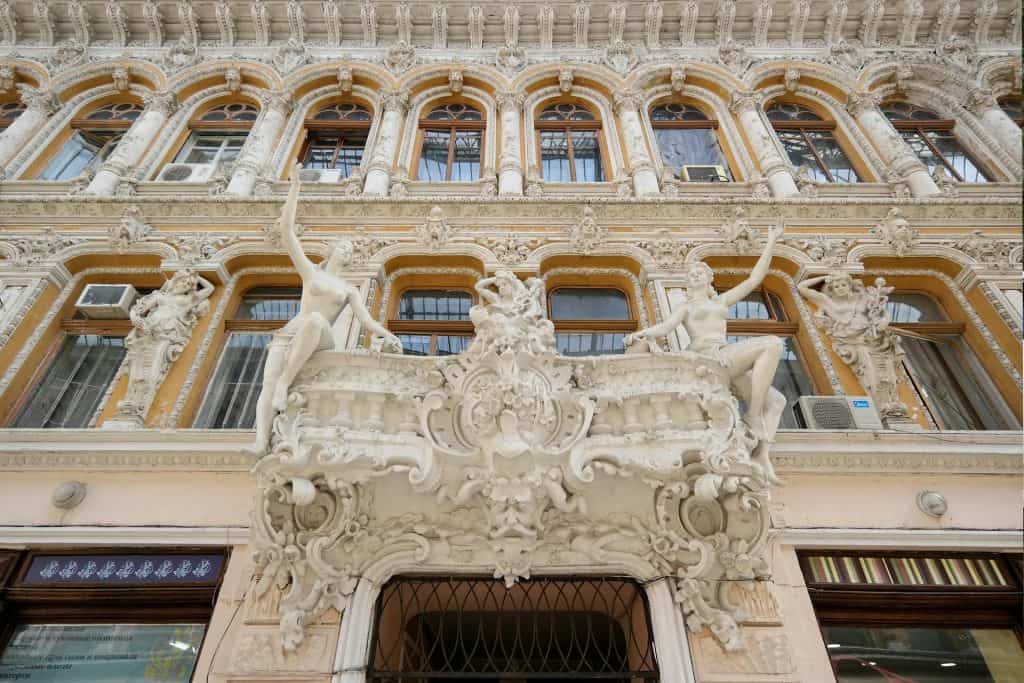
Art Nouveau lasted barely two decades, but its influence on how architects think about the relationship between structure, ornament and craft has never fully faded. It proposed that a building could be a complete, integrated work — that every joint, every surface, every threshold could participate in a single design idea.
That ambition is worth holding onto. Not as nostalgia for iron tendrils and stained glass lilies, but as a standard for what architectural design can be when it refuses to treat any element as someone else’s problem. The best Art Nouveau buildings still feel radical because they are whole — and that quality is as rare and valuable now as it was in 1893.
Recent Posts
Architectural Section Drawing: 14 Styles to Inspire You
Romanesque Architecture Explained: Arches, Mass, and Monastic Power
Neoclassical Architecture Explained: Order, Symmetry, and Democratic Ideals