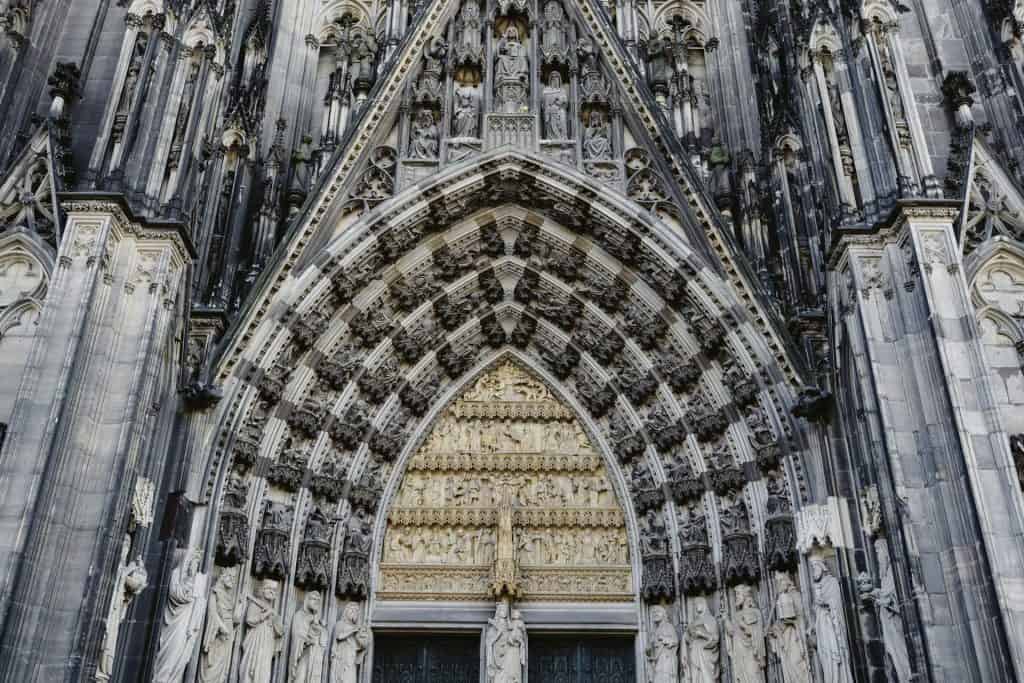
Gothic Architecture Explained: Structural Innovation, Light, and Verticality
Gothic architecture is not merely a style defined by pointed arches and tall spires. It is a complete structural system — one invented to serve a specific theological vision. Between roughly 1140 and 1500, builders across Europe developed an interdependent set of structural innovations that allowed them to construct churches of extraordinary height and luminosity. Every technical breakthrough — the pointed arch, the ribbed vault, the flying buttress — was driven by a singular ambition: to build a space that felt like a foretaste of heaven, flooded with divine light and drawing the soul upward toward God.
Understanding Gothic architecture features means understanding this inseparability of structure and belief. The engineering is remarkable on its own terms, but it only makes full sense when you recognise what it was in service of.
This guide covers the structural system, the role of light and tracery, the pursuit of verticality, and the key regional variations that shaped Gothic buildings across Europe.
From Romanesque to Gothic — The Problem That Demanded Innovation
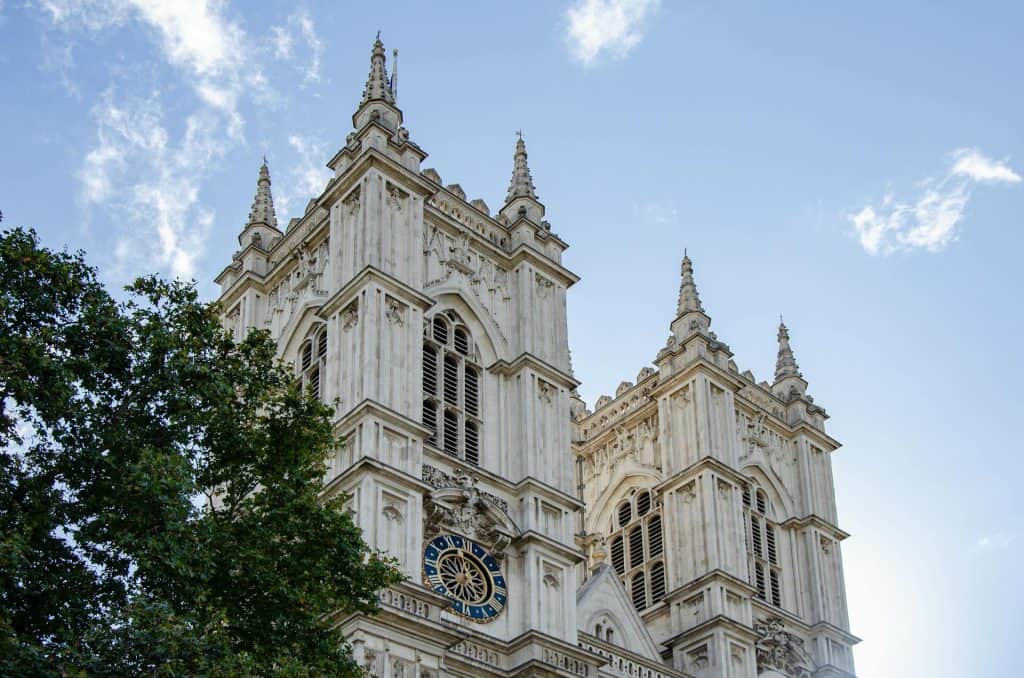
To understand why Gothic architecture emerged, you need to understand what came before it. Romanesque churches — the dominant building type across Europe from roughly the 10th to mid-12th century — relied on thick masonry walls, semicircular arches, and barrel or groin vaults. These were powerful, durable buildings, but they had fundamental limitations.
The barrel vault generates continuous lateral thrust along its entire length. The only way to resist that thrust was with massive, thick walls. And thick walls mean small windows. Romanesque interiors, while often spatially impressive, tend toward dimness. The structural system and the admission of light were in direct conflict.
This was not simply an aesthetic problem. For the medieval Church, it was a theological one. Light was understood not as neutral illumination but as a manifestation of God’s presence — “God is light, and in him is no darkness at all” (1 John 1:5). A church that could not admit light was, in a real sense, failing its spiritual purpose.
The turning point came at the Abbey Church of Saint-Denis, north of Paris, where Abbot Suger oversaw a radical rebuilding of the choir between 1140 and 1144. Suger was explicit about his intentions. Drawing on the writings of Pseudo-Dionysius the Areopagite, he believed that physical light was an analogy for — and a pathway to — divine illumination. The church must become a vessel of radiance. This theological conviction demanded structural solutions that Romanesque construction simply could not provide.
What emerged at Saint-Denis was the beginning of the Gothic structural system: pointed arches, ribbed vaults, and walls opened up to enormous glazed surfaces. The evolution of Christian architecture through the ages had reached a decisive turning point — one where theology directly drove structural invention.
The Gothic Structural System
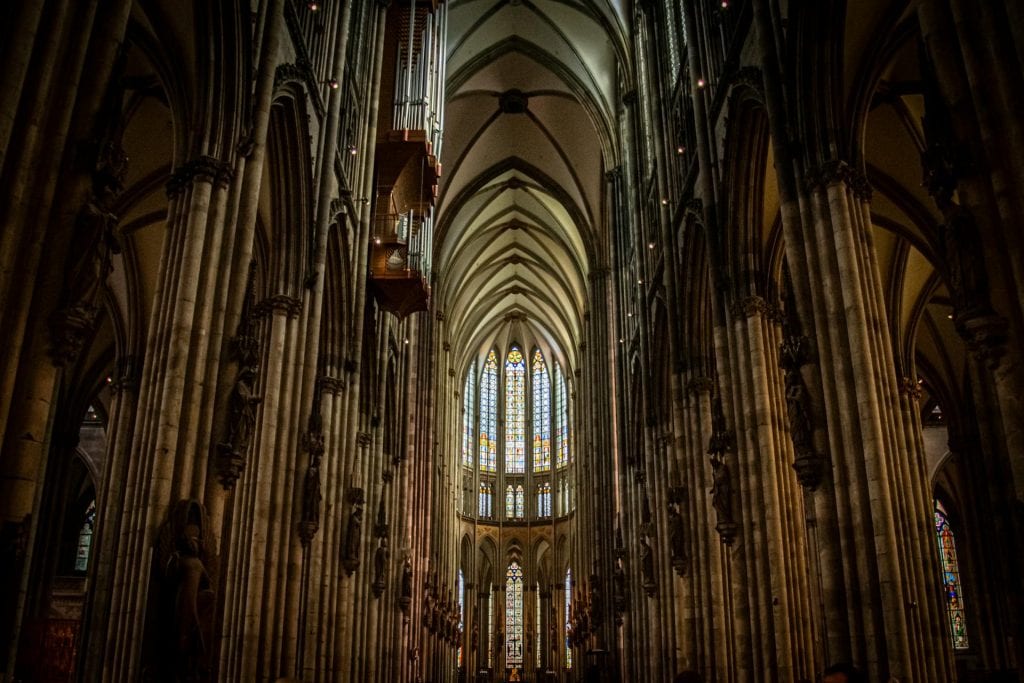
Gothic architecture features are best understood not as a list of isolated elements but as an integrated structural system. Each component depends on the others. Remove one, and the logic of the whole collapses.
The Pointed Arch
The pointed arch is the most visually recognisable Gothic element, but its significance is structural rather than decorative. Unlike the semicircular arch, which has a fixed relationship between span and height (the height is always half the span), the pointed arch can be adjusted. By varying the angle of the point, builders could span different widths while maintaining a consistent crown height across a vault.
This flexibility was critical. In a rectangular bay — where the nave span and the bay depth differ — a semicircular arch produces vaults of uneven height, creating awkward geometry and uneven load distribution. The pointed arch solved this, allowing consistent vault heights across bays of varying proportion.
Structurally, the pointed arch also directs thrust more vertically than a round arch of equivalent span. This reduces the lateral forces that the walls and buttresses must resist, enabling thinner supports and taller structures.
The Ribbed Vault
In a Romanesque groin vault, the entire surface is structural — the vault acts as a continuous shell, distributing loads across the full wall below. The Gothic ribbed vault works differently. Stone ribs are constructed first along the diagonal and transverse lines of the vault, forming a skeletal framework. The panels between the ribs (the webbing) are then filled in as relatively thin, non-structural infill.
This concentrates the vault’s loads onto discrete points — the spots where the ribs meet the supporting piers — rather than distributing them along the full length of the wall. The consequence is profound: the wall between those points no longer needs to carry significant load. It can be opened up. It can become glass.
Early Gothic churches typically used sexpartite vaults (six-part, with an intermediate transverse rib dividing each bay), while the mature High Gothic system settled on quadripartite vaults (four-part), which produced a more regular rhythm of bays and supports.
The ribbed vault also makes the structural logic of the building legible. You can look up and read how the loads travel — from rib to pier to ground. The building explains itself. For medieval builders, this transparency was not merely practical; it reflected a conviction that divine creation is orderly and comprehensible, and that a church should mirror that clarity.
The Flying Buttress
The flying buttress is perhaps the most ingenious element of the Gothic system, and the one that most directly enabled the theological programme of light.
Even with pointed arches directing thrust more vertically, a tall vault still generates significant lateral forces — particularly at the point where the vault meets the top of the nave wall. In a Romanesque building, this thrust is absorbed by the sheer mass of the wall itself. In a Gothic building, where the wall has been dissolved into glass, that mass is gone. The thrust must be transferred elsewhere.
The flying buttress does exactly this. It is an arched strut that reaches from an external pier (standing away from the building) to the precise point on the nave wall where the vault’s lateral thrust is concentrated. It catches that thrust and channels it down through the external pier to the ground.
By externalising the structural resistance, the flying buttress liberates the interior wall entirely. The nave elevation can become a continuous screen of glass from pier to pier. This is not a minor refinement — it is the structural move that made Sainte-Chapelle and the great clerestory windows of Chartres and Amiens physically possible.
Early flying buttresses were sometimes hidden beneath gallery roofs. By the High Gothic period, they were fully expressed and celebrated — acknowledged as both structurally essential and architecturally beautiful.
Clustered Piers and Continuous Mouldings
At ground level, the loads gathered by the vault ribs are received by clustered piers — compound columns made up of multiple shafts bundled together. Each shaft in the cluster corresponds to a rib or arch above, creating a visual and structural continuity from the vault down to the floor.
This bundling of shafts achieves two things. Structurally, it provides the necessary cross-section to handle the concentrated loads from multiple ribs converging at one point. Visually, it creates an unbroken vertical line from floor to vault — reinforcing the sense of upward movement and making the heavy stone appear almost weightless. The eye follows the shaft upward without interruption, and the building seems to lift.
Light as Material — Tracery and Stained Glass
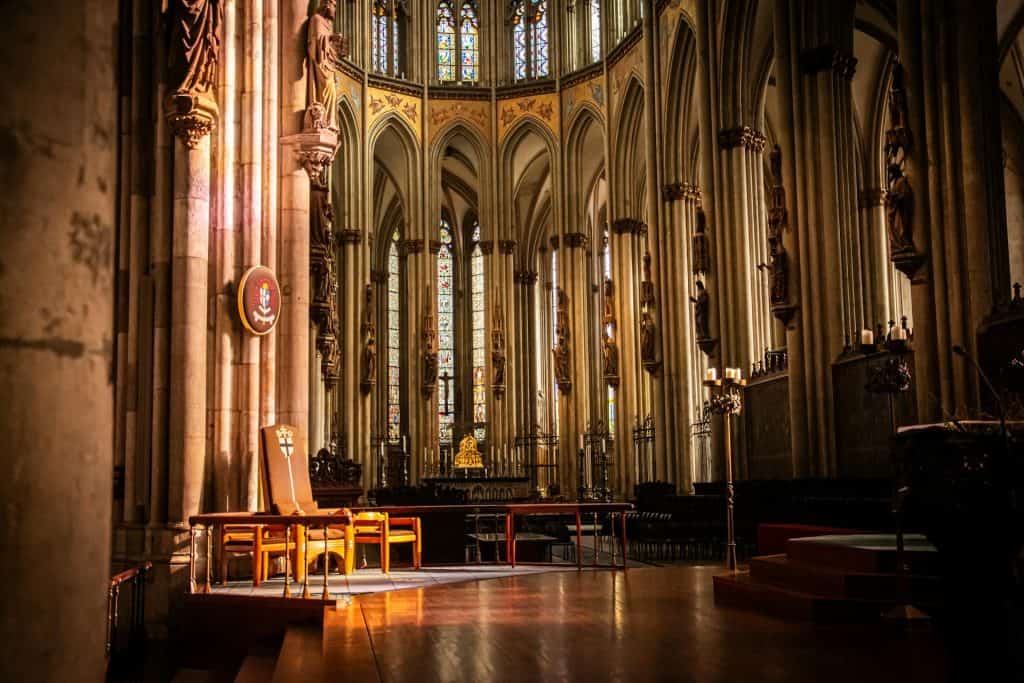
The entire Gothic structural system — pointed arches, ribbed vaults, flying buttresses — exists ultimately to do one thing: free the wall for light. And in the Gothic cathedral, light is not simply a practical consideration. It is the material through which the building achieves its spiritual purpose.
For Abbot Suger and the theologians who shaped the Gothic programme, the church interior bathed in coloured light was an image of the Heavenly Jerusalem described in Revelation — a city of jewelled walls where “the Lord God gives them light” (Revelation 22:5). The stained glass window was not decoration applied to a building; it was the building’s reason for being.
The Evolution of Tracery
As the structural system matured, the stone frameworks holding the glass — tracery — evolved dramatically:
Plate tracery (early Gothic) involves openings punched through a solid stone wall. The wall is still dominant; the glass is contained within it. The effect is relatively heavy.
Bar tracery (from the 1230s onward) reverses this relationship. Thin stone bars — mullions and curved elements — subdivide large openings into patterns. The stone becomes a slender framework; the glass dominates. This was a decisive shift, enabling windows of enormous scale.
Decorated and Flamboyant tracery (14th–15th century) pushed bar tracery into increasingly complex curvilinear patterns — flowing, flame-like forms that dissolved the boundary between structure and ornament.
Glass as Narrative
Stained glass in the Gothic cathedral served a didactic purpose alongside its luminous one. For a congregation that was largely illiterate, the windows taught Scripture, saints’ lives, and theological ideas through image and colour. The cathedral was a Bible in glass — a complete teaching instrument where every surface communicated.
The coloured light itself transforms the interior into something qualitatively different from ordinary space. Reds, blues, and golds shift through the day, marking time and season. The interior feels set apart — not of this world. This was entirely intentional. The cathedral was meant to be experienced as a threshold between earth and heaven.
Key examples of this programme at its most complete include Sainte-Chapelle in Paris (where the walls are almost entirely glass, the stone structure reduced to a minimal skeleton), the west rose and lancets at Chartres, and the Great East Window at York Minster — the largest expanse of medieval stained glass in England.
Verticality — Proportion, Scale, and Spiritual Aspiration
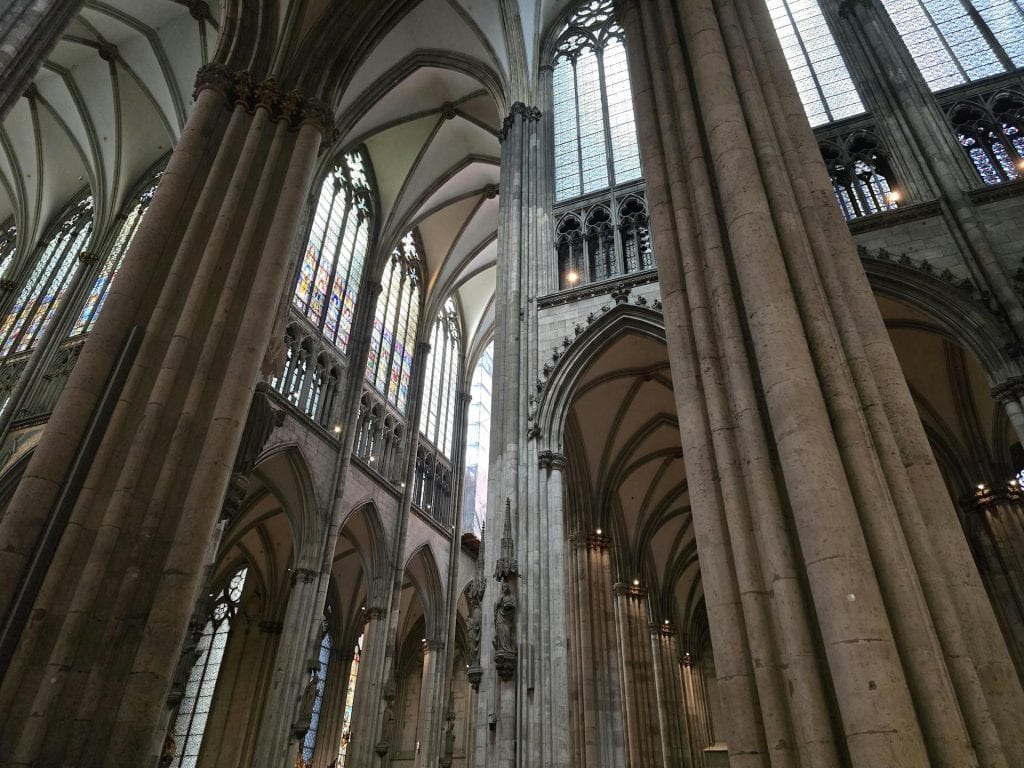
Gothic cathedrals are tall. Strikingly, almost irrationally tall. The nave of Amiens Cathedral reaches 42.3 metres — roughly the height of a fourteen-storey building. Beauvais attempted 48 metres before its vault partially collapsed in 1284.
This pursuit of height was not competition for its own sake, though civic pride certainly played a role. The primary motivation was theological. The vertical dimension draws the eye upward, away from the earthly plane and toward God. The individual standing in the nave is made small — not diminished, but placed in proper relationship to the divine. The building enacts a spatial theology: you are finite; God is infinite; look up.
How Verticality Is Achieved
Height in Gothic architecture is not simply a matter of building taller walls. It is produced through a coordinated set of design strategies:
Proportion — Gothic naves typically have height-to-width ratios of 3:1 or greater, compared to roughly 2:1 in Romanesque buildings. The section is dramatically compressed laterally, emphasising the vertical.
Continuous vertical lines — Clustered pier shafts rise without interruption from floor to vault, sometimes across multiple storeys. Horizontal elements (string courses, gallery levels) are minimised or visually subordinated.
Pointed forms — Arches, gables, pinnacles, and spires all terminate in points that direct the eye upward. Even the moulding profiles are designed to create shadow lines that emphasise verticality.
Proportional systems — Medieval builders used geometric systems (ad quadratum, ad triangulum) to determine the proportions of their elevations. These were not arbitrary; they were understood as reflecting the mathematical order that God had built into creation. The building’s geometry was a mirror of cosmic harmony.
Beauvais: The Limit
The Cathedral of Saint-Pierre at Beauvais represents the Gothic system pushed to — and beyond — its structural limits. The choir vault, completed in 1272, reached 48 metres. In 1284, portions of it collapsed. The failure was likely caused by inadequate pier spacing and insufficient buttressing for the extreme height. Beauvais was never completed; its truncated form stands as a reminder that material has limits, even when ambition does not.
Regional Variations — Not One Gothic, But Many
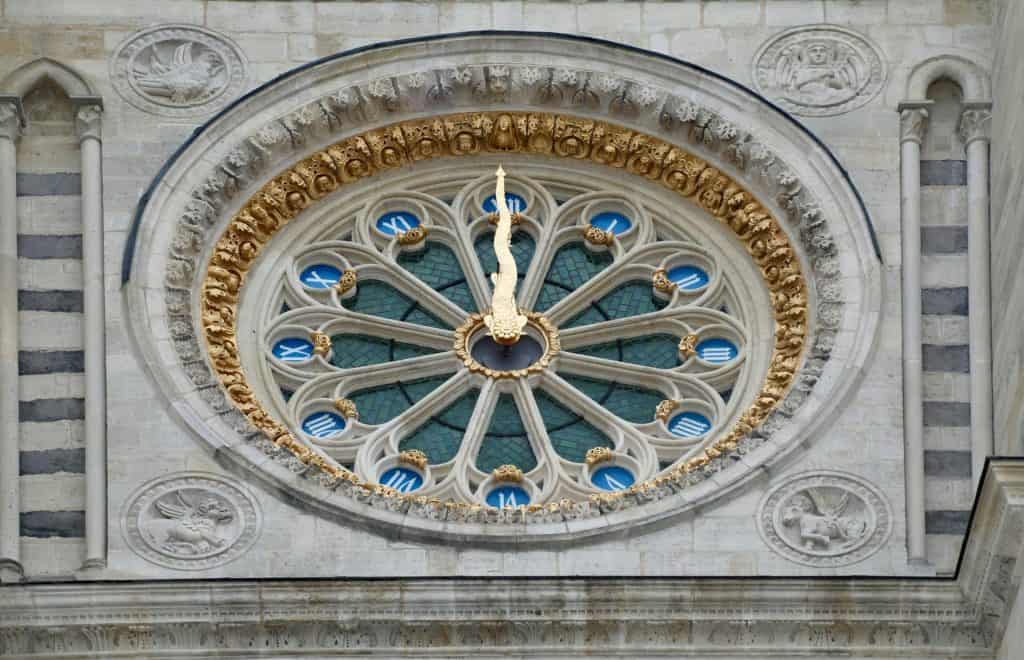
Gothic architecture originated in the Île-de-France but spread across Europe, adapting to local materials, traditions, liturgical needs, and theological emphases. The result is not one Gothic but several related traditions.
French Gothic
The French tradition — particularly the cathedrals of the Île-de-France — represents the “classic” Gothic system in its most resolved form. Chartres (begun 1194) established the template: three-storey elevation (arcade, triforium, clerestory), quadripartite vaults, fully developed flying buttresses, and an emphasis on height and structural clarity. Reims and Amiens refined this further.
French Gothic prioritises the unified, soaring interior volume. The structural system is expressed with confidence and consistency.
English Gothic
English Gothic developed its own distinct character, often prioritising length and horizontal elaboration over extreme height. English cathedrals tend to be longer, lower, and more additive in plan — with prominent transepts, retrochoirs, and Lady chapels extending the composition.
The English tradition is typically divided into three phases: Early English (lancet windows, restrained mouldings — Salisbury), Decorated (flowing tracery, complex vault patterns — Exeter), and Perpendicular (rectilinear tracery, fan vaults — Gloucester, King’s College Chapel Cambridge). The fan vault, a uniquely English invention, represents a late Gothic culmination where ribs spread from a single point in a cone-like form, producing surfaces of extraordinary geometric consistency.
Central European Gothic
In Central Europe, Gothic arrived somewhat later and often merged with local traditions. Prague’s Gothic heritage — exemplified by St Vitus Cathedral (begun 1344 under Matthias of Arras and later Peter Parler) — demonstrates the influence of French models filtered through Germanic and Bohemian sensibilities. Parler’s innovative net vaults and sculptural detailing represent a distinctly Central European contribution to the Gothic tradition. For more on how Gothic sits within Prague’s broader architectural layering, see our guide to Prague’s architectural styles.
Italian Gothic
Italian Gothic often diverges significantly from the northern European model. Churches tend to be wider, lower, and less structurally daring in terms of height. Walls remain more solid, often decorated with polychrome marble rather than dissolved into glass. The mendicant orders (Franciscans, Dominicans) prioritised wide, open preaching halls over vertical aspiration — a different theological emphasis producing a different architecture. Milan Cathedral, begun in 1386, is the notable exception: a northern-influenced design that pursued height and tracery complexity on a scale unusual for Italy.
Key Buildings — A Structural Reference
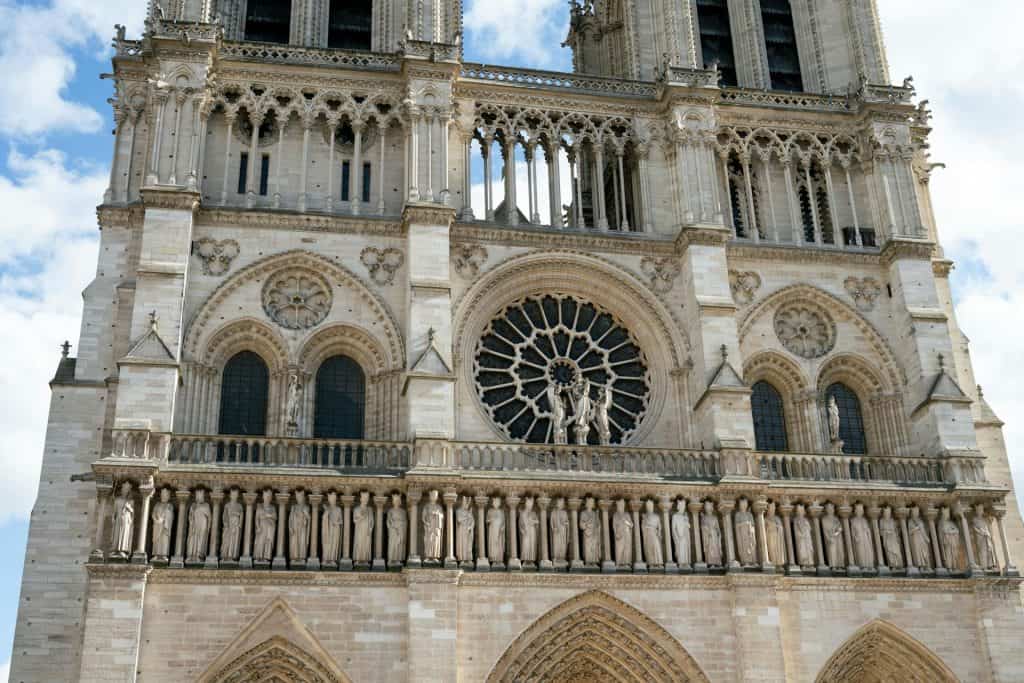
Abbey Church of Saint-Denis, Paris (1140–1144) — Origin point. Suger’s choir demonstrates the first coherent application of Gothic structural principles in service of a theology of light.
Chartres Cathedral, France (begun 1194) — The template for High Gothic. Three-storey elevation, flying buttresses, and an extraordinary programme of stained glass largely intact.
Sainte-Chapelle, Paris (1242–1248) — Dematerialisation taken to its logical extreme. The upper chapel is essentially a glass cage supported by the thinnest possible stone skeleton.
Amiens Cathedral, France (begun 1220) — The tallest complete Gothic nave in France (42.3m). Represents the High Gothic system at its most ambitious and resolved.
Beauvais Cathedral, France (choir completed 1272) — The structural limit. Partial collapse in 1284 demonstrated that Gothic ambition had outrun material capacity.
Salisbury Cathedral, England (1220–1258) — English Early Gothic at its purest. Horizontal emphasis, lancet windows, and a unified construction campaign producing unusual stylistic consistency.
King’s College Chapel, Cambridge (1446–1515) — The fan vault as Late Gothic culmination. A single vast space roofed by one of the most geometrically refined vault systems ever constructed.
St Vitus Cathedral, Prague (begun 1344) — Central European Gothic. Peter Parler’s net vaults and triforium gallery represent innovative departures from French models.
Milan Cathedral, Italy (begun 1386) — An anomaly in Italian Gothic: northern European scale and tracery ambition applied in an Italian context, with a famously protracted construction history.
Gothic’s Legacy and Common Misreadings
Gothic architecture has been interpreted and misinterpreted repeatedly since its own era. The very name “Gothic” was a Renaissance insult — implying barbarism — applied retroactively to a tradition that its own builders would have simply called “the modern style” (opus modernum).
The “Dark Gothic” Myth
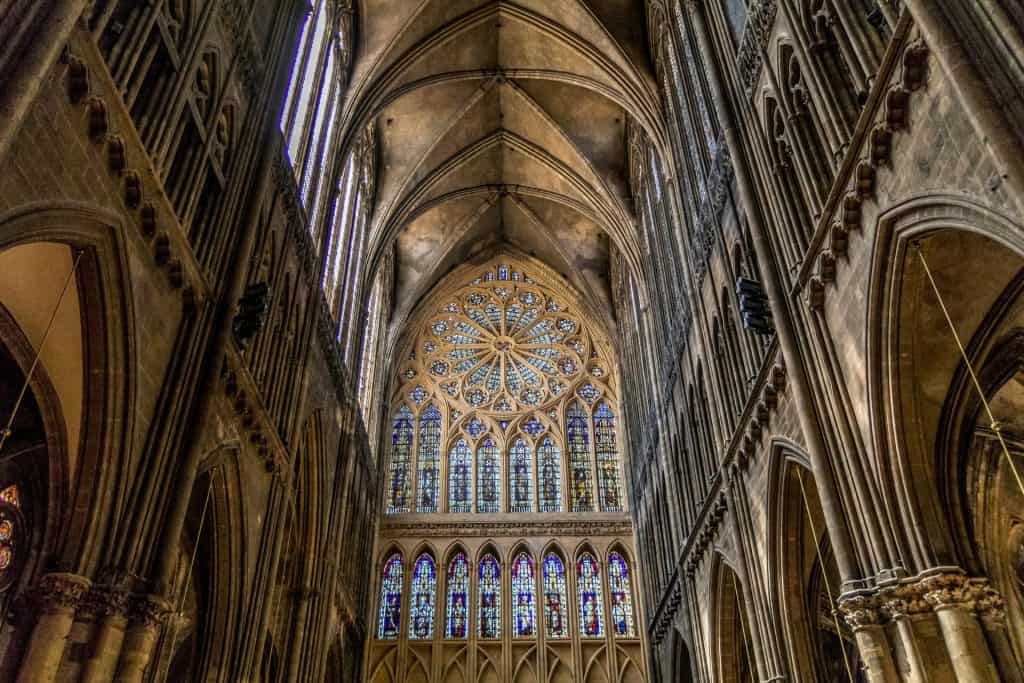
Perhaps the most persistent misconception is that Gothic buildings are dark, gloomy spaces. The opposite is true. The entire structural system was invented to maximise light. A well-preserved Gothic interior — particularly one retaining its original clear or coloured glass — is luminous. The association with darkness comes largely from centuries of grime, later alterations, and the influence of Gothic fiction, which borrowed the name but not the architecture.
Viollet-le-Duc and Structural Rationalism
In the 19th century, Eugène Viollet-le-Duc reinterpreted Gothic architecture as a proto-rational structural system — an early form of the structural expressionism that would later characterise modern architecture. His analysis was brilliant and influential, but it was also selective. By emphasising the engineering logic and downplaying the theological programme, Viollet-le-Duc made Gothic legible to a secular, industrialising age — but at the cost of stripping away the faith that had motivated every structural decision.
Gothic architecture was not built by proto-engineers who happened to work for the Church. It was built by believers — master masons, clergy, and communities — who understood structural innovation as a means of glorifying God. To read Gothic purely as engineering is to misunderstand it as fundamentally as reading it purely as decoration. The broader trajectory of Christian architecture makes this continuity of faith and form clear across multiple periods.
Gothic Revival
The 19th-century Gothic Revival — from Pugin to the great Victorian churches — represents a conscious attempt to recover Gothic principles for a new age. This is a substantial topic in its own right, deserving separate treatment.
Conclusion
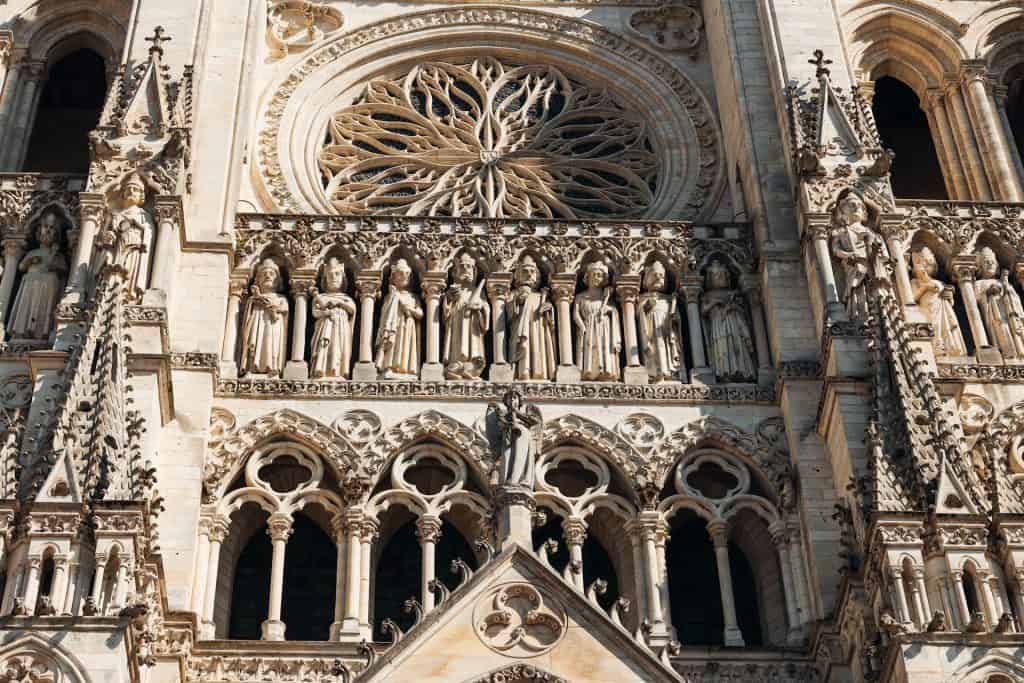
Gothic architecture demonstrates something that contemporary practice often struggles to articulate: that structure and meaning need not be separate concerns. Every pointed arch, every flying buttress, every ribbed vault in a Gothic cathedral exists simultaneously as an engineering solution and as an act of faith. The builders were not decorating structure or engineering decoration — they were doing one thing, and that thing was building a space worthy of the presence of God.
For architects and students today, Gothic remains instructive not as a style to revive but as a precedent for architecture where technical innovation serves a larger purpose. The question it poses is still live: can a building embody something beyond its programme and its material? The Gothic builders answered yes, and built the proof.

Recent Posts
How to Use Textures in Architectural Renders: Where to Find Them and How to Apply Them
Free Architecture Cutouts: Where to Find Them and How to Use Them in Renders
Architectural Diagrams: 15 Styles and Examples for Your Next Presentation