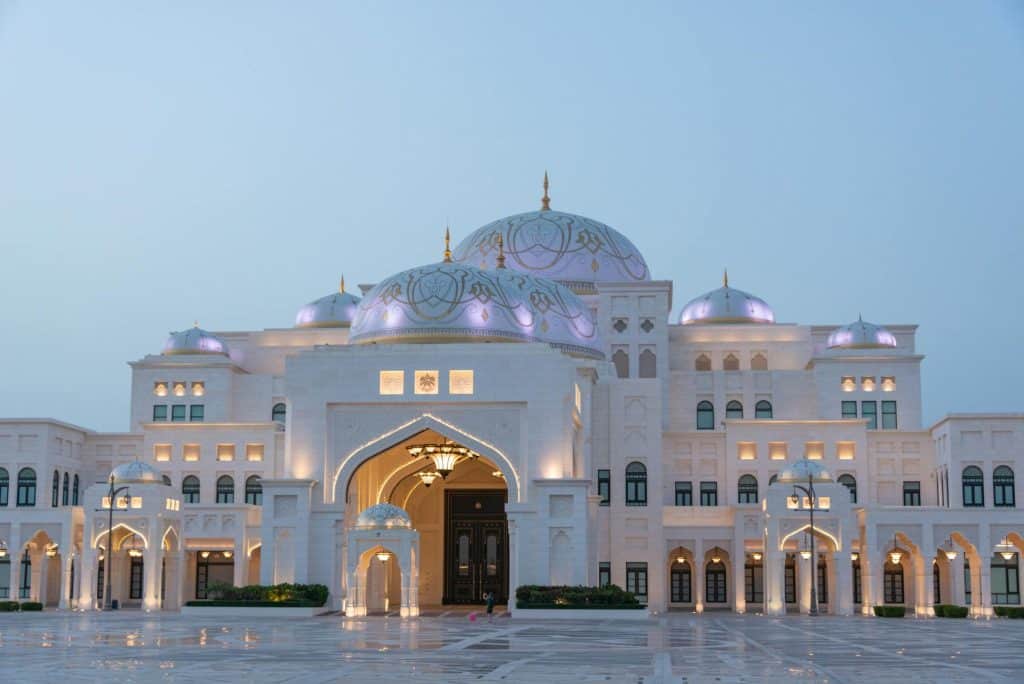
Abu Dhabi Architecture: Key Buildings, Design Strategies and What Architects Can Learn
Abu Dhabi is often overshadowed by Dubai in architectural conversations. Dubai’s skyline — defined by supertall towers, artificial islands and spectacle-driven development — tends to dominate discussions about architecture in the UAE. But Abu Dhabi has pursued a fundamentally different path, one that rewards closer attention from architects and architecture students alike.
Where Dubai has largely prioritised vertical ambition and commercial iconography, Abu Dhabi has invested heavily in cultural institutions, contextual design responses and long-term urban planning. The results are some of the most compelling architectural precedents in the Gulf region — buildings that grapple seriously with climate, identity and programme rather than simply competing for height or novelty.
This guide examines the key buildings that define Abu Dhabi architecture, the design strategies that connect them, and what practising architects and students can take from the city as a case study.
Climate and Context as Design Drivers
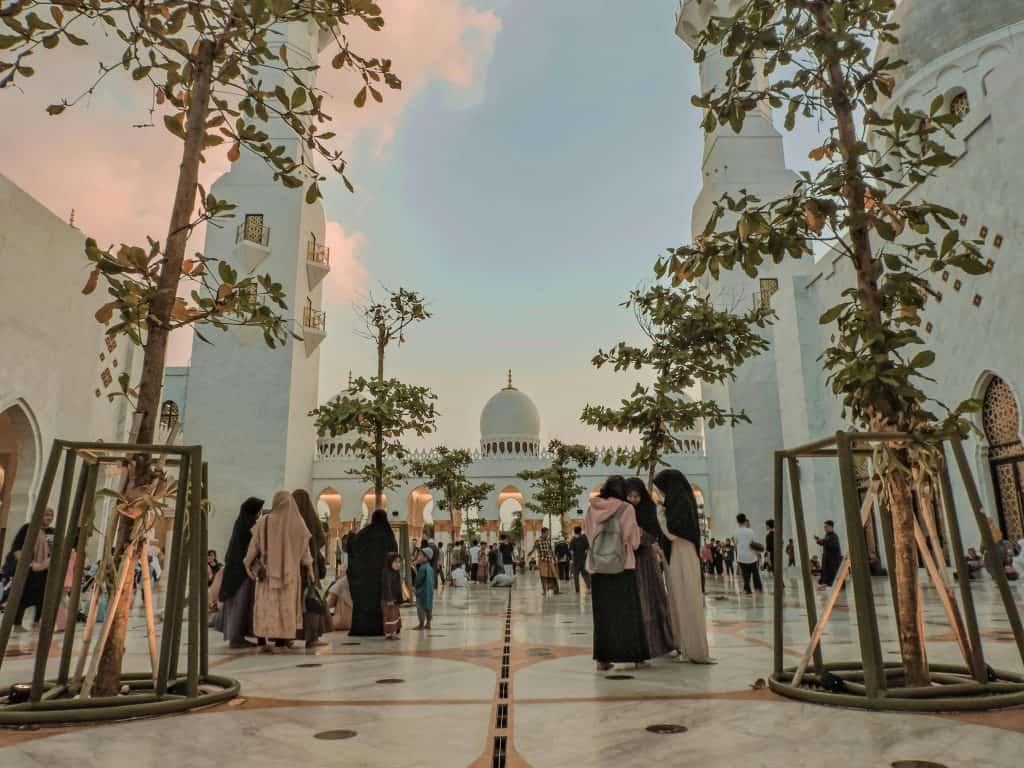
Any serious discussion of Abu Dhabi architecture has to start with climate. The city sits on a coastal island in the Arabian Gulf, subject to extreme summer temperatures regularly exceeding 45°C, intense solar radiation, high humidity and occasional sandstorms. These are not background conditions — they are primary design drivers that shape every credible architectural response in the region.
Traditional Emirati architecture developed sophisticated strategies for these conditions long before mechanical cooling. Courtyard planning created shaded, ventilated microclimates at the heart of buildings. Wind towers (barjeel) captured and directed prevailing breezes into interior spaces. Thick masonry walls provided thermal mass. Narrow streets and clustered building forms maximised shade at the urban scale.
What makes Abu Dhabi’s contemporary architecture worth studying is how these principles reappear — sometimes literally, sometimes abstractly — in modern projects. The responsive façade of Al Bahar Towers draws directly on the mashrabiya screen tradition. The Louvre Abu Dhabi’s dome functions as a vast shading canopy. Even in buildings by international architects with no direct connection to the region, the climate forces a reckoning with environmental mediation that produces genuinely interesting architecture.
There is also a deliberate cultural agenda at work. Abu Dhabi’s government has used architecture — particularly its programme of major cultural commissions — as a tool for nation-building and identity formation. The buildings on Saadiyat Island are not simply museums and galleries; they are statements about how the emirate sees itself and wants to be seen. This gives the architecture a layer of intentionality that goes beyond the typical client brief.
Key Buildings and Precedents in Abu Dhabi
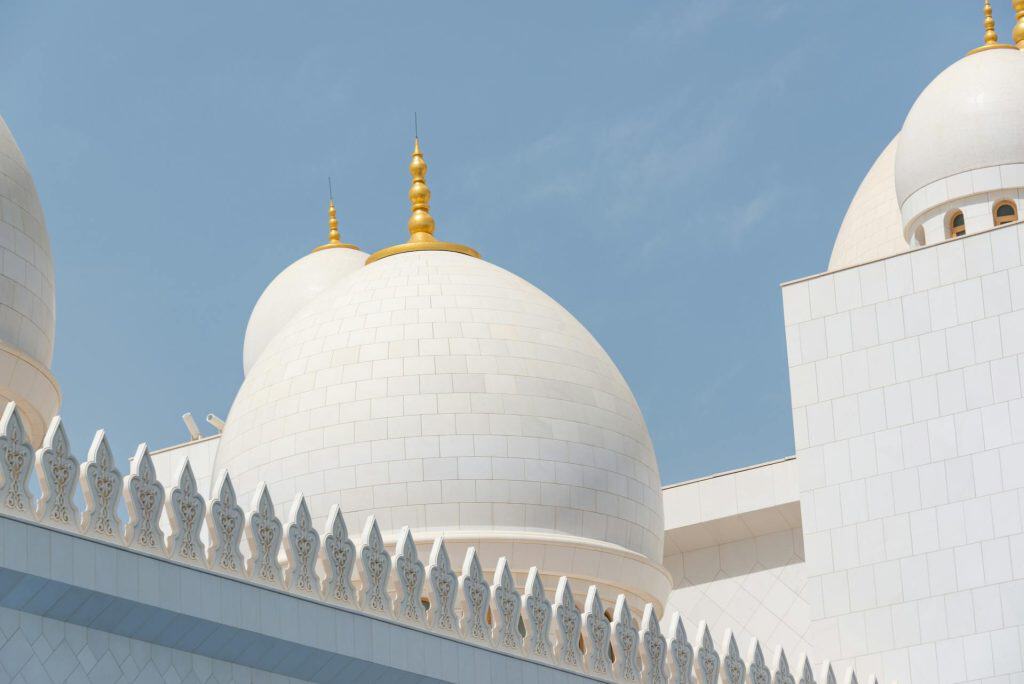
The following buildings represent the most architecturally significant projects in Abu Dhabi. Each is treated here as a concise case study, focusing on the design moves and strategies that make them valuable precedents.
Sheikh Zayed Grand Mosque
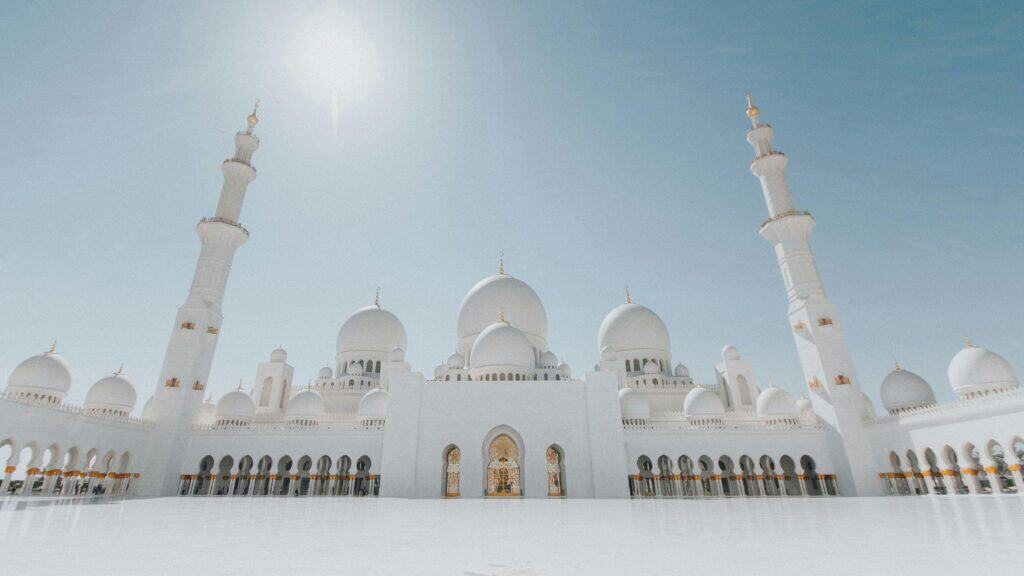
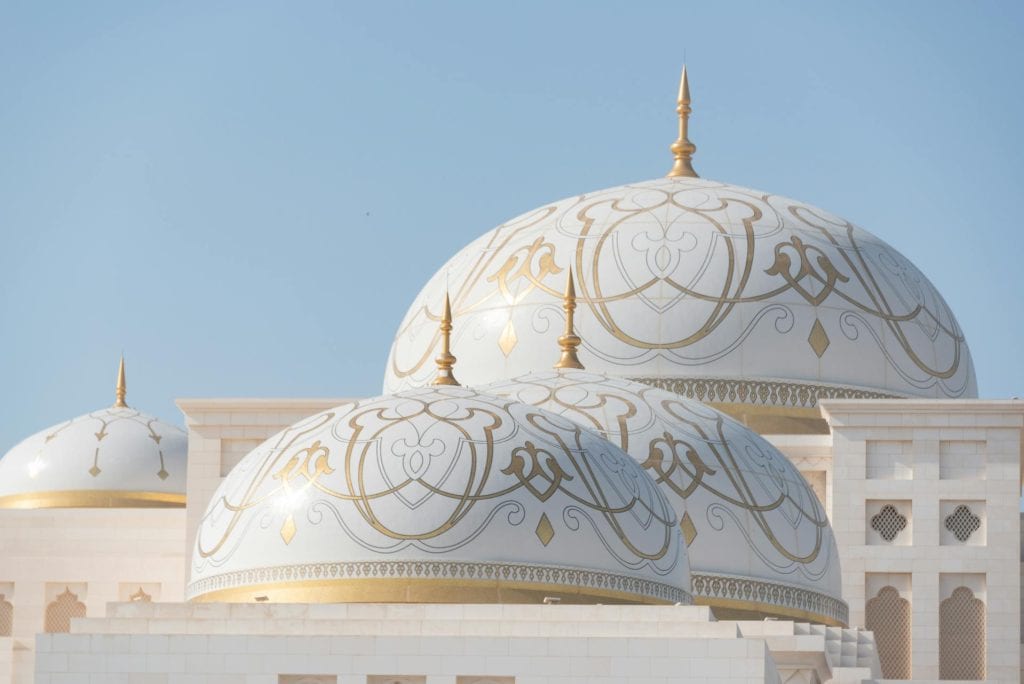
Completed in 2007, the Sheikh Zayed Grand Mosque is Abu Dhabi’s most recognised building and one of the largest mosques in the world. It accommodates over 40,000 worshippers and covers approximately 12 hectares.
The mosque’s design draws on a broad range of Islamic architectural traditions rather than adhering to a single regional style. Moorish horseshoe arches, Ottoman-scale domes, Mughal-influenced inlaid floral patterns and Fatimid geometric motifs all coexist within a unified composition clad predominantly in white Macedonian marble. The result is a kind of pan-Islamic synthesis — an architectural argument that Islamic design traditions share a common language across geography and history.
For architects, the most instructive aspects are the material strategy and the handling of scale. The marble cladding, semi-precious stone inlays and gold-plated detailing create a coherent material palette that manages the building’s enormous scale without losing legibility. The 82 domes, graduated in size, establish a clear hierarchy that guides movement and orientation across the complex. The main prayer hall’s dome — roughly 33 metres in diameter — uses a double-shell structure that allows natural light to wash the interior.
As a precedent, the mosque is most useful for studying how traditional geometric and ornamental systems can operate at contemporary scales, and how material consistency can unify a very large and complex composition.
Louvre Abu Dhabi
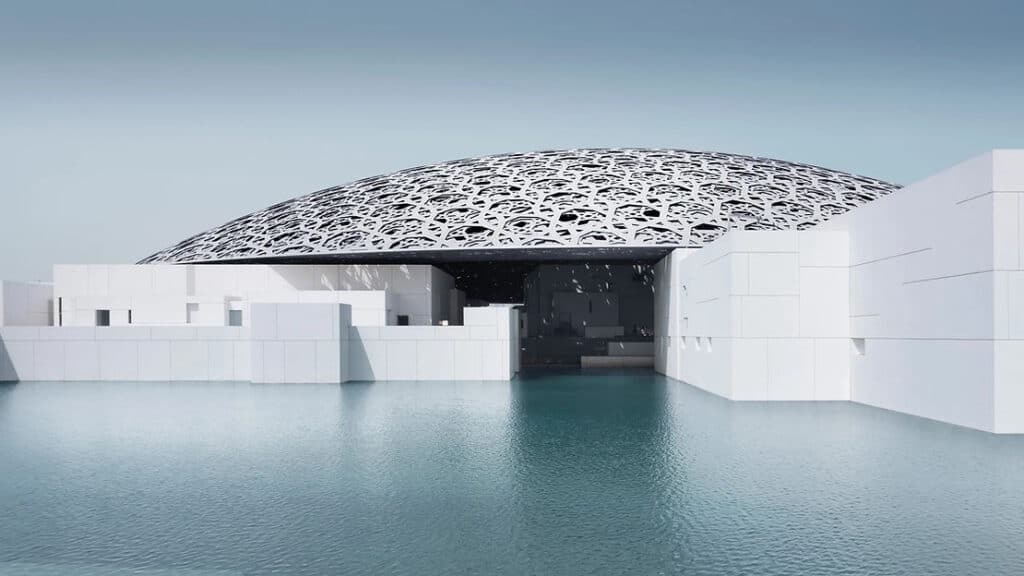
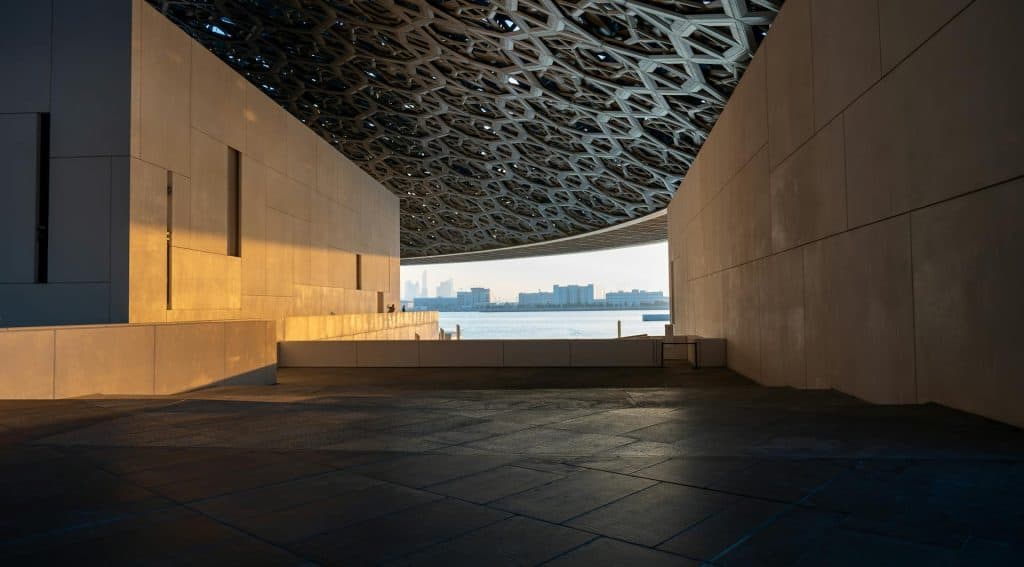
Jean Nouvel’s Louvre Abu Dhabi, which opened in 2017 on Saadiyat Island, is arguably the most architecturally significant building in the emirate. The design centres on a vast shallow dome — approximately 180 metres in diameter — that hovers above a cluster of gallery volumes arranged to evoke the spatial character of an Arab medina.
The dome is the key architectural move. Composed of eight layered steel and aluminium structures, its perforated geometric pattern filters sunlight into what Nouvel described as a “rain of light” — dappled, shifting illumination that references the effect of light passing through palm fronds or layered mashrabiya screens. This is environmental mediation elevated to the primary architectural gesture. The dome reduces solar gain across the complex while creating a microclimate beneath it, lowering temperatures and allowing semi-outdoor circulation between galleries.
The gallery buildings themselves sit in and around water, with channels running between them. The spatial sequence — moving between enclosed galleries, shaded outdoor passages and waterside walkways — produces a varied and atmospheric visitor experience that avoids the sealed-box monotony of many large museums.
For precedent research, the Louvre Abu Dhabi is essential reading on several fronts: museum typology in extreme climates, the dome as environmental device rather than purely structural or symbolic element, and the integration of landscape and water into institutional architecture. It also demonstrates how a building can reference local architectural traditions — the medina, the mashrabiya, the shaded souk — without resorting to pastiche.
Al Bahar Towers
The Al Bahar Towers, designed by Aedas and completed in 2012, are a pair of 25-storey office towers on the Abu Dhabi–Al Ain highway. Their significance lies almost entirely in their façade system — one of the most widely published examples of climate-adaptive building skin in contemporary architecture.
Each tower is wrapped in a secondary screen of triangular units inspired by the traditional mashrabiya. These units are dynamic: they open and close in response to the sun’s movement, controlled by a building management system that tracks solar angles throughout the day. When closed, the units form a tessellated geometric screen that reduces solar gain by approximately 50 per cent compared to a conventional curtain wall. When open, they allow daylight and views.
The system is not merely decorative. It directly reduces cooling loads and glare, contributing to measurable energy performance improvements. The towers reportedly achieved a 40 per cent reduction in energy consumption for cooling compared to a standard glazed tower of equivalent size.
As a precedent, Al Bahar Towers are most valuable for studying responsive façade design, the translation of traditional screening elements into high-performance contemporary systems, and the integration of environmental engineering with architectural expression. The project demonstrates that climate-responsive design in the Gulf does not have to mean retreating behind blank walls — it can produce buildings that are visually dynamic precisely because they respond to their environment.
Qasr Al Hosn
Qasr Al Hosn is the oldest stone building in Abu Dhabi, with origins dating to the 1760s as a coral and sea-stone watchtower. It later expanded into a fort and served as the seat of the ruling Al Nahyan family. The site’s significance is as much historical as architectural — it is the symbolic heart of Abu Dhabi.
The contemporary intervention, designed by CEBRA and completed around 2018, involved the careful restoration of the historic fort alongside the design of a new cultural foundation building and public realm. The new structures use a restrained material palette — white concrete, simple geometric forms — that defers to the historic buildings without mimicking them. The landscape design creates a sequence of public spaces that connect the fort to the surrounding city fabric.
For architects, Qasr Al Hosn is a useful precedent for heritage-adjacent design — how to insert contemporary architecture into a historically sensitive context in a way that is respectful but not timid. The project also illustrates the challenges of preservation in a city where almost everything else has been built within living memory, making the few surviving historic structures carry an outsized cultural burden.
Zayed National Museum
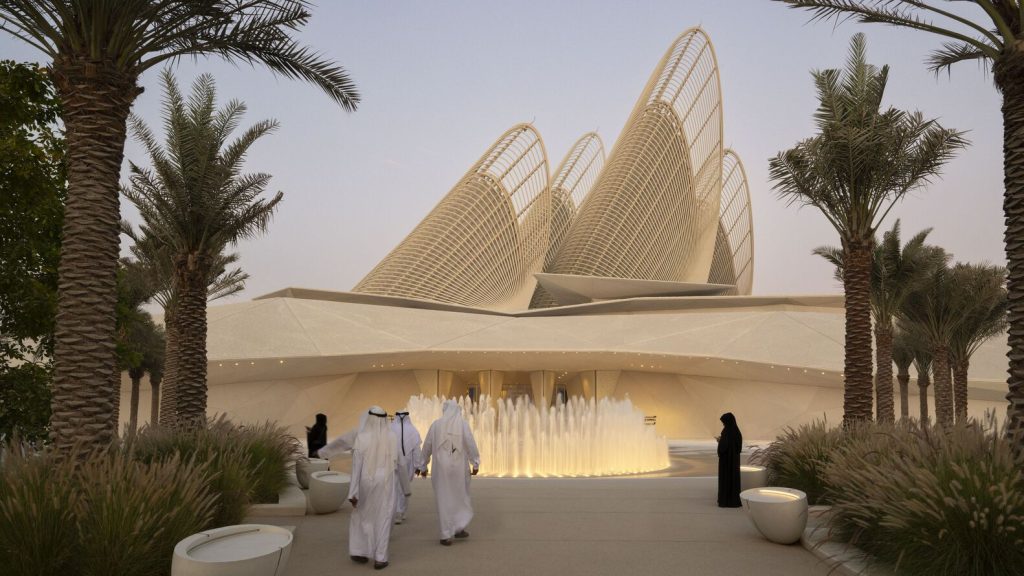
Designed by Foster + Partners, the Zayed National Museum is planned as the centrepiece of Saadiyat Island’s Cultural District. The design features five wing-shaped steel towers rising from a low-slung base, inspired by the feathers of a hawk — a bird of deep cultural significance in Emirati heritage.
The towers are not purely sculptural. They are designed to function as solar thermal chimneys, drawing hot air upward and out of the building to assist with natural ventilation of the spaces below. The base building is partially buried, using the thermal mass of the earth to moderate interior temperatures. These passive environmental strategies are integrated into the building’s formal language rather than applied as technical afterthoughts.
The museum’s programme focuses on the life and vision of Sheikh Zayed bin Sultan Al Nahyan, the founding father of the UAE. The architecture is explicitly intended to embody cultural narrative — the hawk towers as symbols of Emirati identity, the environmental strategies as expressions of a relationship with the desert landscape.
As a precedent, the Zayed National Museum is worth studying for its approach to embedding cultural symbolism in environmental design strategy, and for the way Foster + Partners have attempted to make passive cooling systems the defining formal gesture of a major public building.
Guggenheim Abu Dhabi
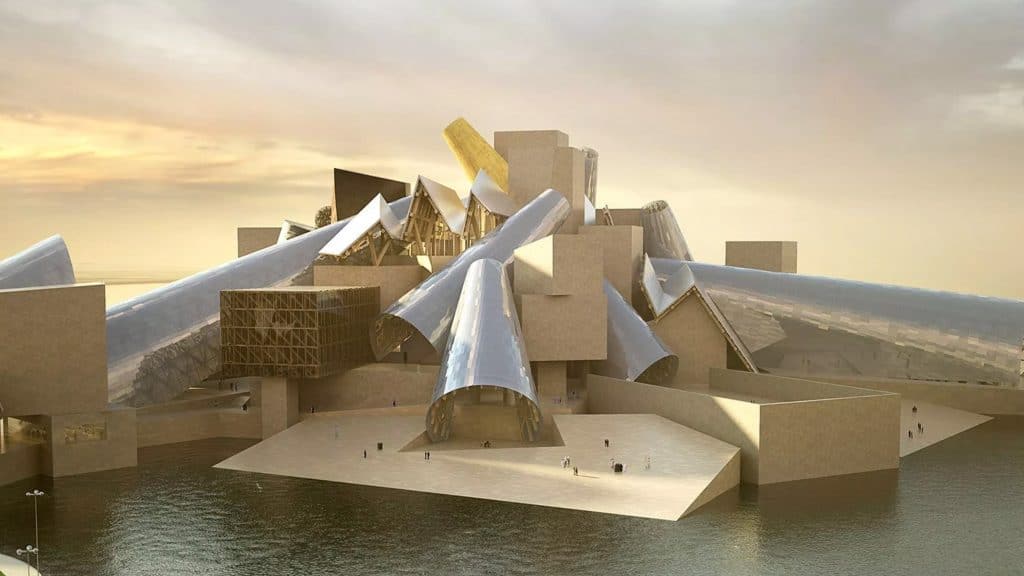
Frank Gehry’s Guggenheim Abu Dhabi, also on Saadiyat Island, has had a protracted development history since its announcement in 2006. The design features Gehry’s characteristic sculptural massing — a cluster of angular, intersecting volumes arranged around a central atrium — but adapted to the Abu Dhabi context with cone-shaped forms that reference wind towers and industrial vernacular.
The building is designed to house contemporary art across a series of galleries of varying scale, from intimate rooms to vast industrial-sized halls. The massing strategy creates a loose, almost village-like arrangement that allows natural light and ventilation to penetrate between volumes.
While the building’s extended timeline has invited scepticism, the Guggenheim Abu Dhabi remains significant as a case study in how signature architectural language adapts (or resists adaptation) to radically different climatic and cultural contexts. It also raises broader questions about the starchitect model of cultural development — questions that apply across the entire Saadiyat Island programme.
Saadiyat Island Cultural District: Architecture as Nation-Building
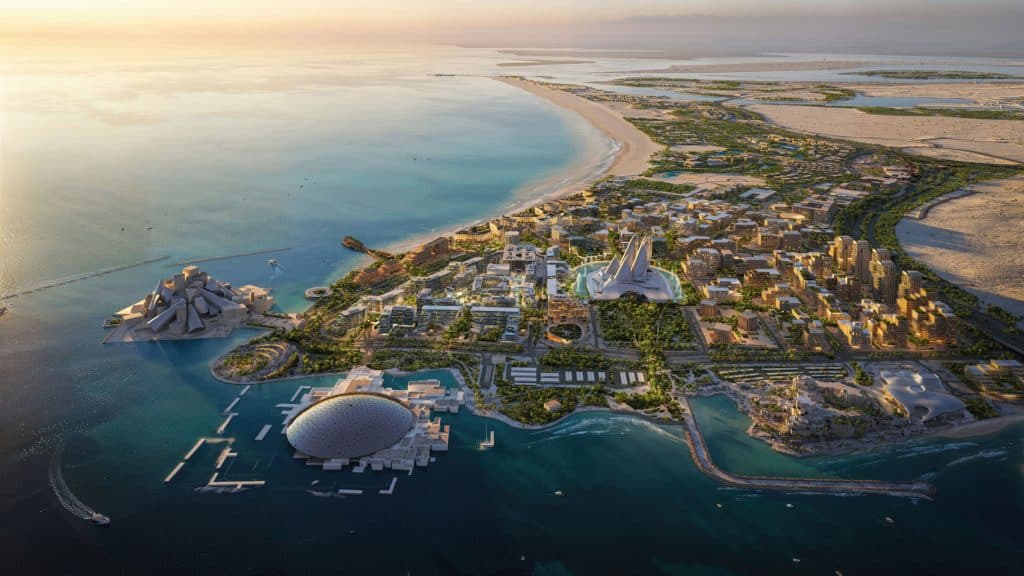
Saadiyat Island deserves discussion at the urban scale, not just building by building. The Cultural District masterplan concentrates major commissions by Jean Nouvel, Frank Gehry, Foster + Partners, and Tadao Ando (whose Maritime Museum is also planned for the island) within a single precinct. This is an extraordinary concentration of Pritzker Prize-winning talent directed at a single urban vision.
The strategy is deliberate. Abu Dhabi has used architecture — specifically, architecture by globally recognised figures — as a tool for cultural positioning. The buildings are intended to establish the emirate as a serious cultural destination, distinct from Dubai’s commercially oriented development model.
There is a legitimate critique here. Concentrating iconic buildings by international architects does not automatically produce vibrant urban life. The spaces between the buildings — the streets, the public realm, the everyday infrastructure — matter as much as the landmarks themselves. Whether Saadiyat Island’s Cultural District will function as a living piece of city or remain a collection of destination buildings visited individually is a question that will only be answered over time as the district matures.
For architects, the masterplan is a valuable case study in cultural infrastructure planning and the opportunities and limitations of architecture-led placemaking. It is also a frank example of how governments use architectural commissions strategically — something worth understanding regardless of where you practise.
Recurring Design Themes in Abu Dhabi Architecture
Across these projects, several themes recur consistently enough to constitute a recognisable design culture:
Shading and environmental mediation as architectural expression. The most successful Abu Dhabi buildings do not treat sun protection as a technical problem to be solved invisibly. They make it the architecture. The Louvre’s dome, Al Bahar’s responsive screens, the Zayed National Museum’s solar chimneys — in each case, the environmental strategy is the primary design gesture. This is perhaps the most transferable lesson for architects working in any hot climate.
Tension between global architectural language and local identity. Every major project in Abu Dhabi navigates this tension. Some resolve it through abstraction — translating traditional elements like the mashrabiya or the courtyard into contemporary formal language. Others, like the Grand Mosque, engage more directly with historical vocabularies. None entirely escape the question, and the range of approaches makes Abu Dhabi a useful comparative study.
Scale of ambition versus human-scale experience. Abu Dhabi’s major buildings are large — often very large. The most successful manage to create intimate spatial moments within grand compositions. The Louvre Abu Dhabi achieves this through its medina-like plan of smaller gallery volumes beneath the dome. The Grand Mosque uses its graduated dome hierarchy and detailed surface treatments to give human-scaled texture to a monumental complex. Where this balance fails, the buildings can feel impressive but uninhabited.
Material choices in extreme heat. Stone, concrete, glass-reinforced concrete (GRC), aluminium and steel dominate. Glass is used carefully and almost always mediated by secondary screening or deep shading. White and light-coloured finishes are prevalent for obvious thermal reasons but also contribute to the visual coherence of the city’s architectural identity. The material palette is constrained by climate, but that constraint produces a disciplined consistency that many cities lack.
What Architects and Students Should Take From Abu Dhabi
Abu Dhabi is not a typical city to study. Its wealth, its pace of development and its government-led commissioning model create conditions that most architects will never work within directly. But the architectural questions the city raises are universal.
How do you design for extreme climate without retreating into sealed, air-conditioned boxes? How do you reference architectural tradition without producing pastiche? How do you use architecture to express cultural identity without reducing it to decoration? How do you make monumental buildings feel humane?
The best Abu Dhabi architecture answers these questions with real conviction. The Louvre Abu Dhabi is a masterclass in environmental design as spatial poetry. Al Bahar Towers prove that performance-driven façades can be architecturally compelling. The Zayed National Museum attempts to make passive cooling the defining formal idea of a national institution.
For architecture students undertaking precedent research, Abu Dhabi offers a concentrated set of case studies where climate, culture and ambition intersect at the highest level. For practising architects, particularly those working in hot climates or on cultural projects, the city’s buildings provide tested strategies and honest lessons — both in what succeeds and in what remains unresolved.
Abu Dhabi architecture deserves to be studied on its own terms, not as a footnote to Dubai. The buildings are there. They reward serious attention.
Recent Posts
Romanesque Architecture Explained: Arches, Mass, and Monastic Power
Neoclassical Architecture Explained: Order, Symmetry, and Democratic Ideals
Abu Dhabi’s Architectural Identity: Key Buildings, Design Strategies & What Architects Can Learn