Rammed Earth Architecture: Process, Performance, and Contemporary Projects
One of humanity's oldest construction techniques is experiencing a genuine resurgence in contemporary architectural practice. Rammed earth — compacted layers of raw earth built up within formwork — has been used for thousands of years. Sections of the Great Wall of China were built with it. The foundations of the Alhambra sit on it. Entire villages across North Africa, the Middle East, and southern Europe have stood in it for centuries.
Yet this is not a story about nostalgia. Today, leading firms are specifying rammed earth for its exceptional thermal mass, low embodied carbon, and the raw, stratified aesthetic that no other material can replicate. As the profession grapples with the carbon cost of conventional construction, earth building offers something increasingly rare: a structural material that can be sourced metres from the building site and requires no firing, no kiln, and minimal processing.
This article covers what rammed earth is, how it is constructed, its measurable performance characteristics, and a selection of contemporary projects that demonstrate its architectural potential.
What Is Rammed Earth?
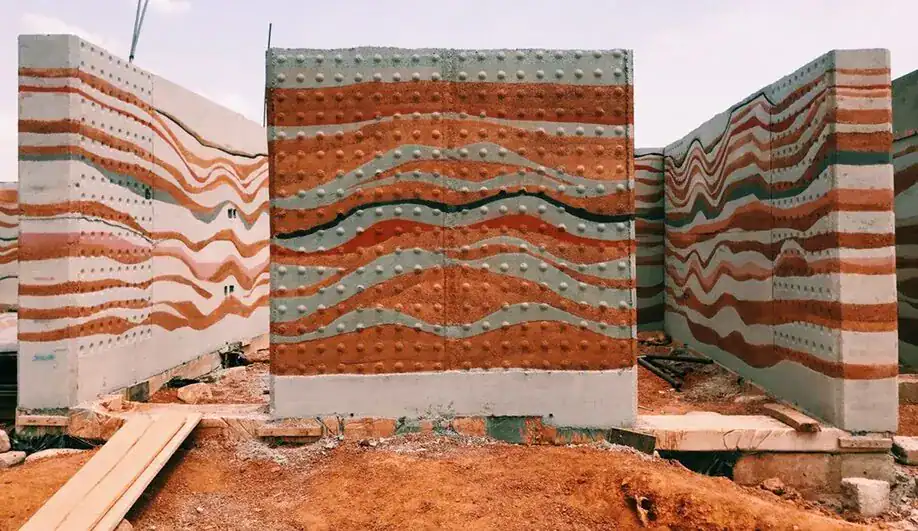
Rammed earth construction involves compacting a carefully proportioned mixture of subsoil — typically gravel, sand, silt, and clay — into formwork to create dense, load-bearing walls. The material is placed in successive layers (called lifts or courses), each compacted before the next is added. Once the formwork is stripped, the wall reveals its characteristic horizontal stratification: visible layers of compressed earth that record the construction sequence.
There are two primary categories:
Unstabilised rammed earth relies solely on the natural binding properties of clay within the soil mix. It contains no cement or chemical additives. This is the traditional method, still widely used in arid and semi-arid climates where moisture exposure is limited.
Stabilised rammed earth (SRE) incorporates a small percentage of Portland cement (typically 5–10% by weight) or occasionally lime into the mix. Stabilisation increases compressive strength, improves moisture resistance, and allows the technique to be used in wetter climates and regions with more demanding structural codes.
Related techniques include pisé de terre (the French term often used interchangeably with rammed earth), compressed stabilised earth blocks (CSEB), and cob — though each has distinct construction methods and performance profiles. This article focuses specifically on monolithic rammed earth walls.
The Construction Process
Rammed earth construction is straightforward in principle but demands precision in execution. Each stage directly affects the finished wall's strength, durability, and appearance.
Soil Selection and Testing
Not all soils are suitable. The ideal mix contains approximately 15–25% clay (acting as the binder), 10–30% silt, and 45–75% sand and gravel (providing structure and reducing shrinkage). Too much clay causes cracking; too little means the wall won't hold together.
Before construction begins, soil samples undergo particle size distribution analysis and Proctor compaction testing to determine the optimal moisture content for maximum density. On many projects, locally excavated soil is blended with imported aggregates to achieve the correct proportions — site excavation material from foundations can sometimes be used directly.
Formwork
Contemporary rammed earth uses rigid formwork — typically steel-framed panels or heavy timber — bolted together to define the wall profile. Formwork must resist significant lateral pressure during compaction without deflecting. Modern systems use modular panels that can be repositioned efficiently, similar in concept to concrete formwork but designed for the shorter pour heights and manual access that rammed earth requires.
Wall thicknesses typically range from 300 mm to 600 mm, depending on structural requirements and thermal performance targets.
Mixing and Moisture Content
The earth mix is prepared to a precise moisture content, usually between 10–12%. This is well below what most people would consider "wet" — the material should clump when squeezed in the hand but not release free water. Too wet, and the wall won't compact properly and may slump. Too dry, and layers won't bond to each other.
Mixing is typically done with front-end loaders or pan mixers on site. Pigments — iron oxides,ite powiteite powite powite powders, or naturally coloured soils — can be added at this stage to create deliberate colour variation between lifts.
Compaction
The prepared earth is placed into the formwork in loose layers of approximately 150–200 mm, then compacted down to around 100–150 mm using pneumatic rammers (backfill tampers). Traditional hand tamping is still used on some projects but is significantly slower.
Compaction is the critical operation. Each lift must be uniformly compacted to achieve consistent density — typically 95–98% of maximum dry density as determined by the Proctor test. Inadequate compaction creates weak planes; over-compaction can damage formwork.
Curing and Stripping
Formwork can usually be stripped within hours of compaction — the wall is self-supporting almost immediately, unlike concrete which requires days of curing in formwork. However, stabilised rammed earth benefits from moist curing over the following days to allow cement hydration, similar to concrete practice.
Surface Finishing
Most architects specify rammed earth walls to be left exposed, celebrating the natural layering and texture. Surfaces can be left raw, sealed with a breathable silane/siloxane treatment for moisture protection, or lightly rubbed to expose aggregate. The layered appearance is not decorative — it is a direct, honest expression of how the wall was made.
Performance Characteristics
Rammed earth is not simply an aesthetic choice. It has measurable performance characteristics that make it genuinely suitable — and in some contexts superior — for architectural applications.
Thermal Mass
This is rammed earth's standout property. A 300 mm stabilised rammed earth wall has a thermal lag of approximately 8–10 hours, meaning heat absorbed on the exterior face during the day is released to the interior in the evening. In climates with significant diurnal temperature variation (hot days, cool nights), this passive thermal regulation can dramatically reduce mechanical heating and cooling loads.
The decrement factor — the ratio of internal temperature swing to external temperature swing — is typically 0.3–0.4 for a 300 mm wall. Combined with appropriate site planning and orientation, rammed earth walls can form the basis of a largely passive thermal strategy.
Embodied Carbon
Unstabilised rammed earth has an embodied carbon footprint of approximately 20–40 kg CO₂e per cubic metre — dramatically lower than concrete blockwork (approximately 120–180 kg CO₂e/m³) or fired clay brick (approximately 200–300 kg CO₂e/m³). Stabilised rammed earth is higher due to cement content, typically 80–120 kg CO₂e/m³, but still significantly below conventional masonry.
When soil is sourced from site excavation, transport emissions are negligible. The material requires no firing, no chemical processing, and no factory production.
Structural Capacity
Compressive strength varies significantly with mix design and stabilisation:
- Unstabilised rammed earth: 1–4 MPa
- Stabilised rammed earth (6–8% cement): 5–15 MPa
For context, standard concrete blockwork achieves 7–15 MPa. Rammed earth walls are load-bearing and can support roof and floor structures, though engineers typically design conservatively given the material's variability compared to factory-produced products.
Acoustic Performance
Mass is the primary driver of airborne sound insulation. A 300 mm rammed earth wall achieves an Rw rating of approximately 50–55 dB — comparable to a standard double-brick cavity wall. The density (typically 1,900–2,200 kg/m³) provides effective sound attenuation without additional linings.
Durability and Limitations
Rammed earth's primary vulnerability is sustained moisture exposure. Walls must be protected by adequate roof overhangs, raised foundations with damp-proof courses, and appropriate detailing at window sills and parapets. In consistently wet climates, stabilisation and surface sealers become essential rather than optional.
Other limitations architects should consider:
- Seismic performance — Unreinforced rammed earth has limited tensile strength. In seismic zones, steel reinforcement, bond beams, or post-tensioning may be required.
- Wall thickness — 300–600 mm walls consume floor area. On tight urban sites, this can be a significant constraint.
- Labour intensity — Construction is slower than conventional masonry or framed systems. Specialist crews are essential for quality outcomes.
- Climate suitability — Best suited to arid, semi-arid, and temperate climates. Tropical or consistently wet regions require careful detailing or alternative earth-building methods.
Contemporary Projects
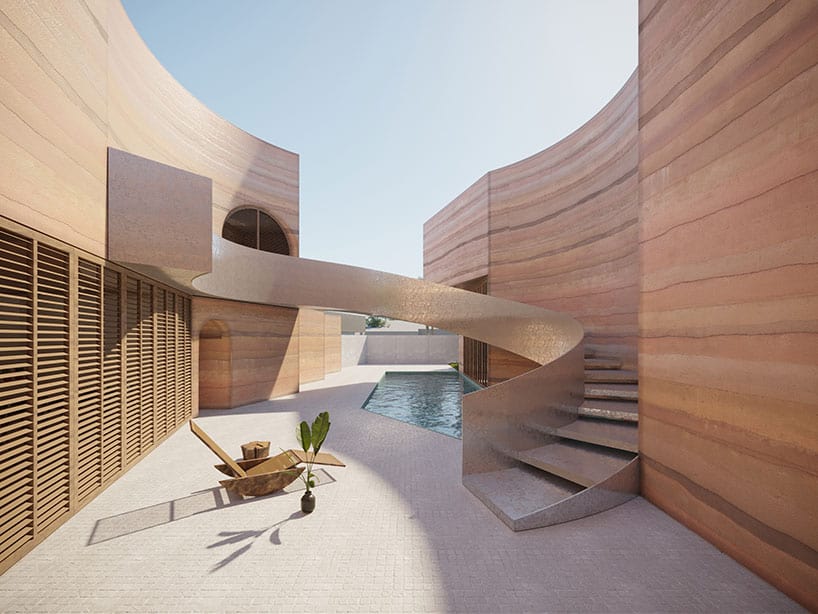
Rammed earth is not confined to rural owner-builder projects. The following examples demonstrate its application at scales and levels of refinement that place it firmly within mainstream architectural practice.
The Great Wall of WA — Luigi Rossini Architects, Western Australia
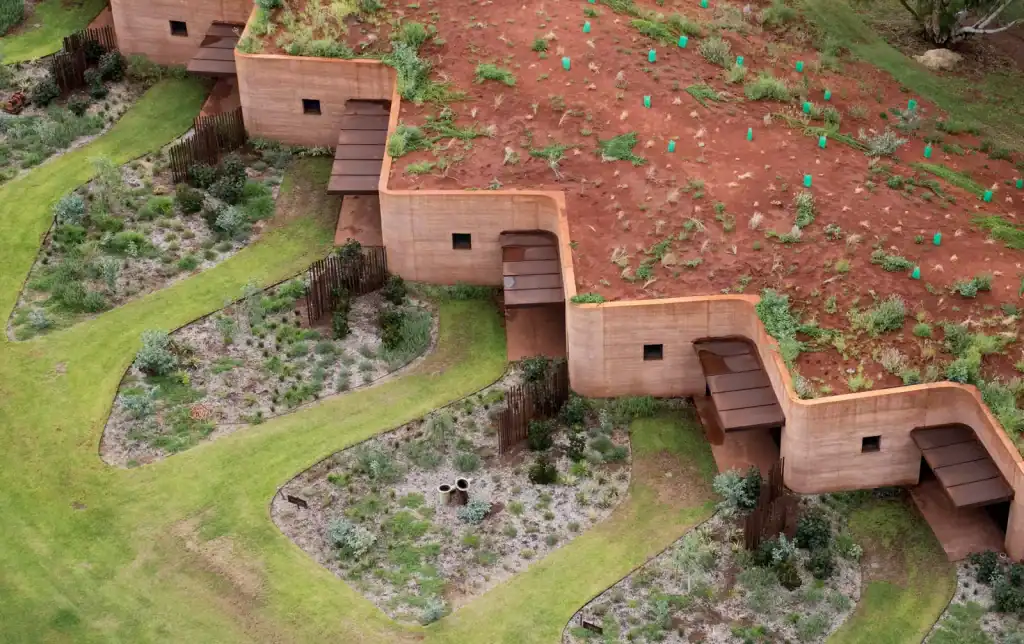
Perhaps Australia's most recognised rammed earth building, this residential project in the Pilbara region uses a 230-metre-long rammed earth wall as both structure and organising element. The wall anchors the house to the landscape, its ochre and red tones drawn directly from local soils. The extreme climate — temperatures regularly exceeding 40°C — makes rammed earth's thermal mass not merely desirable but essential to livability without excessive mechanical cooling.
Ricola Kräuterzentrum — Herzog & de Meuron, Laufen, Switzerland
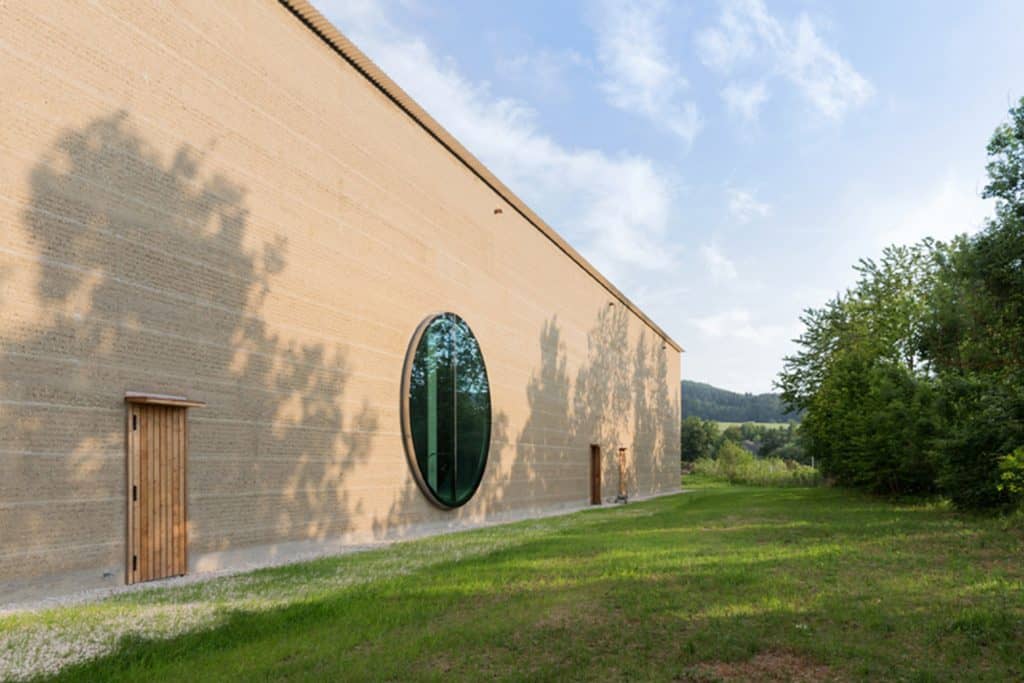
This herb storage and processing facility demonstrates rammed earth at an industrial scale rarely attempted. The walls — constructed by specialist contractor Martin Rauch — use locally sourced earth with carefully controlled pigmentation to create a monumental, layered facade. Herzog & de Meuron selected the material for its capacity to regulate internal humidity (critical for herb storage) and for the tectonic honesty it brings to a utilitarian programme. The project proved that rammed earth could meet Swiss building standards for a commercial structure.
Nk'Mip Desert Cultural Centre — HBBH Architects, Osoyoos, British Columbia
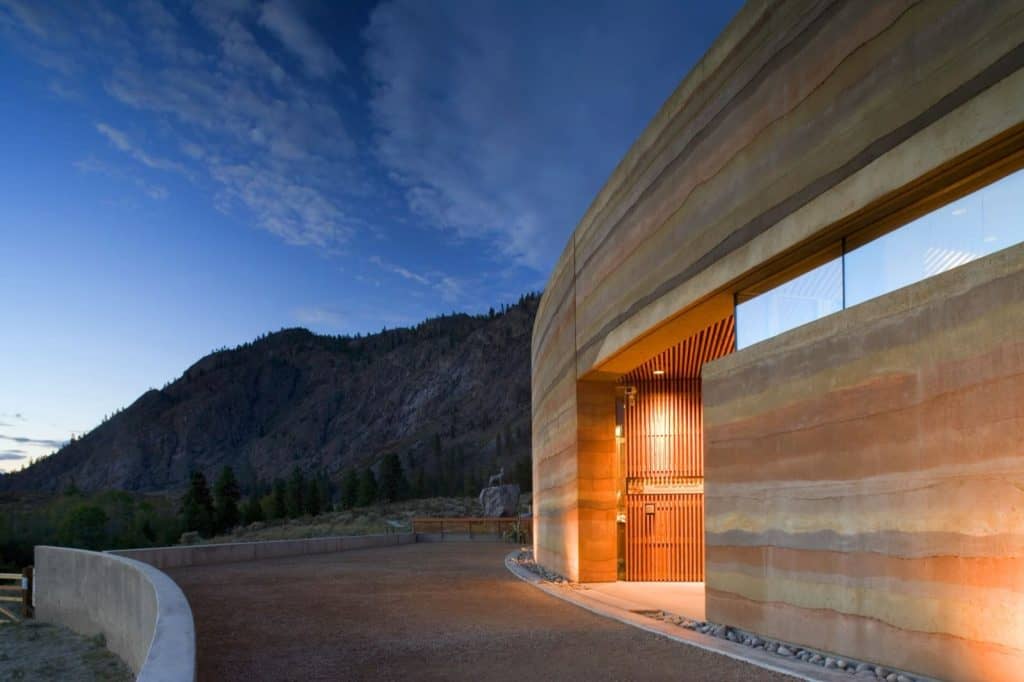
This cultural centre for the Osoyoos Indian Band features one of North America's largest rammed earth walls — approximately 80 metres long and nearly 6 metres high. The wall emerges from the desert landscape as a geological formation, blurring the boundary between building and terrain. The material choice connects the architecture to Indigenous building traditions while delivering contemporary performance. The earth tones and stratification reference the exposed geological strata visible throughout the surrounding desert.
House in Ajuda — Ricardo Bak Gordon, Lisbon, Portugal
A residential project that demonstrates rammed earth's viability in a European urban context. The house uses stabilised rammed earth walls as primary structure, with the material left exposed internally and externally. The project navigates Portuguese building regulations and demonstrates that rammed earth can satisfy contemporary code requirements for structural, thermal, and fire performance in a temperate maritime climate.
Earth House — BCHO Partners, South Korea
This residential project integrates rammed earth with a contemporary architectural language — clean geometries, large openings, and refined detailing. The earth walls provide thermal mass suited to Korea's continental climate (hot summers, cold winters) while the material's texture creates warmth and tactility in the interior spaces. The project demonstrates that rammed earth need not imply a rustic or vernacular aesthetic.
SIREWALL System — Various Projects, North America
Worth noting as a system rather than a single project, SIREWALL (Structural Insulated Rammed Earth) incorporates a layer of rigid insulation within the rammed earth wall profile, creating a thermally broken assembly that achieves both high thermal mass and high insulation values. This addresses one of rammed earth's traditional limitations in cold climates — that thermal mass alone cannot compensate for low R-values in heating-dominated conditions.
Specifying Rammed Earth: Practical Considerations
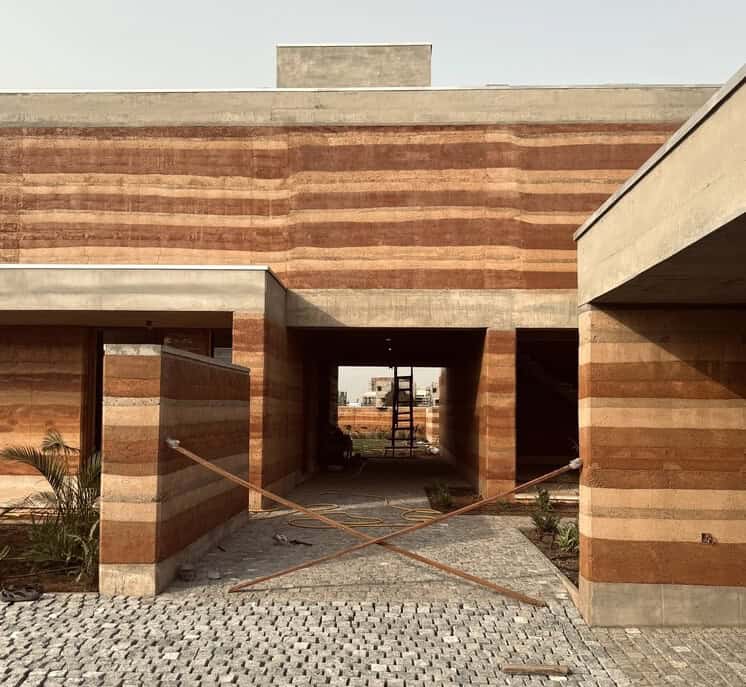
For architects considering rammed earth on a project, several practical realities shape the specification process.
Finding Specialist Contractors
Rammed earth requires experienced crews. The quality difference between specialist rammed earth contractors and general builders attempting the technique is stark and immediately visible in the finished wall. In Australia, a small but established network of specialist contractors operates primarily in Western Australia, South Australia, and Victoria. Internationally, firms like Lehm Ton Erde (Martin Rauch's studio in Austria) and SIREWALL in Canada have developed proprietary systems with documented performance data.
Standards and Codes
In Australia, the primary reference is the Australian Earth Building Handbook (HB 195), supplemented by the New Zealand Standard NZS 4298. These documents provide guidance on mix design, testing, structural design, and durability requirements. In many jurisdictions, rammed earth still requires performance-based assessment rather than deemed-to-satisfy compliance — meaning engineering certification is typically required.
Cost
Rammed earth is labour-intensive but material-cheap. Overall costs are typically comparable to high-quality face brickwork or stone masonry — roughly $800–$1,500 per square metre of finished wall face in Australia, depending on wall height, complexity, and contractor availability. The material itself (earth) may cost almost nothing if sourced from site excavation. The cost is in the formwork, compaction, and skilled labour.
Integration with Services
Electrical conduits and plumbing cannot be easily chased into rammed earth walls after construction. Services must be planned and cast in during the ramming process, or routed through adjacent framed walls and floor zones. Window and door openings require robust lintels — typically steel or reinforced concrete — detailed to be concealed or expressed depending on the design intent.
Representing Rammed Earth in Visualisation
For architecture students and practitioners developing presentations or competition entries featuring rammed earth, the material's distinctive layered texture requires careful representation. The stratified earth tones and subtle colour variations are central to the material's architectural identity. When composing sections, elevations, or rendered views, consider how figures and landscape elements interact with the wall's horizontal banding. Resources like free architectural cutouts can help populate scenes with appropriate scale figures that complement rather than distract from the material expression.
The material honesty inherent in rammed earth — where the construction process is legible in the finished surface — connects it to broader architectural values around craft and authenticity. This same commitment to honest material expression appears across different periods and styles, from the handcrafted detailing of Art Nouveau interiors to the exposed concrete of Brutalism. Rammed earth sits comfortably within this lineage.
Conclusion
Rammed earth is not a compromise material or a nostalgic gesture. It is a load-bearing, thermally massive, low-carbon construction system with a documented history spanning millennia and a growing body of contemporary precedent. Its limitations are real — moisture sensitivity, labour intensity, wall thickness — but so are its strengths: exceptional thermal performance, negligible embodied energy in its unstabilised form, and an aesthetic quality that no applied finish can replicate.
For architects working in suitable climates and willing to engage specialist contractors, rammed earth offers something increasingly valuable: a building material that performs well, ages honestly, and carries almost none of the carbon debt that defines conventional construction.
This is the first in a series of material deep-dives on Archtene. Future posts will explore additional construction systems and their architectural applications.

Recent Posts
Romanesque Architecture Explained: Arches, Mass, and Monastic Power
Neoclassical Architecture Explained: Order, Symmetry, and Democratic Ideals
Abu Dhabi’s Architectural Identity: Key Buildings, Design Strategies & What Architects Can Learn