Palais Garnier by Charles Garnier in Paris
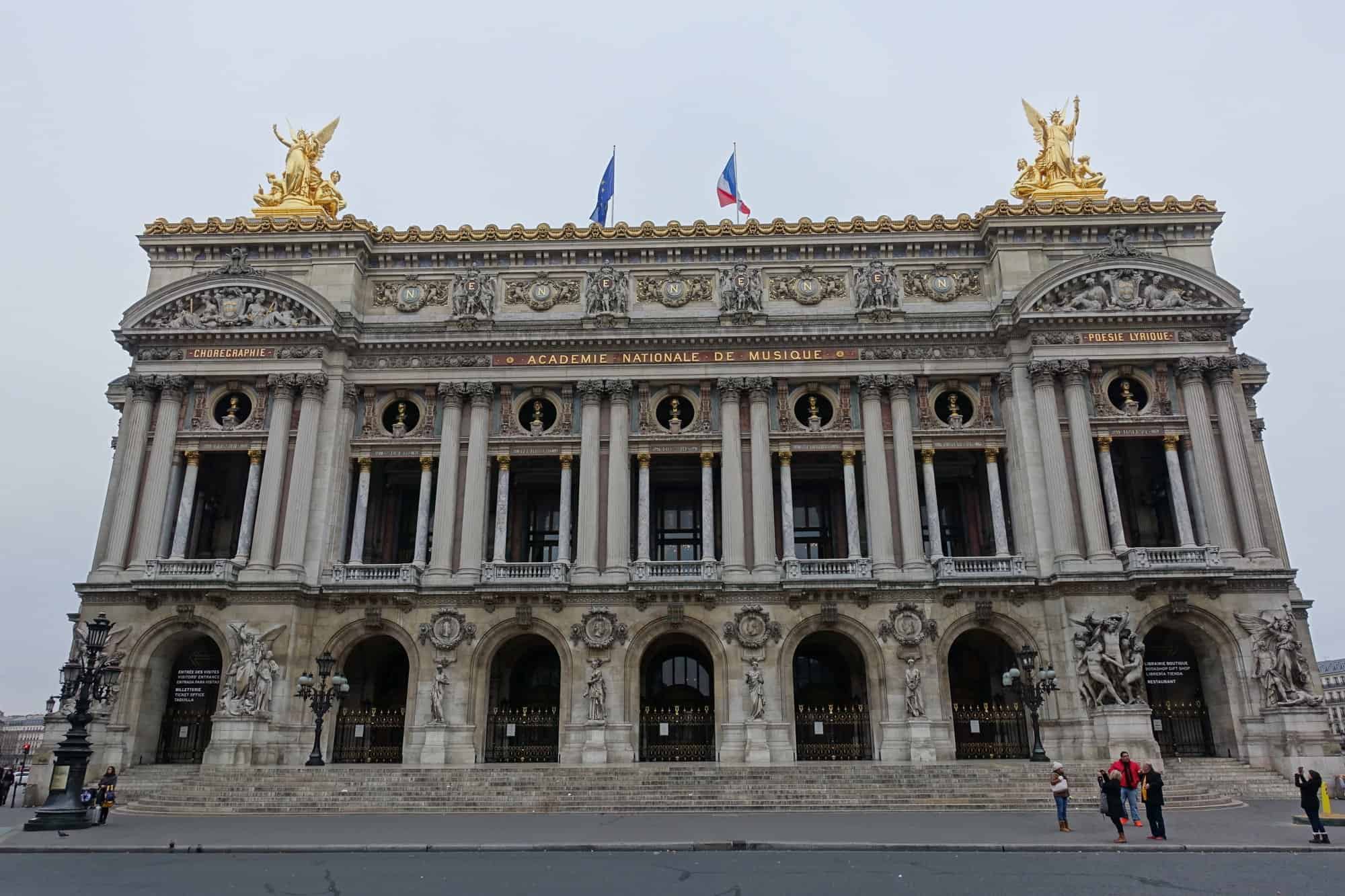
The Palais Garnier, the opera house of Paris also known as the Opéra Garnier, was designed by the French architect Charles Garnier, and it stands at the head of the Avenue de l’Opéra in Paris, where it was inaugurated on 5 January 1875. With 1,979 seats, a grand staircase of coloured marble and a horseshoe auditorium wrapped in red velvet and gold, it is the defining building of the Second Empire, a showpiece of Beaux-Arts eclecticism, and since 1923 it has been listed as a monument historique.
A competition and a lake beneath the opera
The new opera was part of Baron Haussmann’s rebuilding of Paris under Napoleon III. In 1860-61 a public competition drew about 170 entries, and the little-known Garnier, then 35, won it under the motto “Bramo assai, poco spero” (I aspire to much, I hope for little). The first stone was laid on 21 July 1862, but the site sat on a high water table, so the foundations were built around a vast concrete cistern, the origin of the legend of the lake beneath the opera. The façade was unveiled in 1867, work halted during the Franco-Prussian War and the Commune of 1870-71, and when the old opera on the rue Le Peletier burned down in 1873 the building was rushed to completion.
A façade of marble, bronze and gold
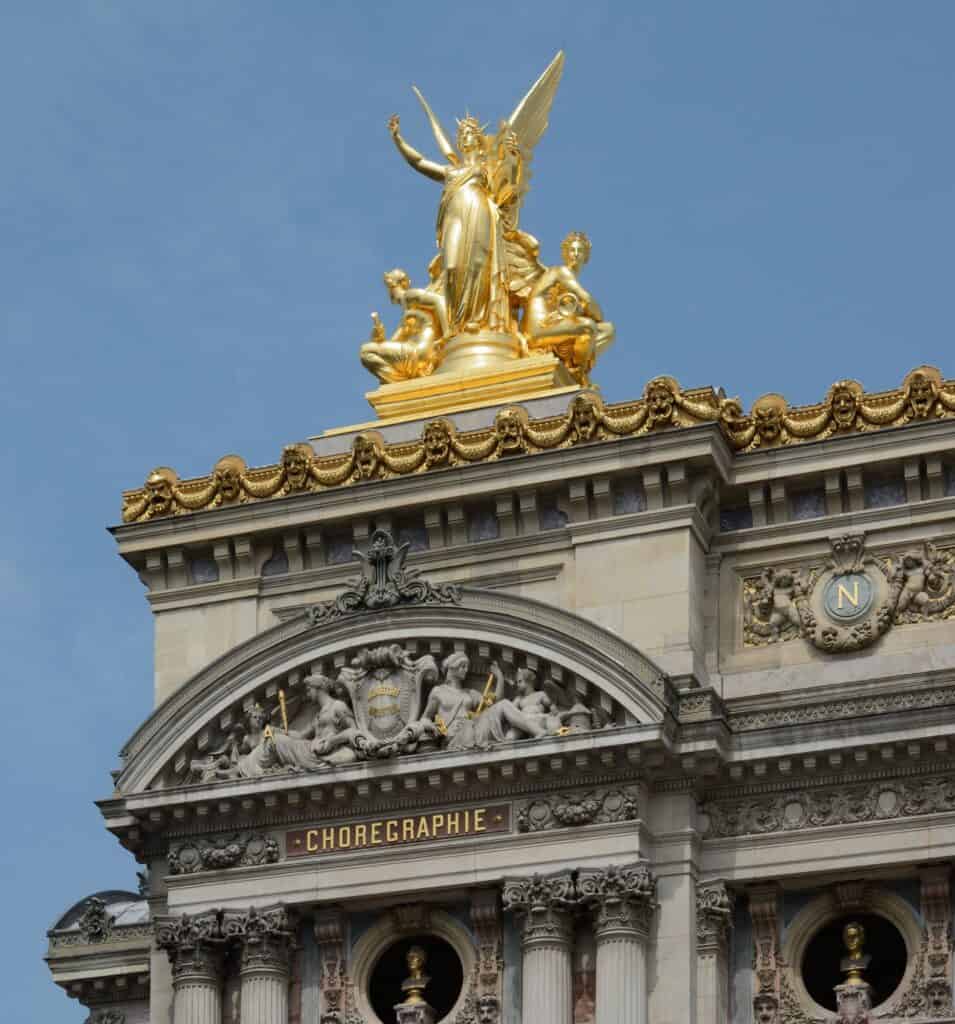
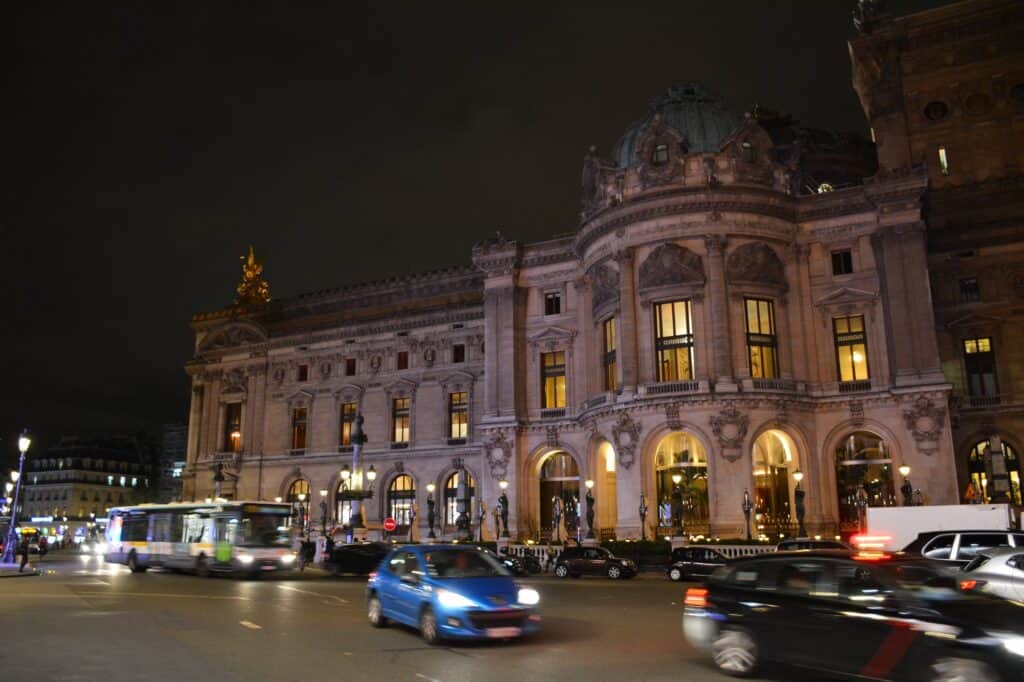
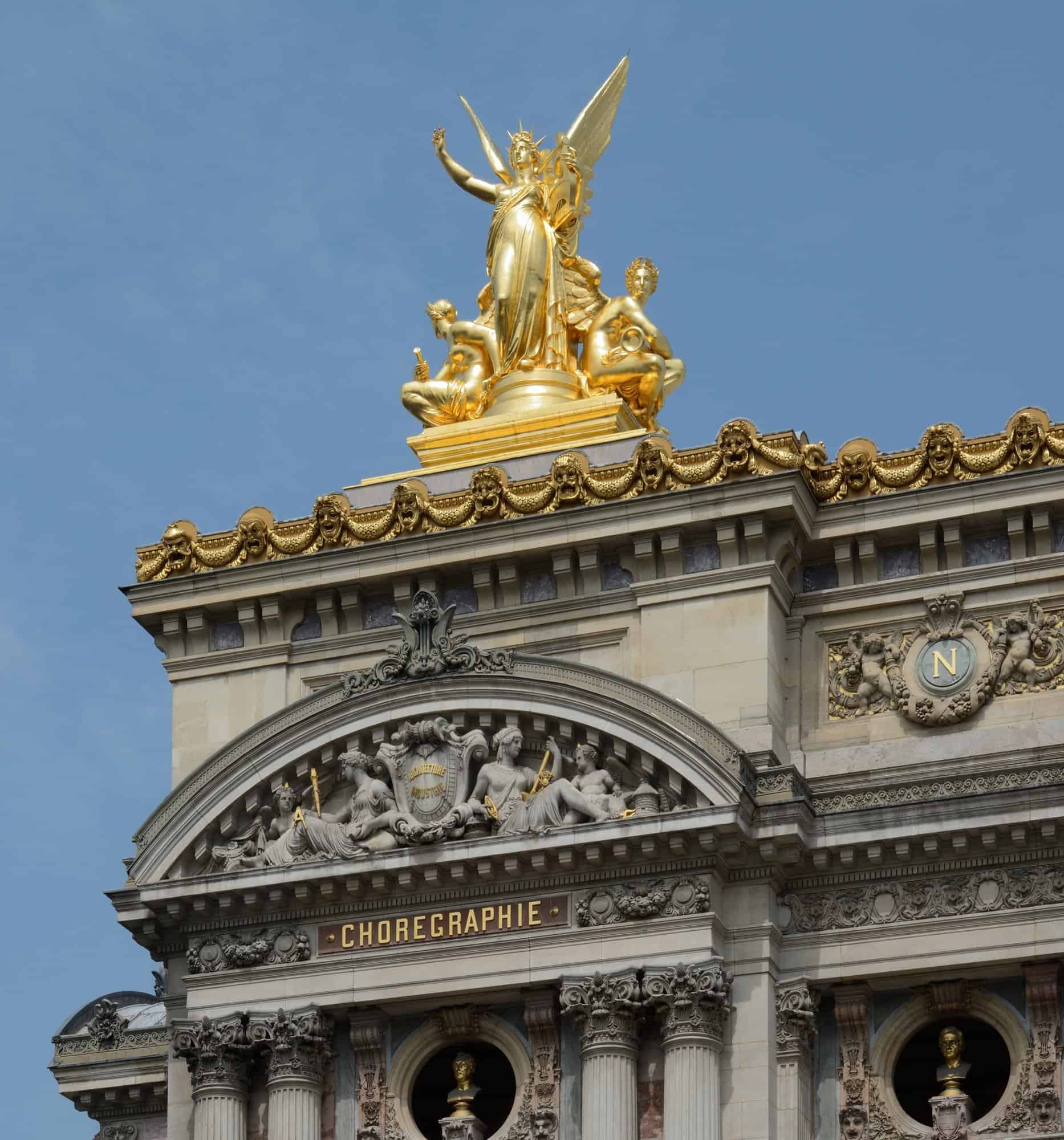
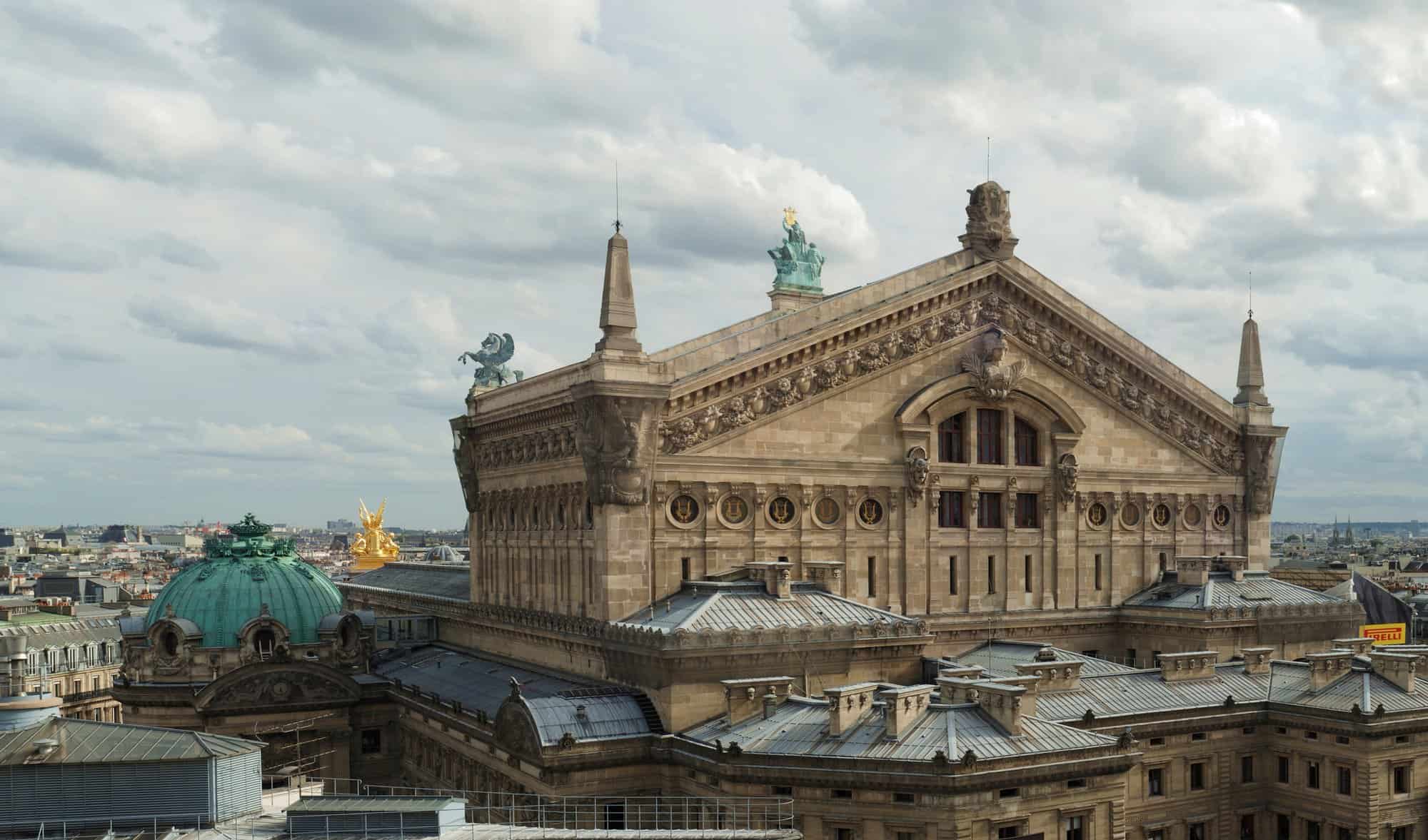
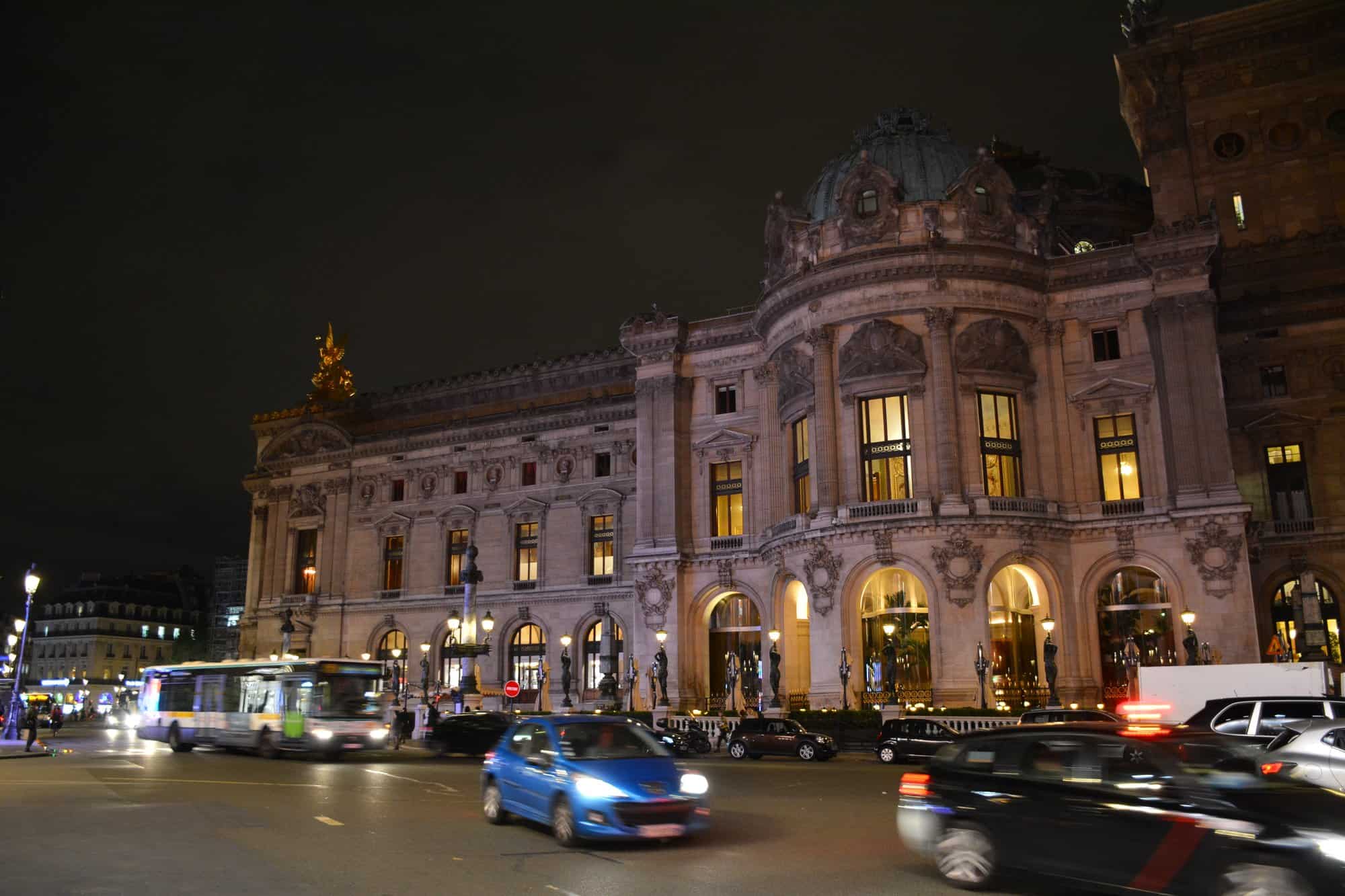
Garnier gave the exterior an eclectic richness, using some 17 kinds of stone, marble and bronze on the main façade alone. Above the arcaded ground floor, a loggia of paired columns frames gilded bronze busts of composers, and the corner pavilions are crowned by Charles Gumery’s gilded groups of Harmony and Poetry. Over the stage house, Aimé Millet’s bronze Apollo raises his lyre above the green copper dome of the auditorium. Jean-Baptiste Carpeaux’s group La Danse, which caused a scandal for its sensuality, was moved to the Musée d’Orsay and replaced by a copy. Side pavilions held a ramped entrance for the emperor and an entrance for subscribers.
The Grand Escalier
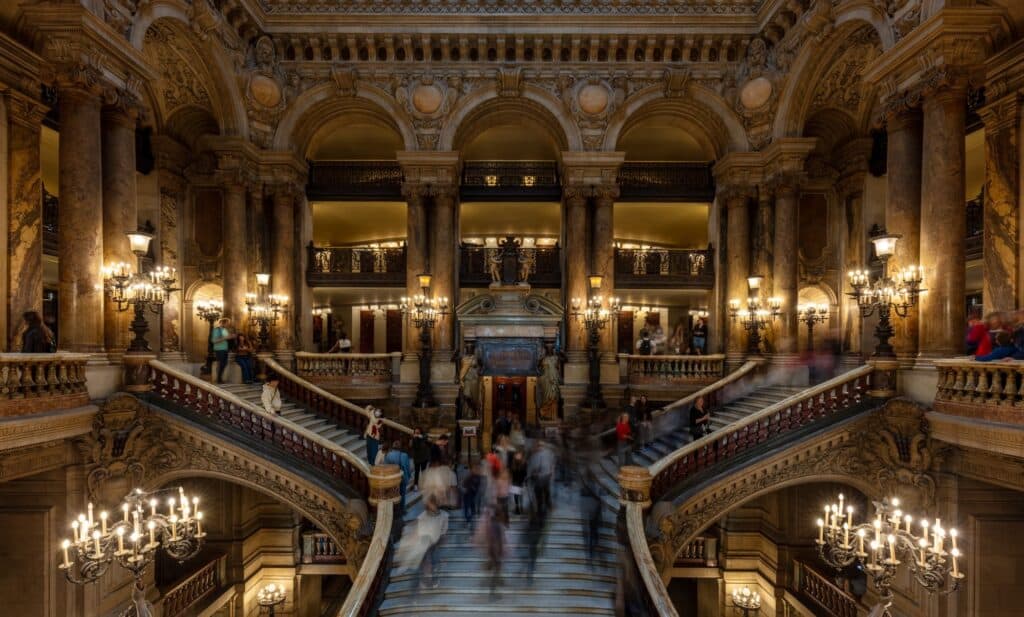
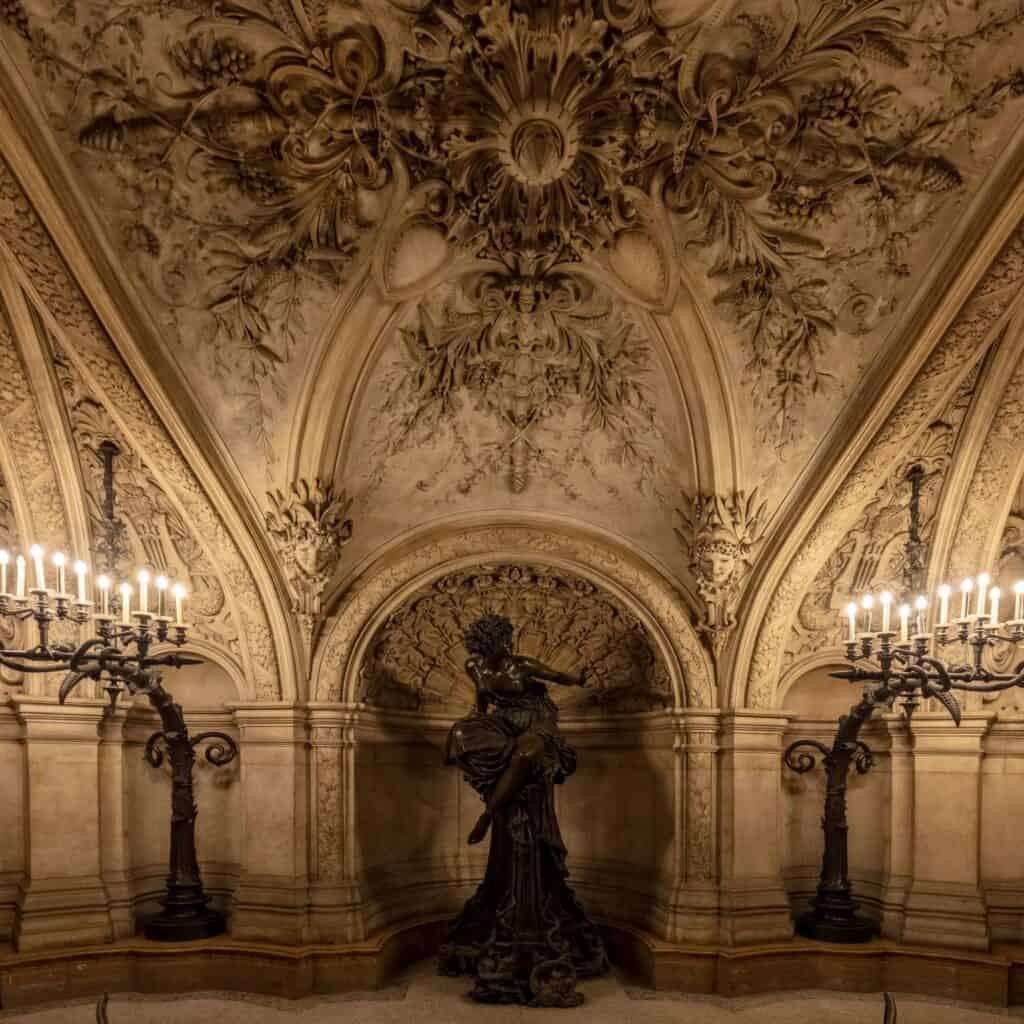
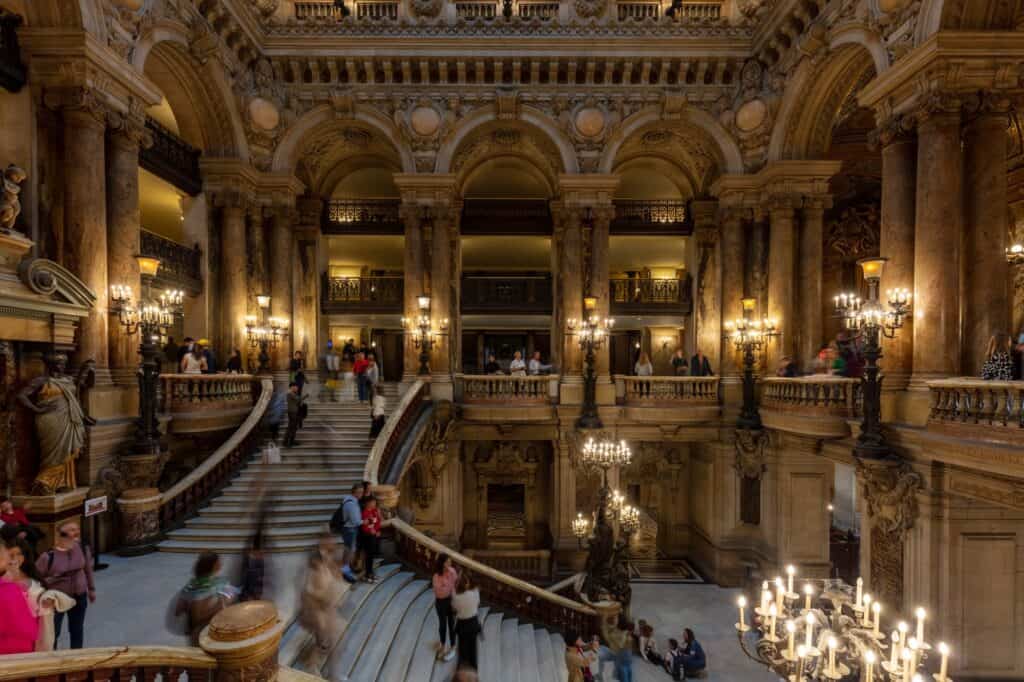
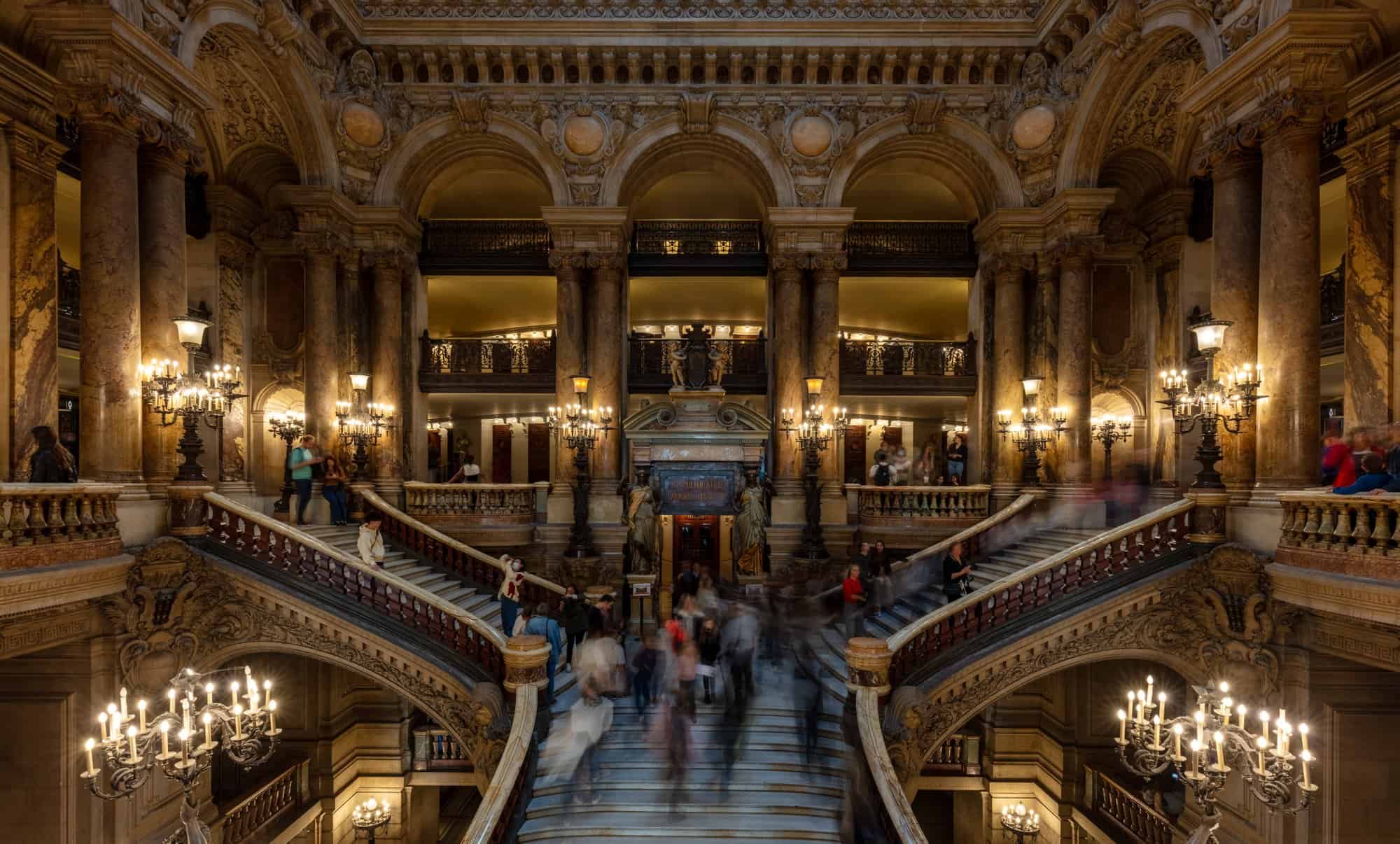
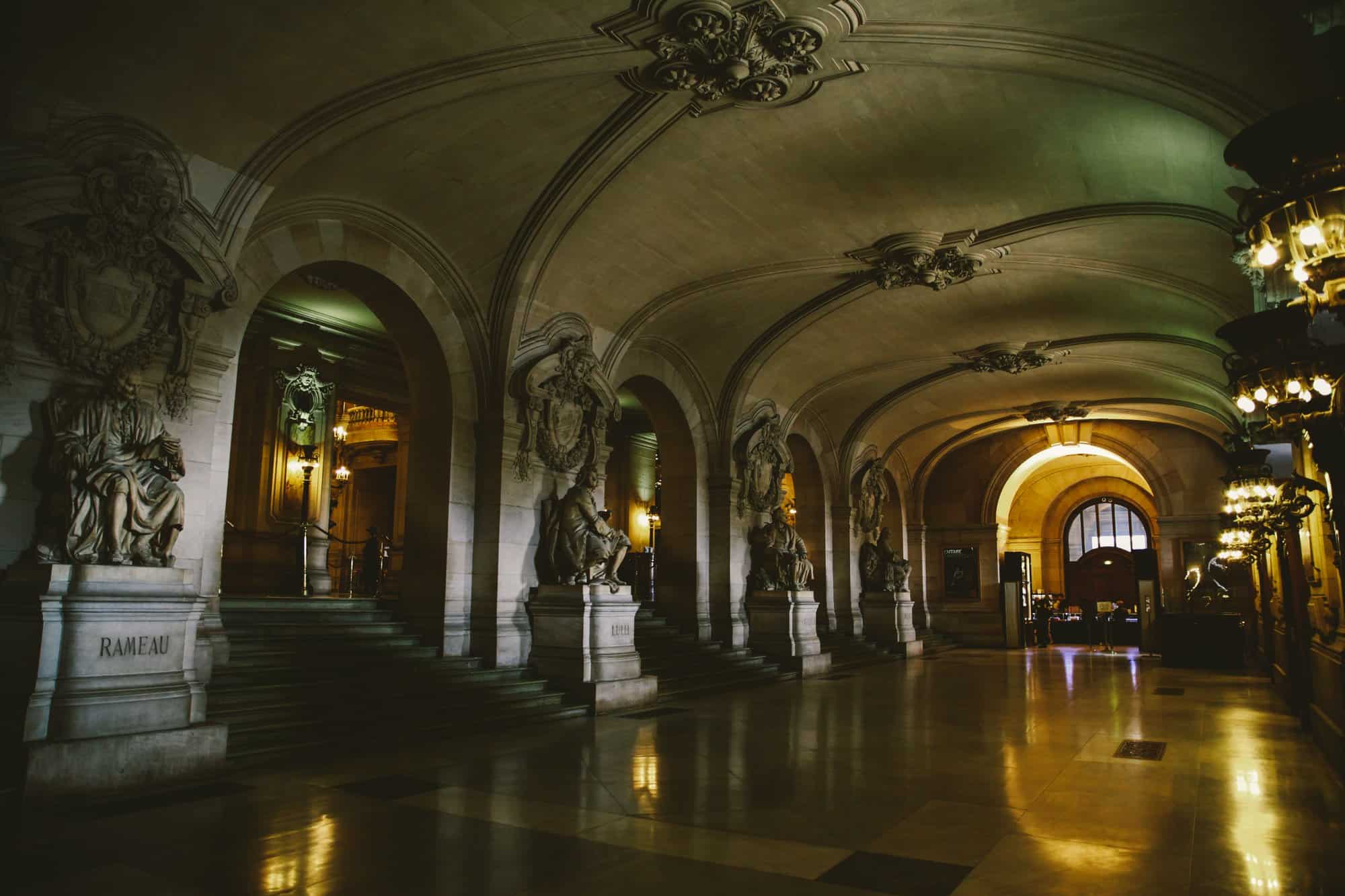
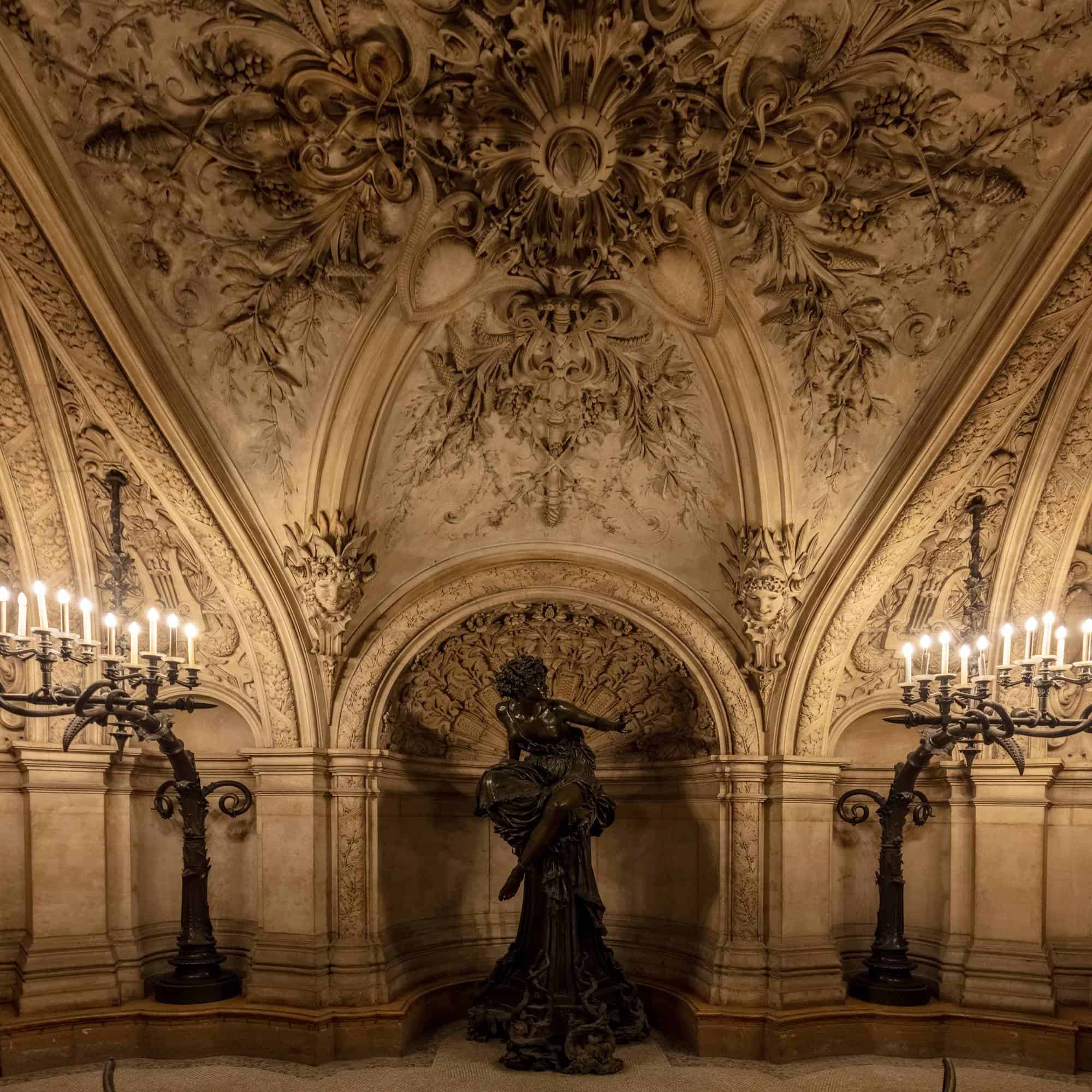
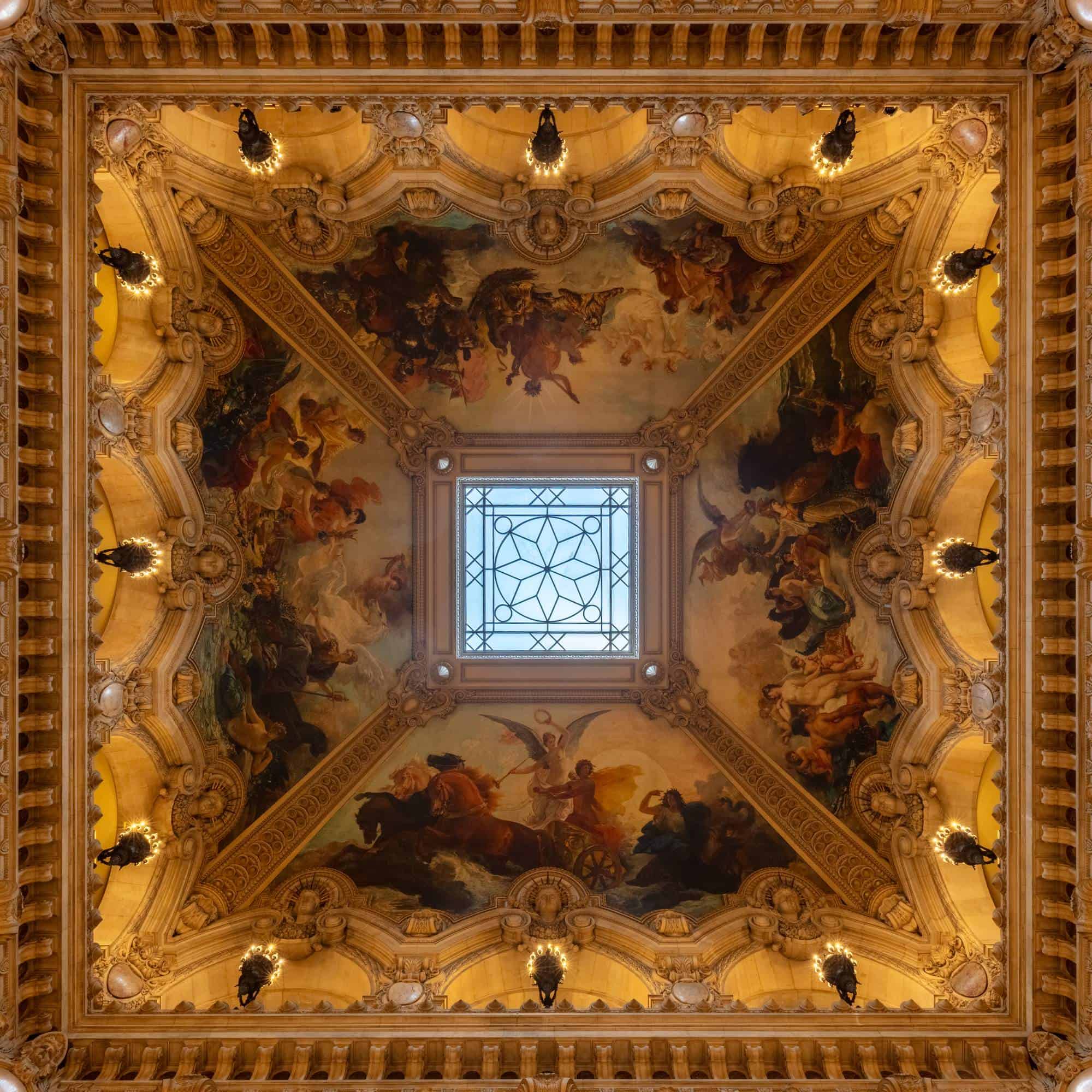
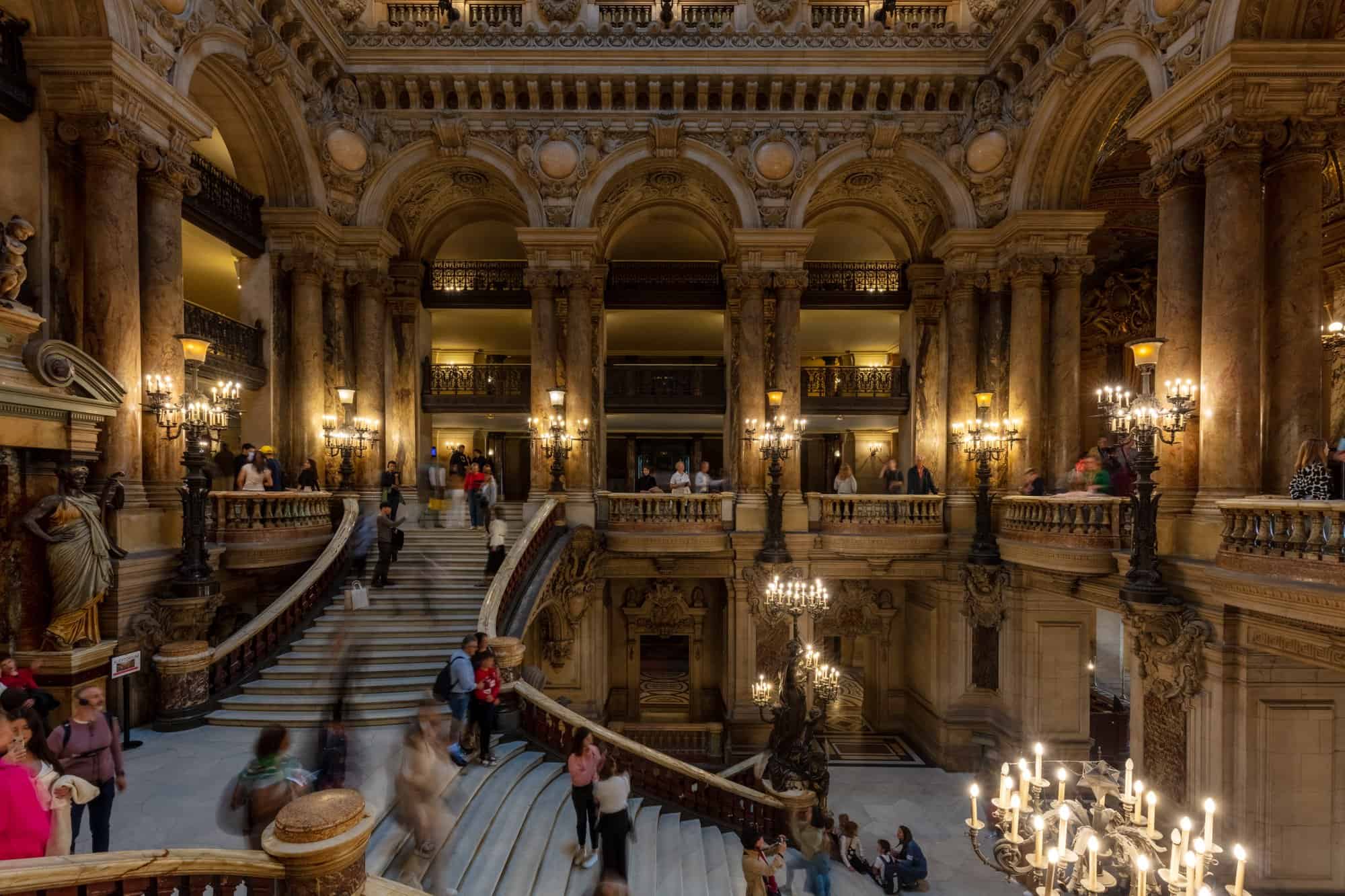
Inside, Garnier treated circulation as theatre. From the vaulted vestibules, lined with statues of composers including Rameau, and the Bassin de la Pythie, where a bronze Pythia by the sculptor Marcello stands in a grotto-like niche, visitors reach the Grand Escalier. Its white marble steps divide and return in two curving flights, with balustrades of red and green marble and bronze candelabra, while galleries on every level let the audience see and be seen. Above, the ceiling paintings by Isidore Pils frame a central skylight.
The avant-foyer and the Grand Foyer
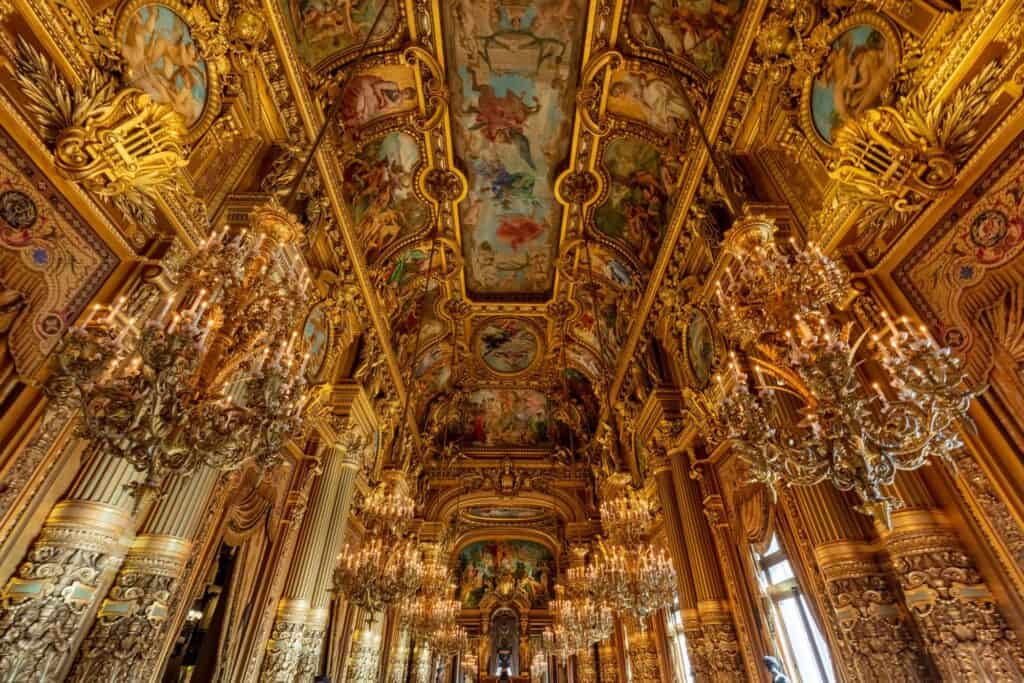
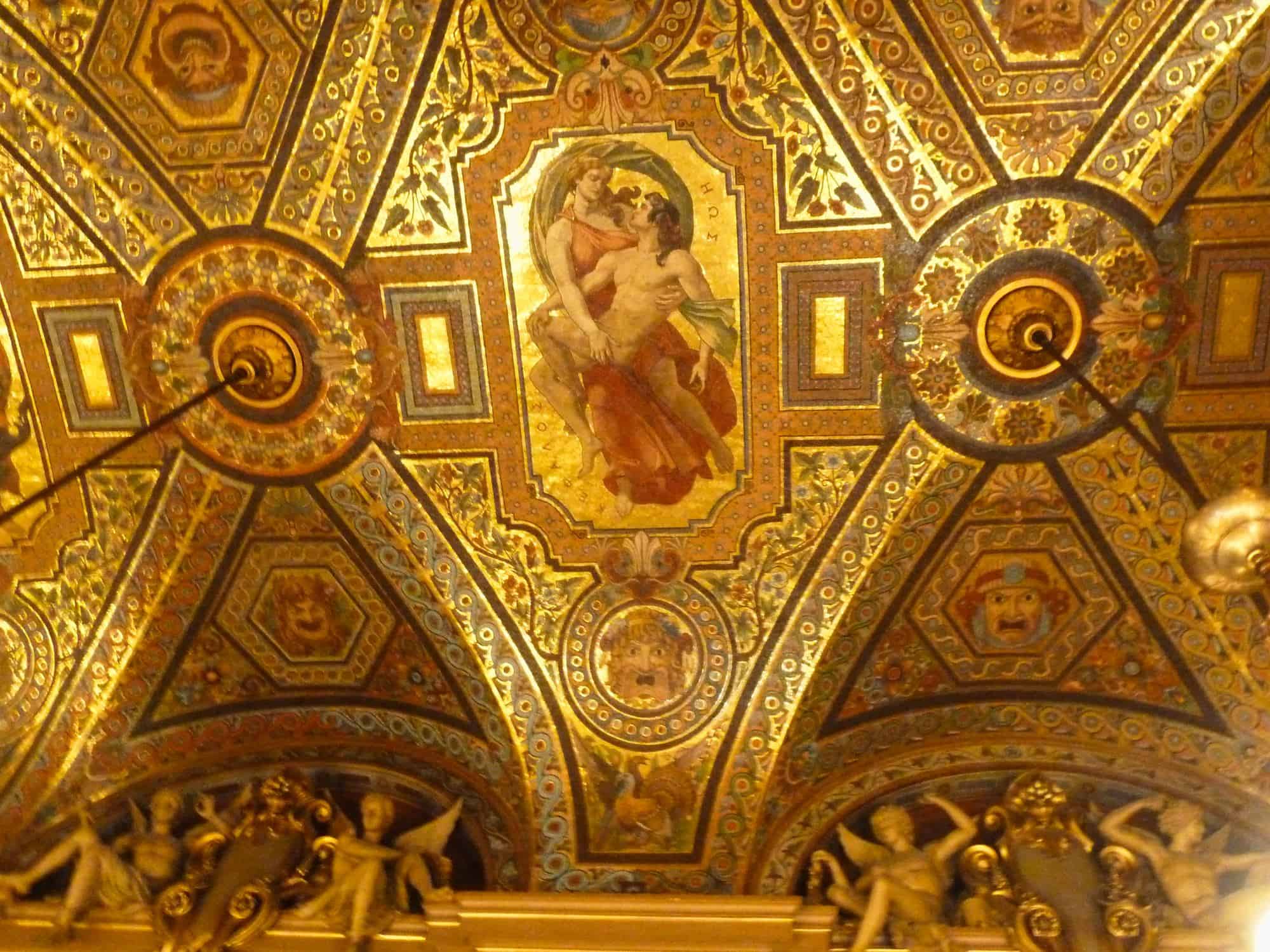
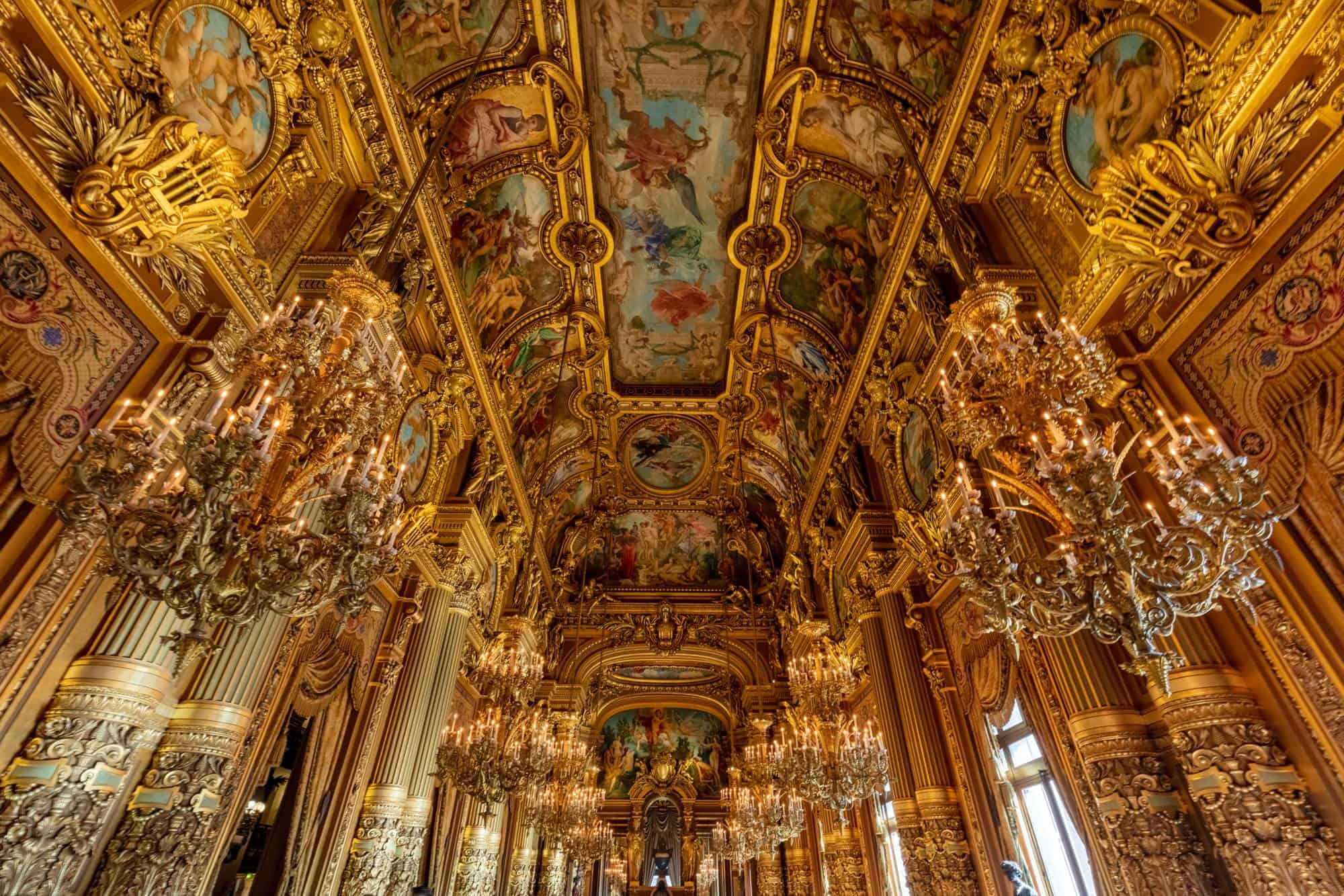
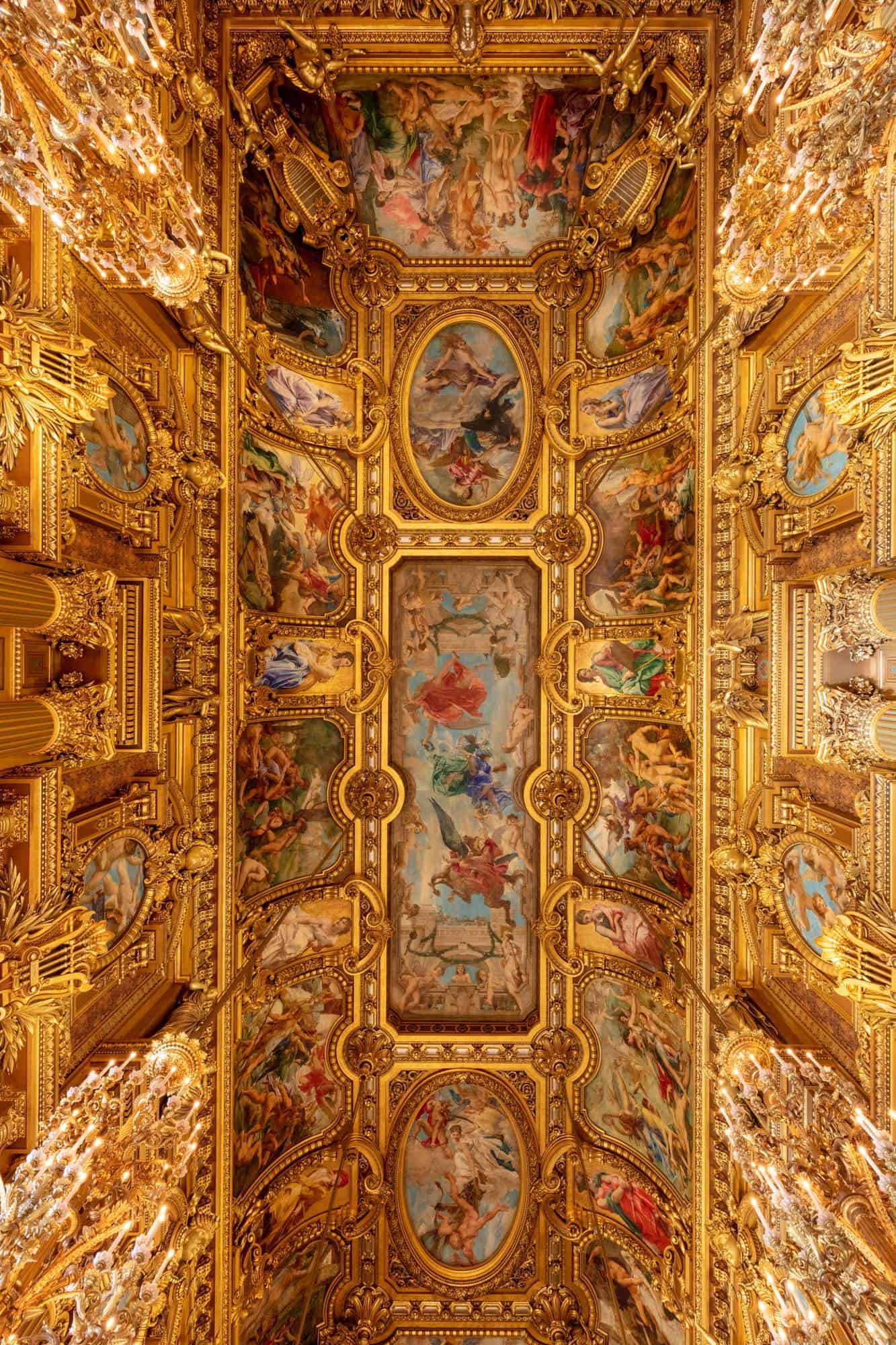
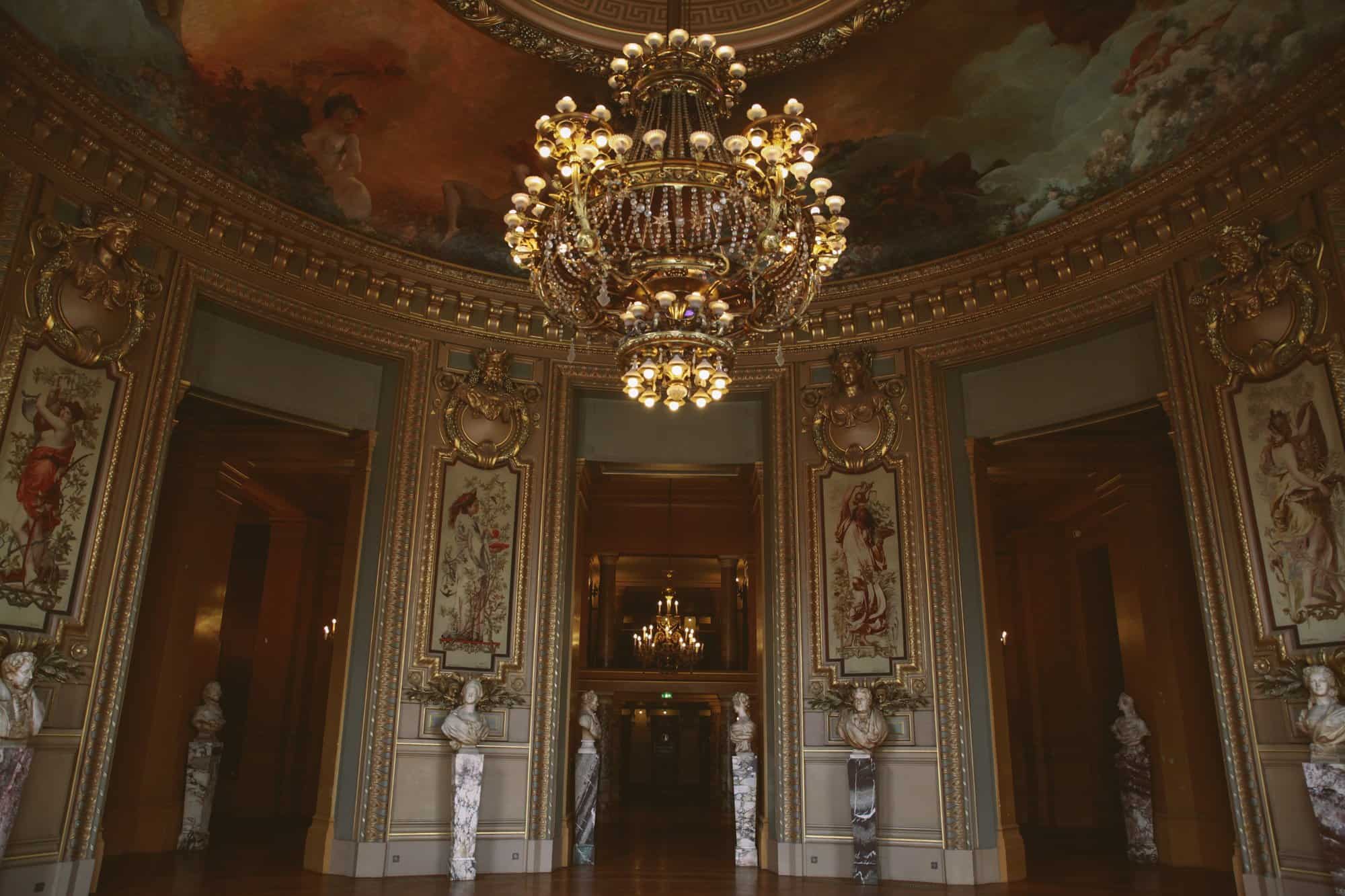
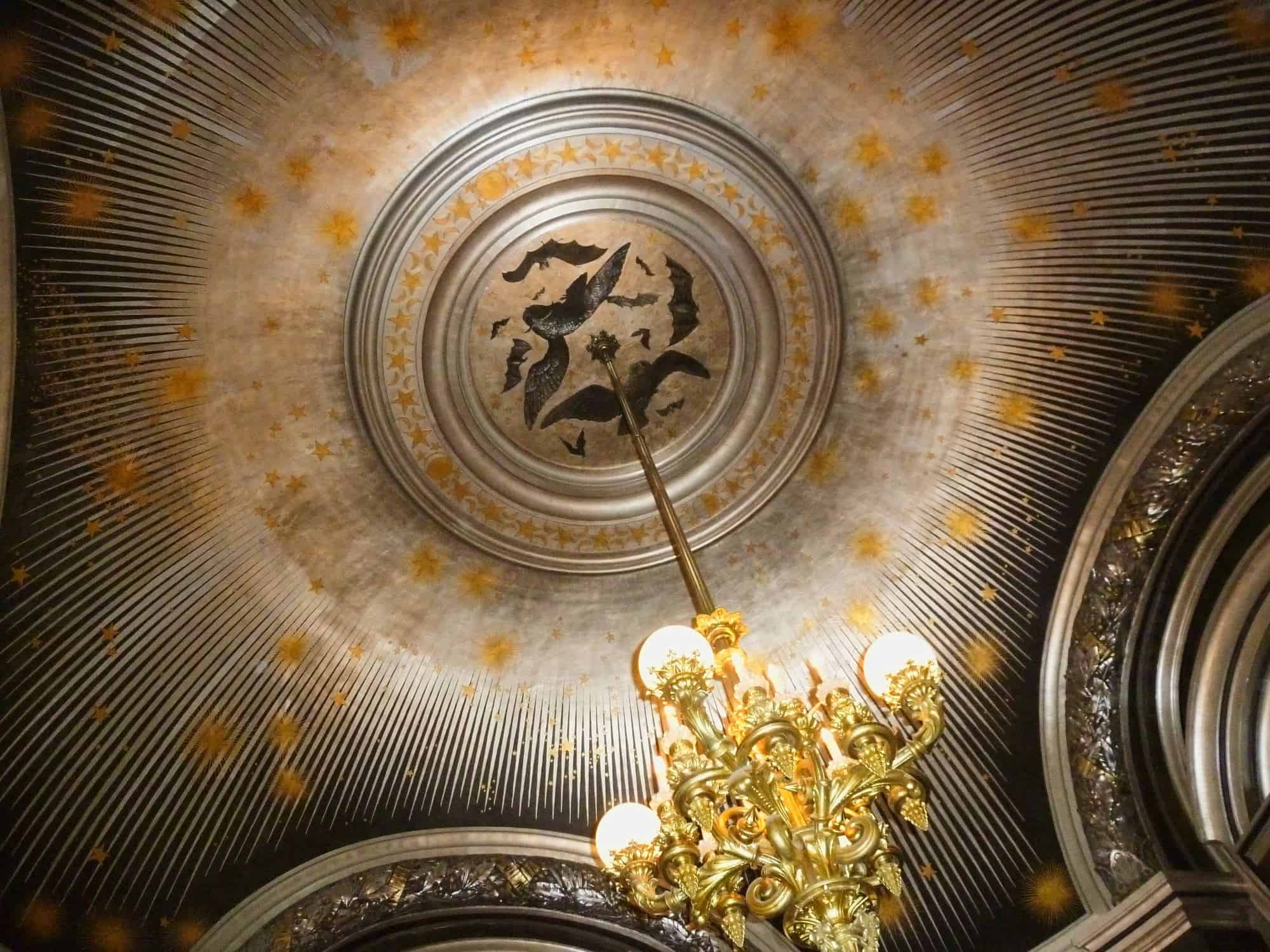
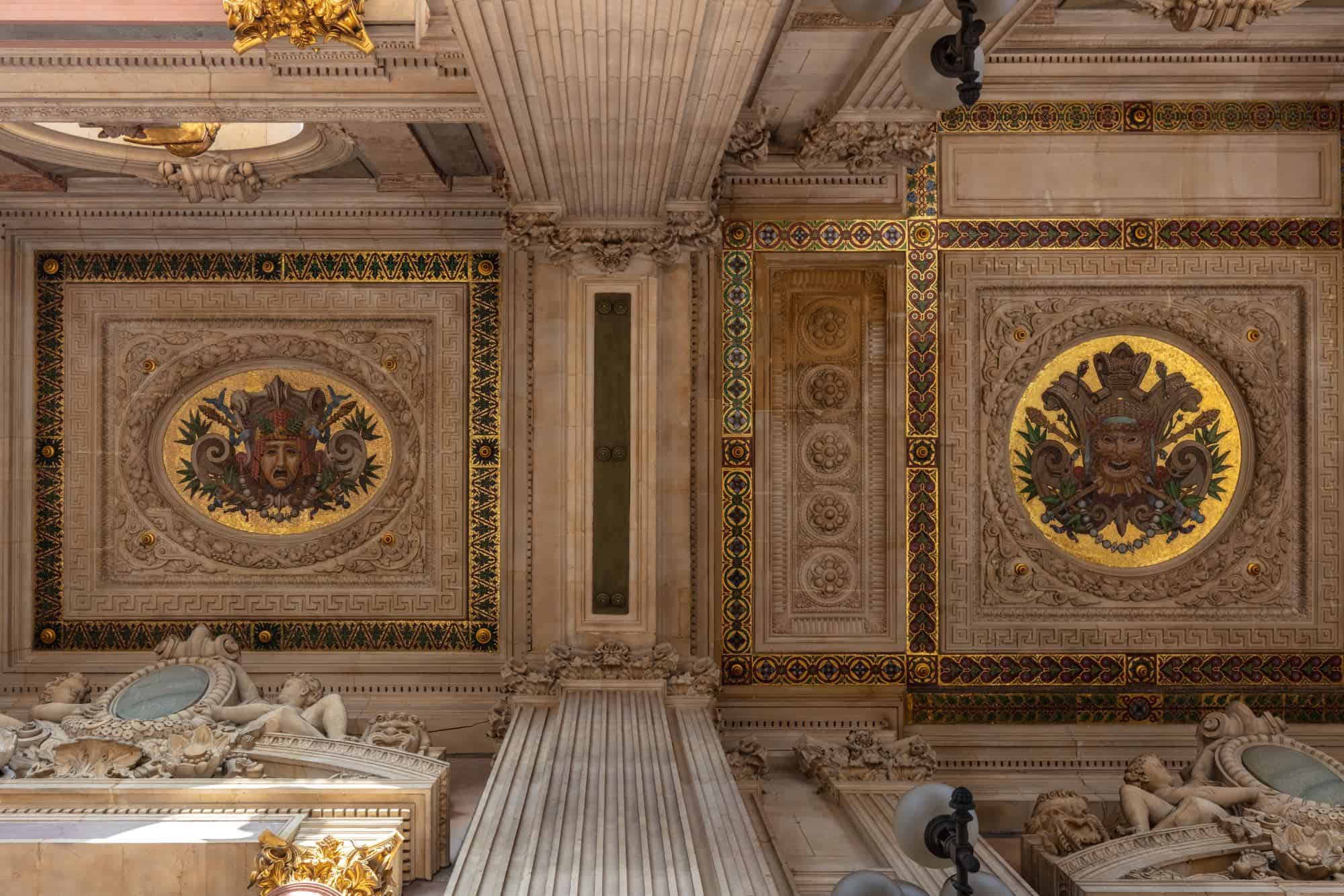
The staircase leads to the avant-foyer, whose vault glitters with gold-ground mosaics made by Facchina to designs by Paul-Albert Curzon, and on to the Grand Foyer, a gallery about 54 metres long and 18 metres high. Gilded columns, mirrors and chandeliers frame the ceiling painted by Paul Baudry with scenes from the history of music, cleaned in a restoration completed in 2004. At either end, the octagonal Salon du Soleil and Salon de la Lune are finished in gold and silver, and the rotunda of the Salon du Glacier is hung with tapestries by Mazerolle.
A horseshoe of red and gold
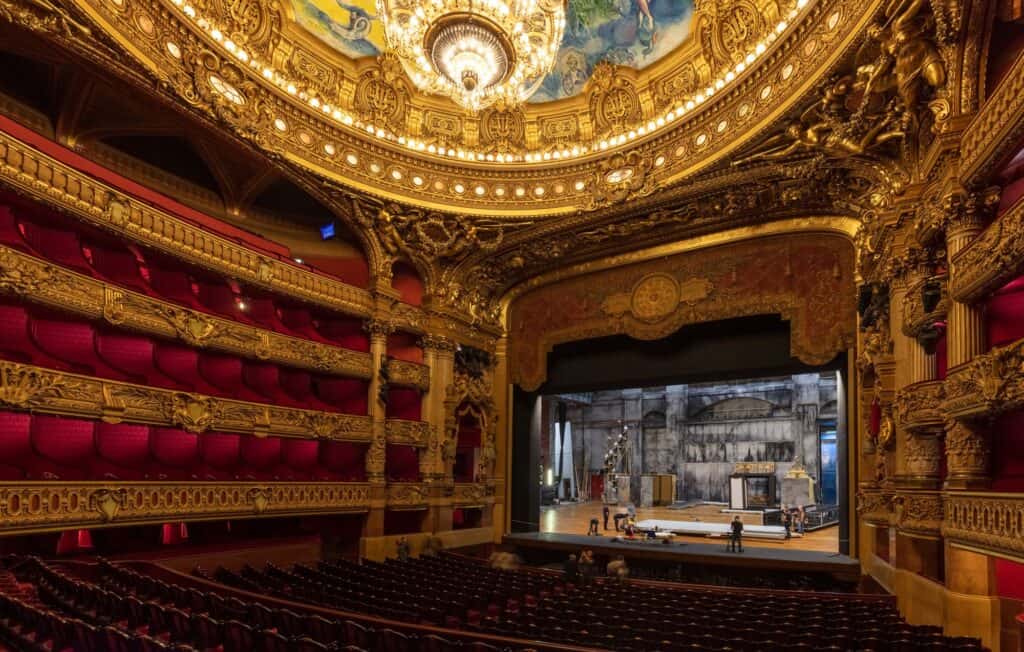
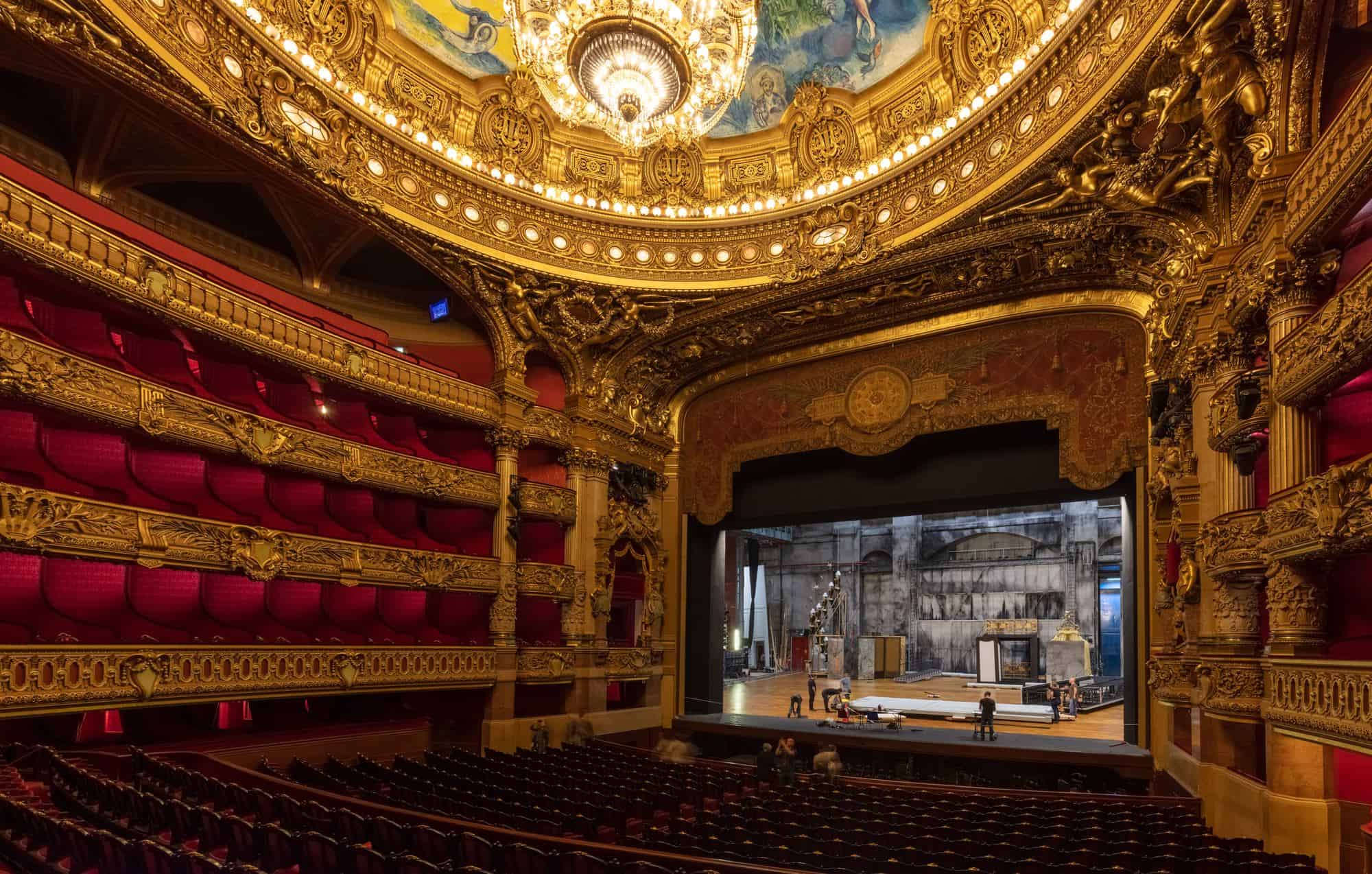
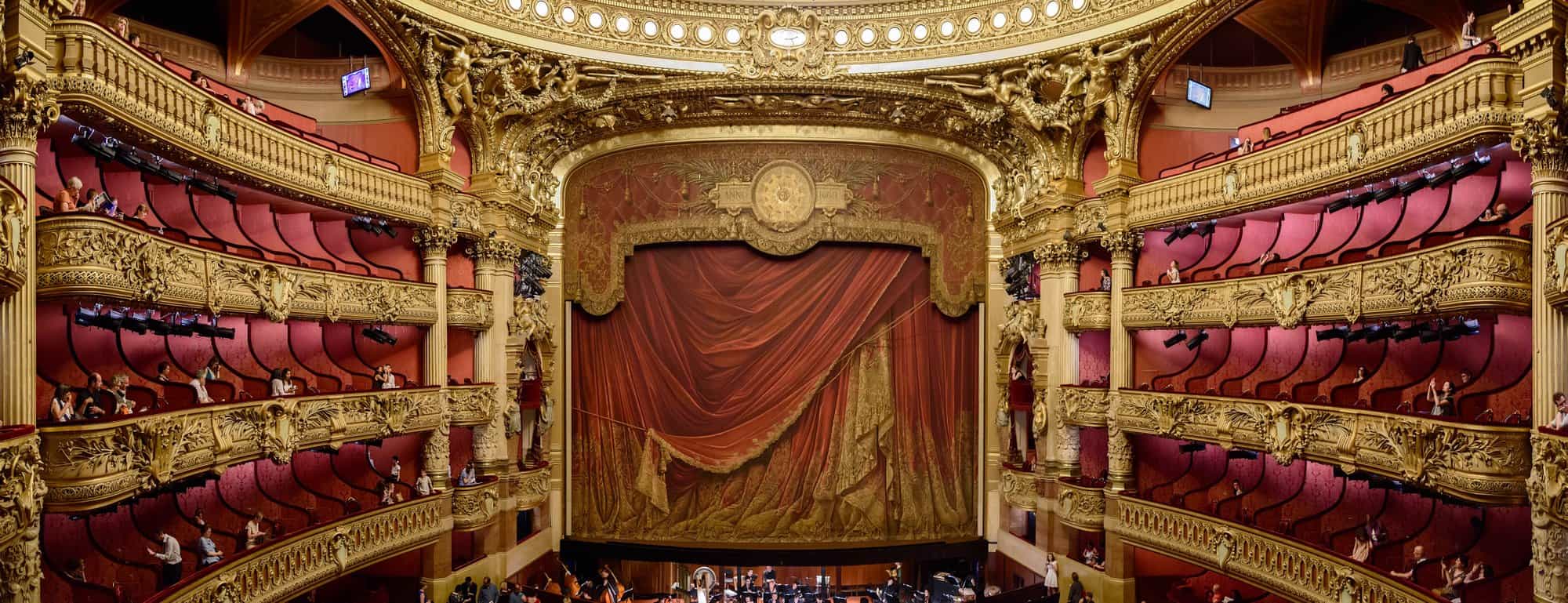
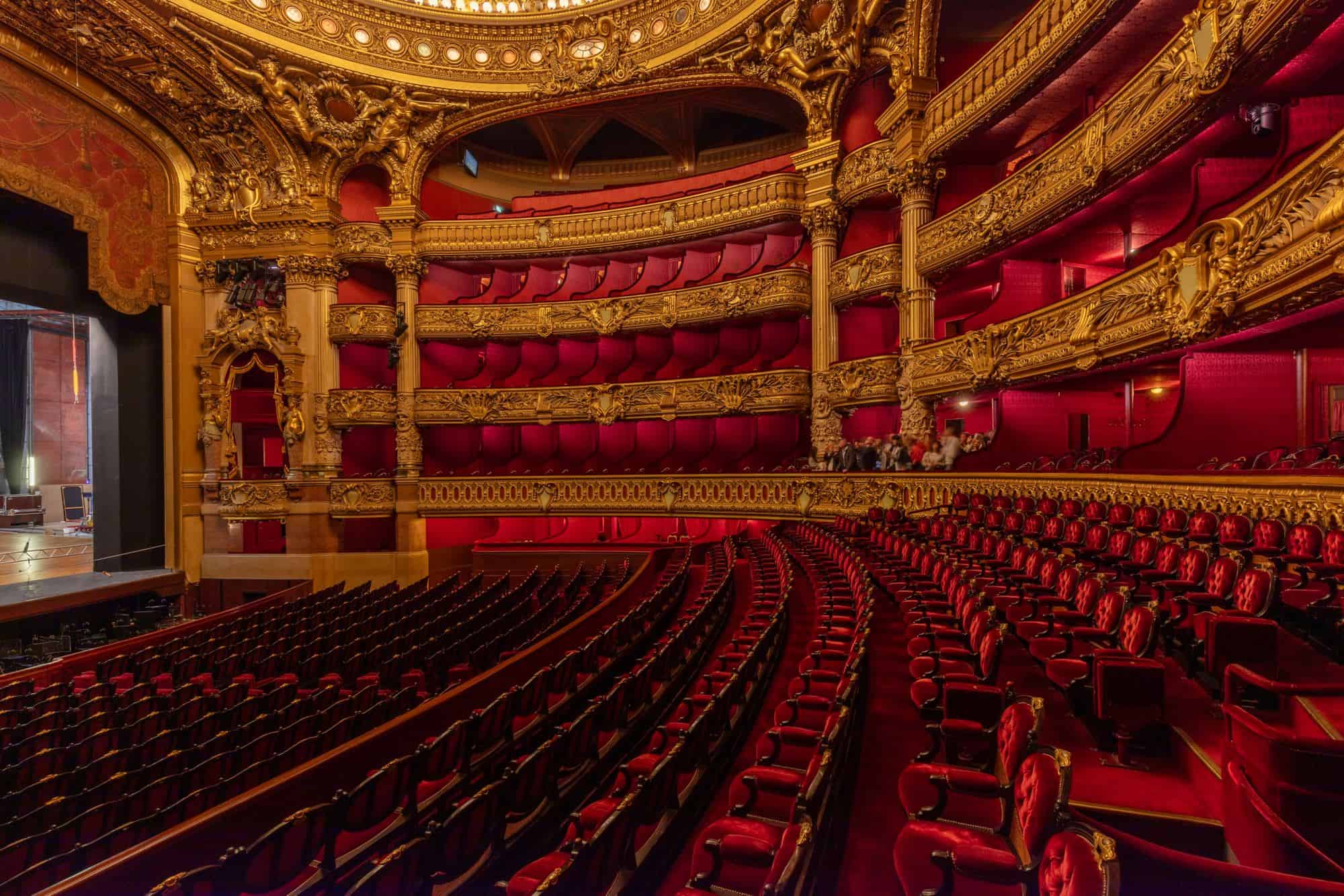
The auditorium follows the Italian horseshoe plan, with tiers of boxes in red velvet and gilded plaster rising around the stalls. From the centre hangs a bronze and crystal chandelier of about seven tonnes; in 1896 one of its counterweights fell and killed a spectator, an accident that found its way into Gaston Leroux’s 1910 novel The Phantom of the Opera. In 1964 the original ceiling by Jules-Eugène Lenepveu was covered by a new painting by Marc Chagall, installed on a removable frame and paying tribute to composers of the repertoire.
Ballet, museum and credits
Since the Opéra Bastille opened in 1989, the Palais Garnier has been used mainly for ballet, as the home of the Paris Opera Ballet, while remaining one of the most visited monuments in Paris, and it also houses the library and museum of the Paris Opera, run with the Bibliothèque nationale de France. The photography is by Diego Delso, Guilhem Vellut, Peter Haas, Joaquim Alves Gaspar, Cheng-en Cheng, Cristian Bortes, Pierre André Leclercq and Joe deSousa, shared on Wikimedia Commons under CC BY 2.0, CC BY-SA 2.0, CC BY-SA 3.0 and CC BY-SA 4.0 licences, with Joe deSousa’s panorama of the auditorium released under CC0.
Palais Garnier (Paris Opera) gallery
Explore more on Archtene
- More projects by Charles Garnier
- More projects in Paris
- More Opera House projects