Bacchanalia by Martin Brudnizki Design Studio in London, United Kingdom
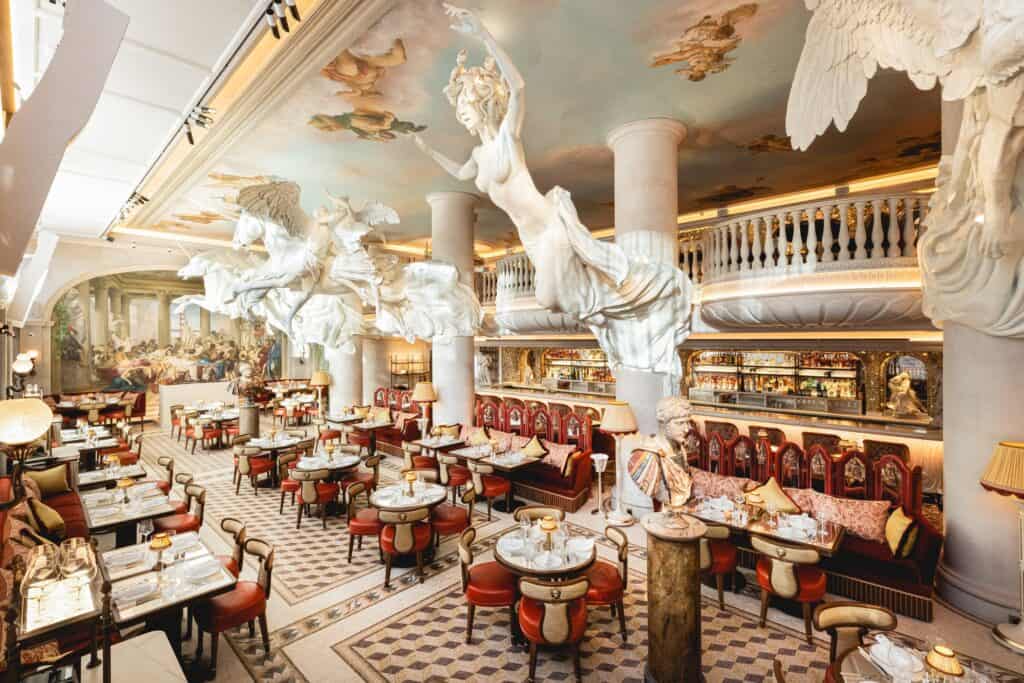
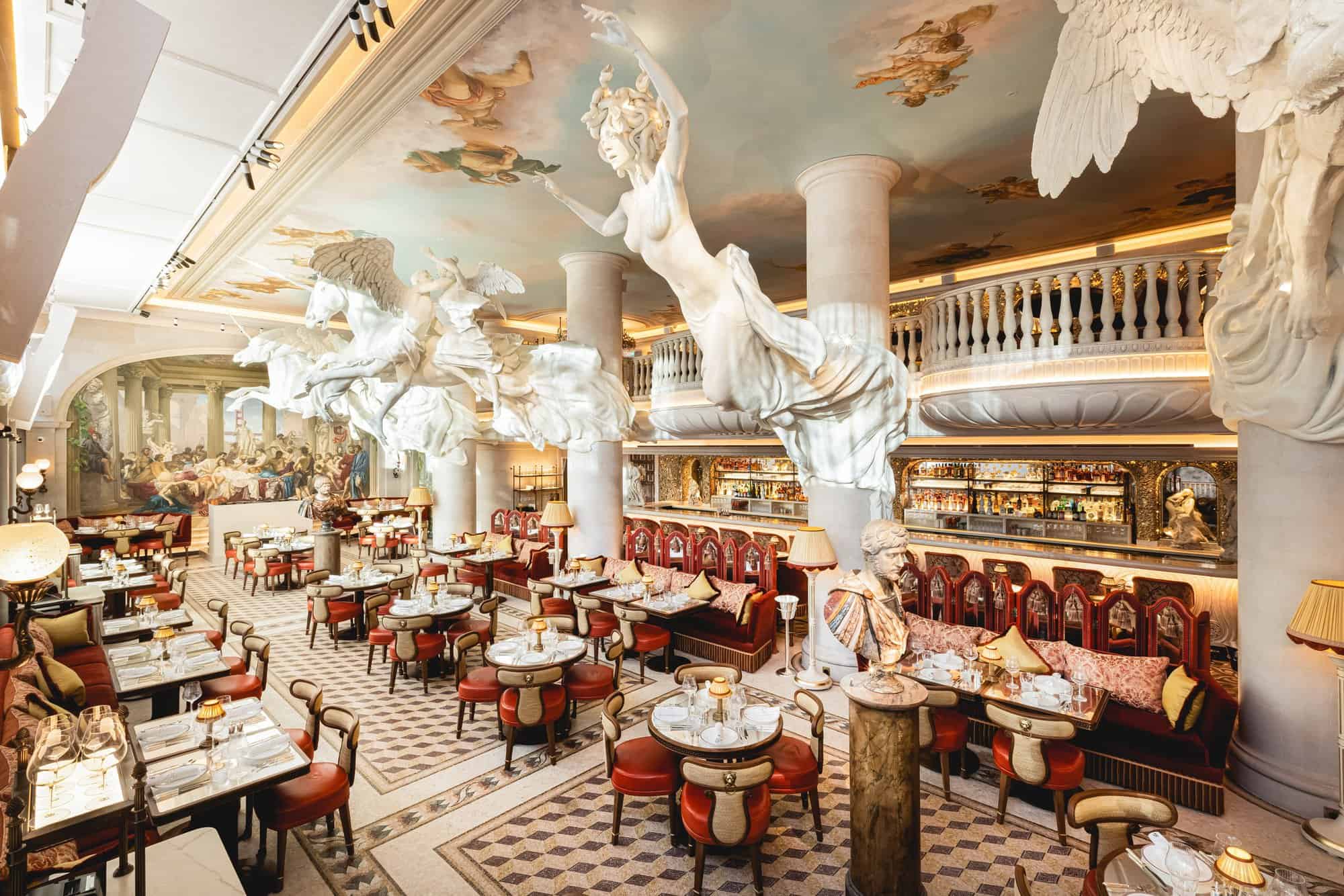
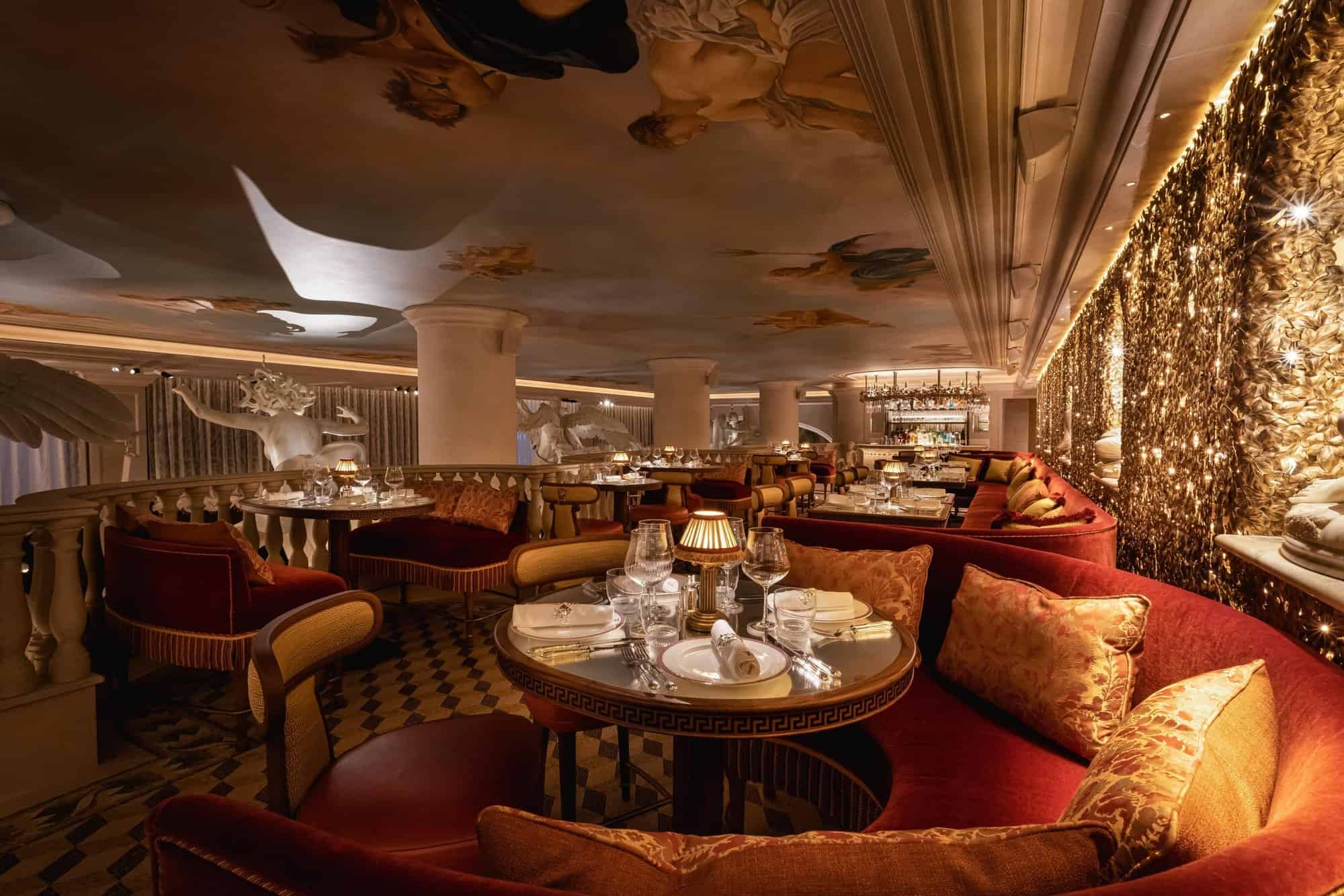
Bacchanalia is a Greco-Roman restaurant interior on the corner of Mount Street and Berkeley Square in Mayfair, London, designed by Martin Brudnizki Design Studio for the restaurateur Richard Caring and his group Caprice Holdings. Named after the Roman festivals of Bacchus, the god of wine, it occupies a former Porsche showroom at 1 Mount Street and opened on 1 December 2022, after a launch party in November. Its main dining room is ruled by five monumental white sculptures by Damien Hirst, set beneath a hand-painted ceiling and beside floor-to-ceiling murals by Gary Myatt, and it is furnished with Greek and Roman antiquities, many of them more than 2,000 years old. The studio had already rebuilt Caring’s members’ club Annabel’s around the corner in 2018, and Bacchanalia takes its taste for fantasy further still, joining the theatrical London dining rooms of The Gallery at Sketch and the gilded Belle Époque hall of Le Train Bleu in Paris.
From Porsche showroom to Greco-Roman banquet hall
Behind the transformation lies a substantial piece of construction. The fit-out contractor Brown & Carroll describes trenching and piling beneath the old showroom and the building of a cantilevered mezzanine, so that the premises could carry the weight of marble, stone, ornamental metalwork and statuary demanded by the design, and it puts the cost of turning the garage into a restaurant at £75 million. The result is a tall, colonnaded hall with a balustraded mezzanine wrapping around its upper level. The Evening Standard’s critic Jimi Famurewa described stepping “utterly agog, into its colonnaded hall of rippling stone, triple-height frescoed ceilings, and serpentine wall sconces in glittering alcoves.” Martin Brudnizki Design Studio, the London and New York practice founded by the Swedish-born designer Martin Brudnizki, is known for maximalist hospitality interiors, and here every surface is put to work in telling a story of classical myth and excess.
Damien Hirst’s flying sculptures and Gary Myatt’s murals
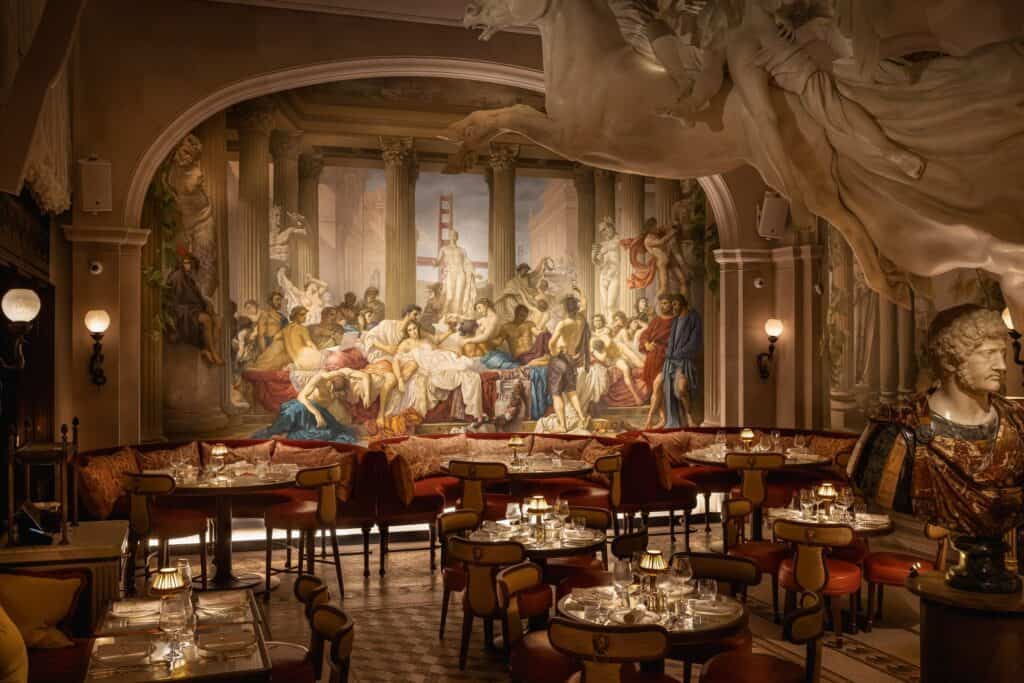
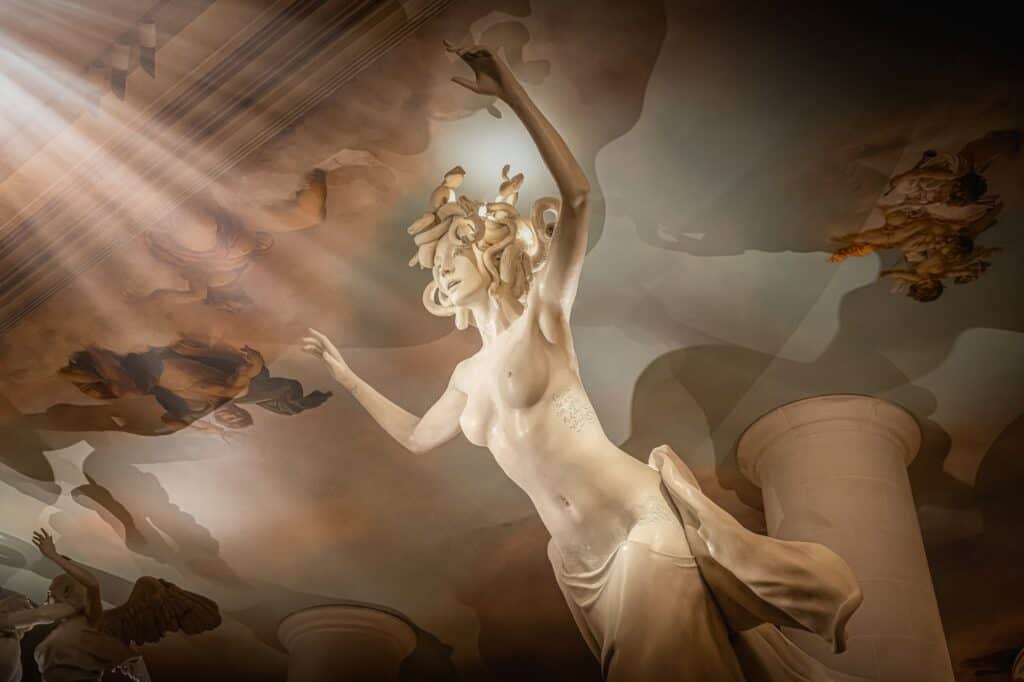
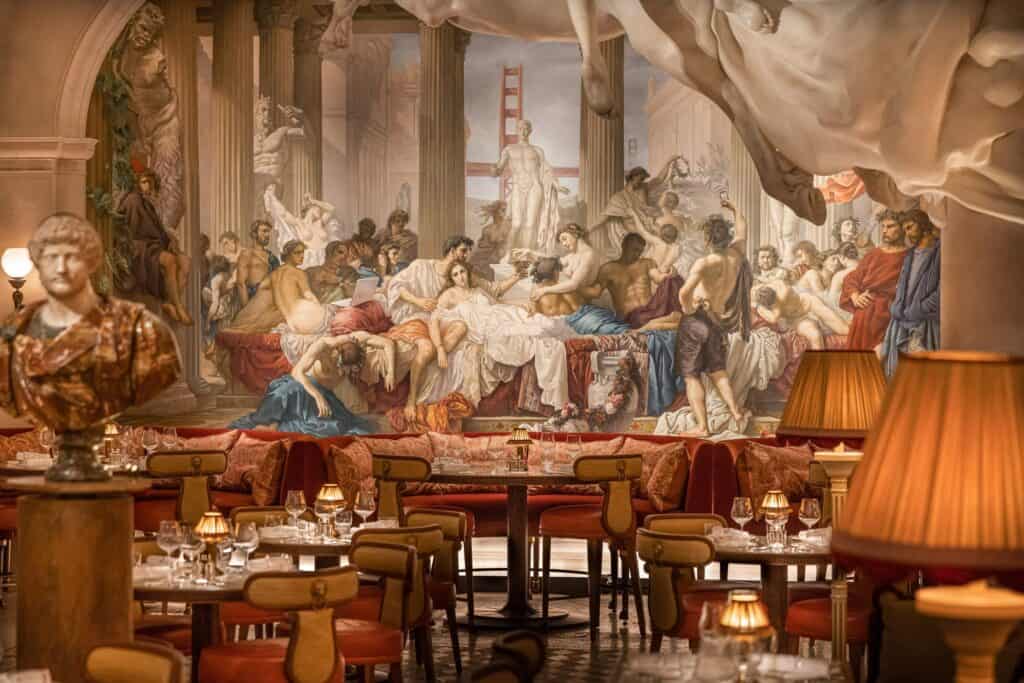
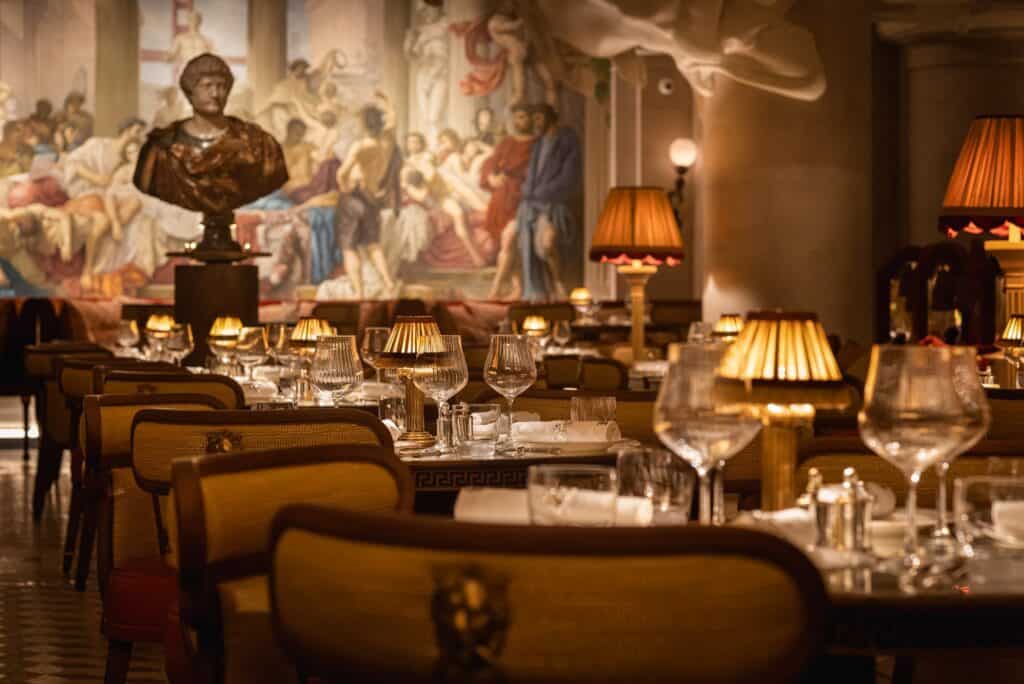
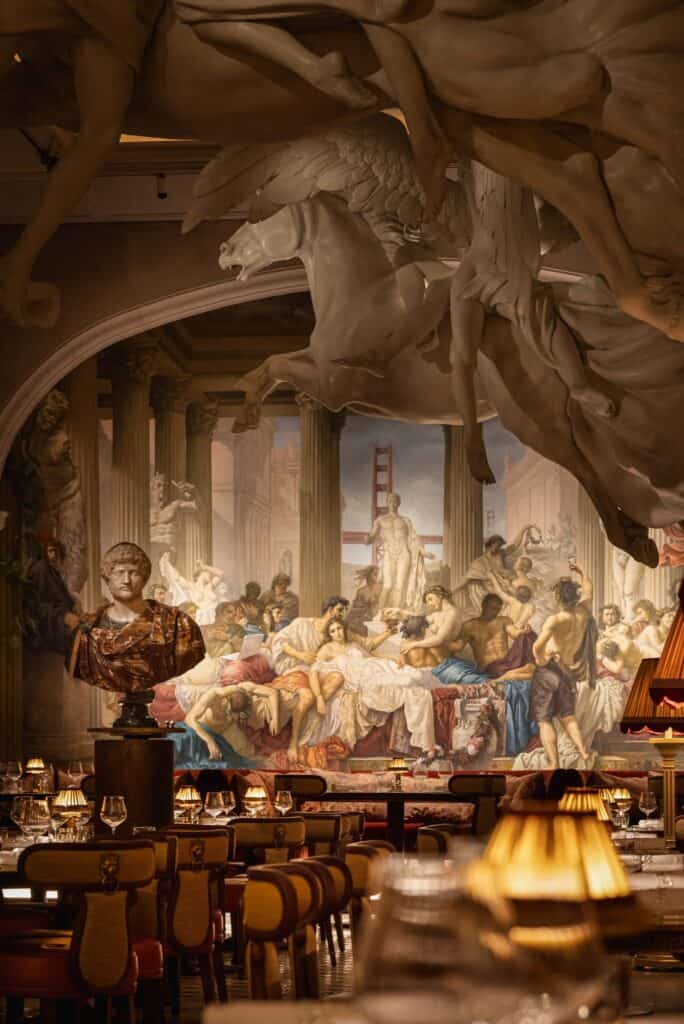
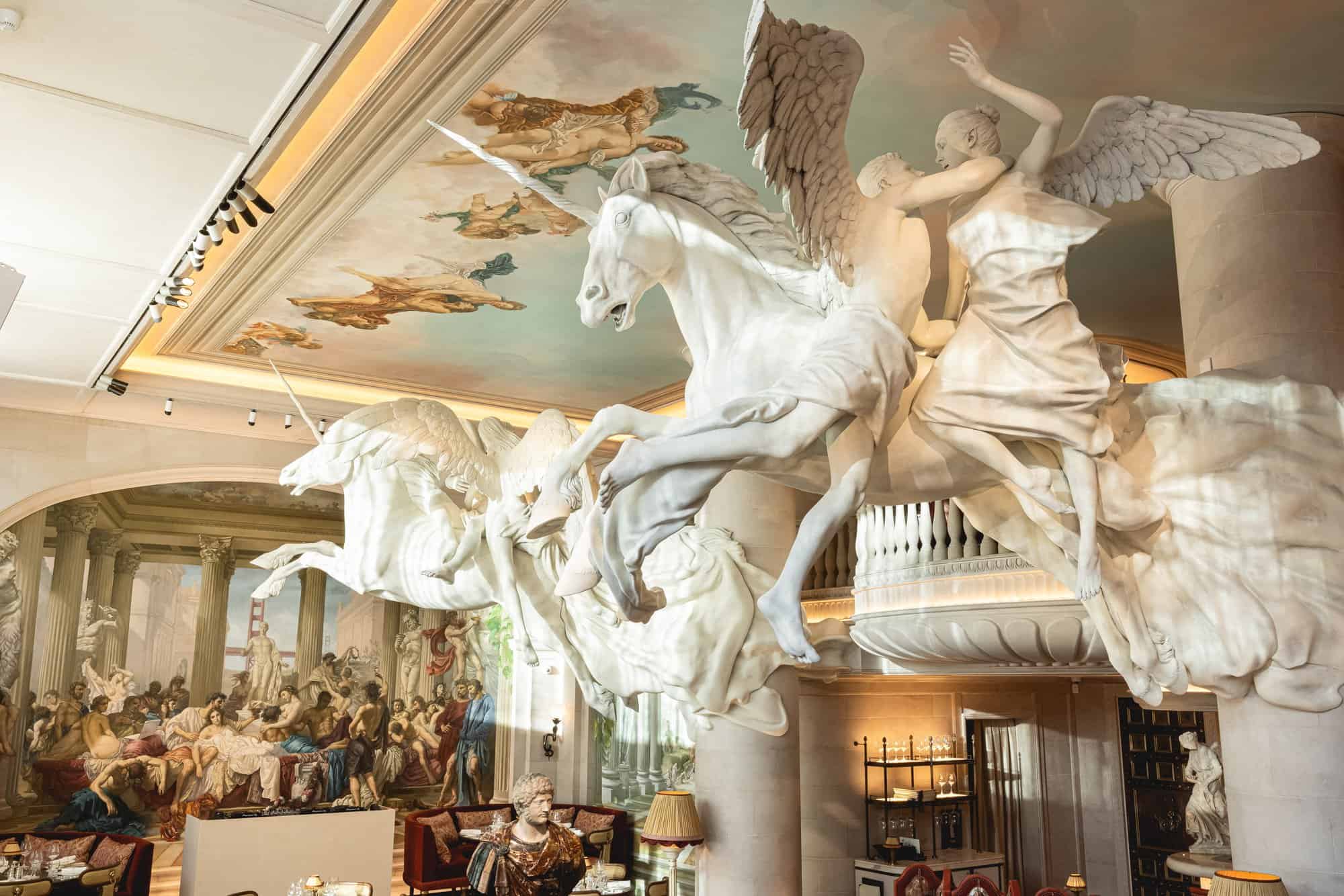
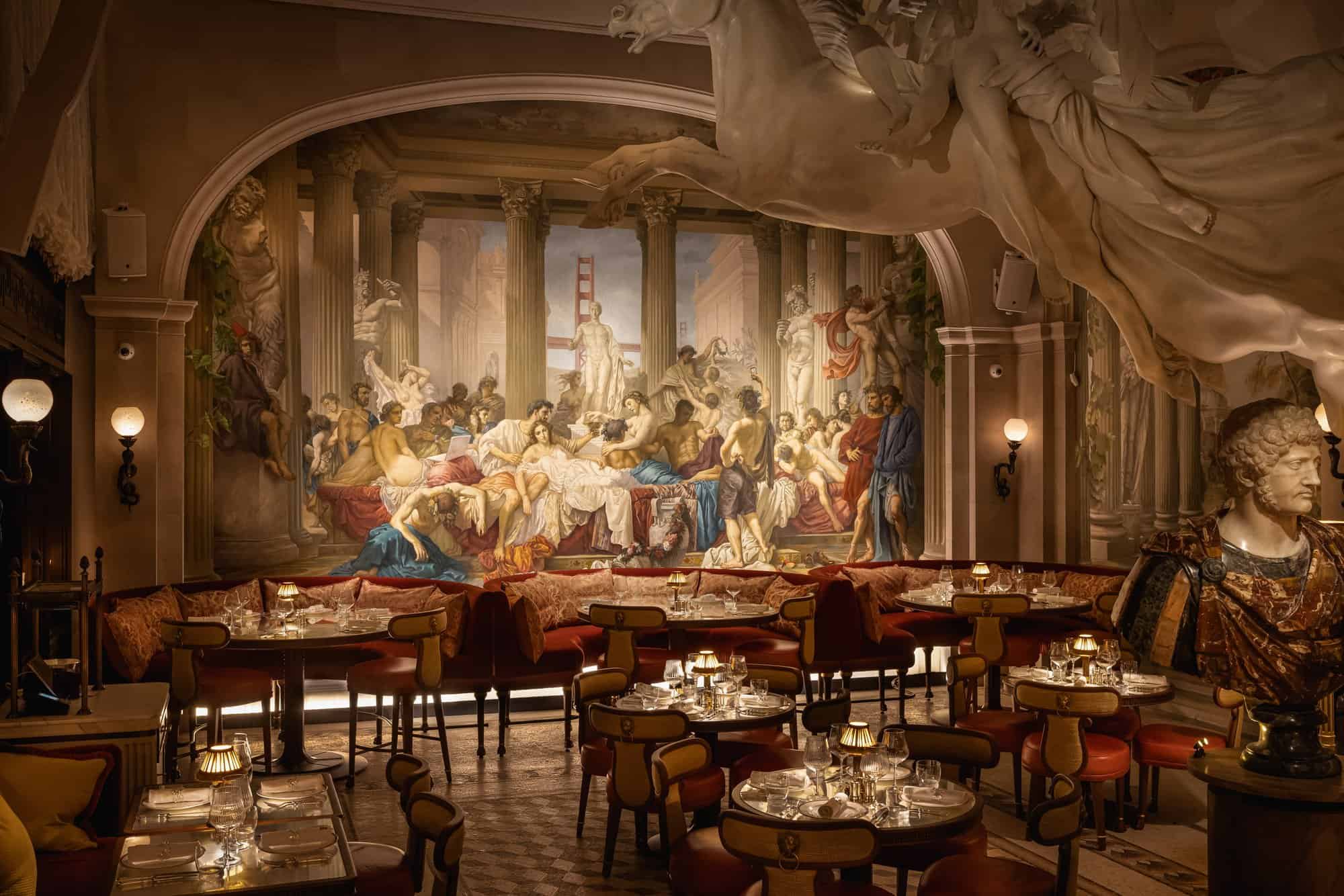
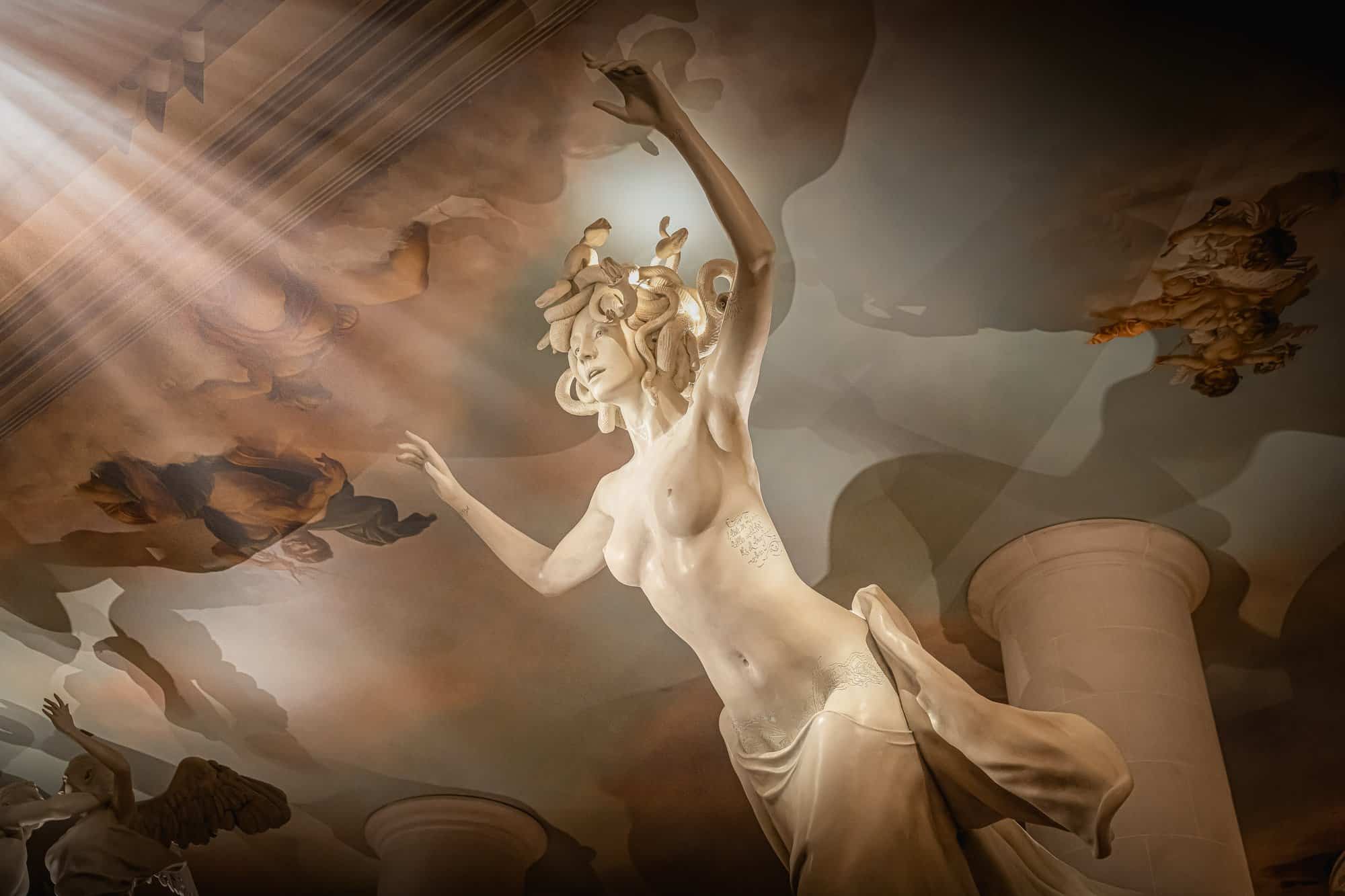
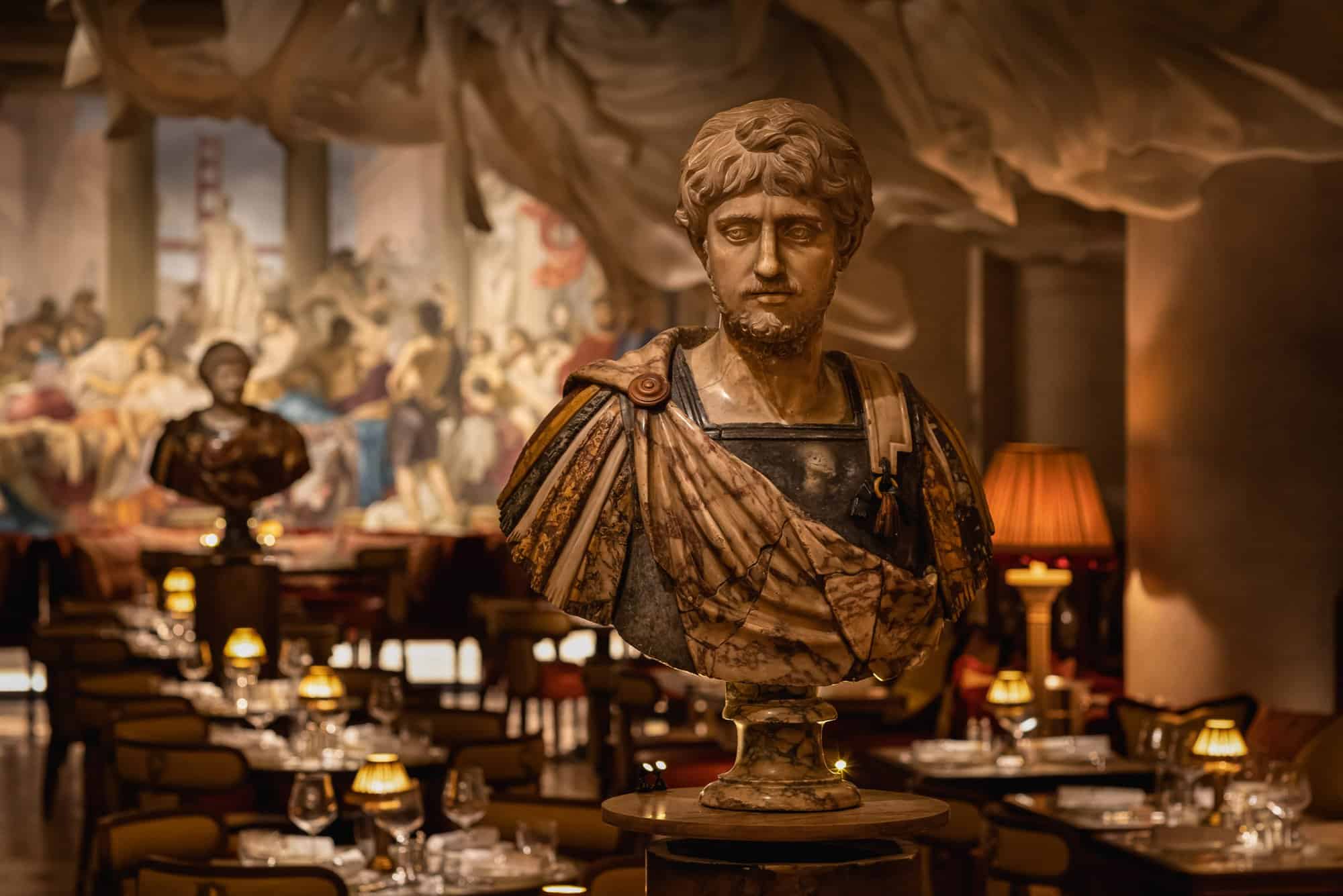
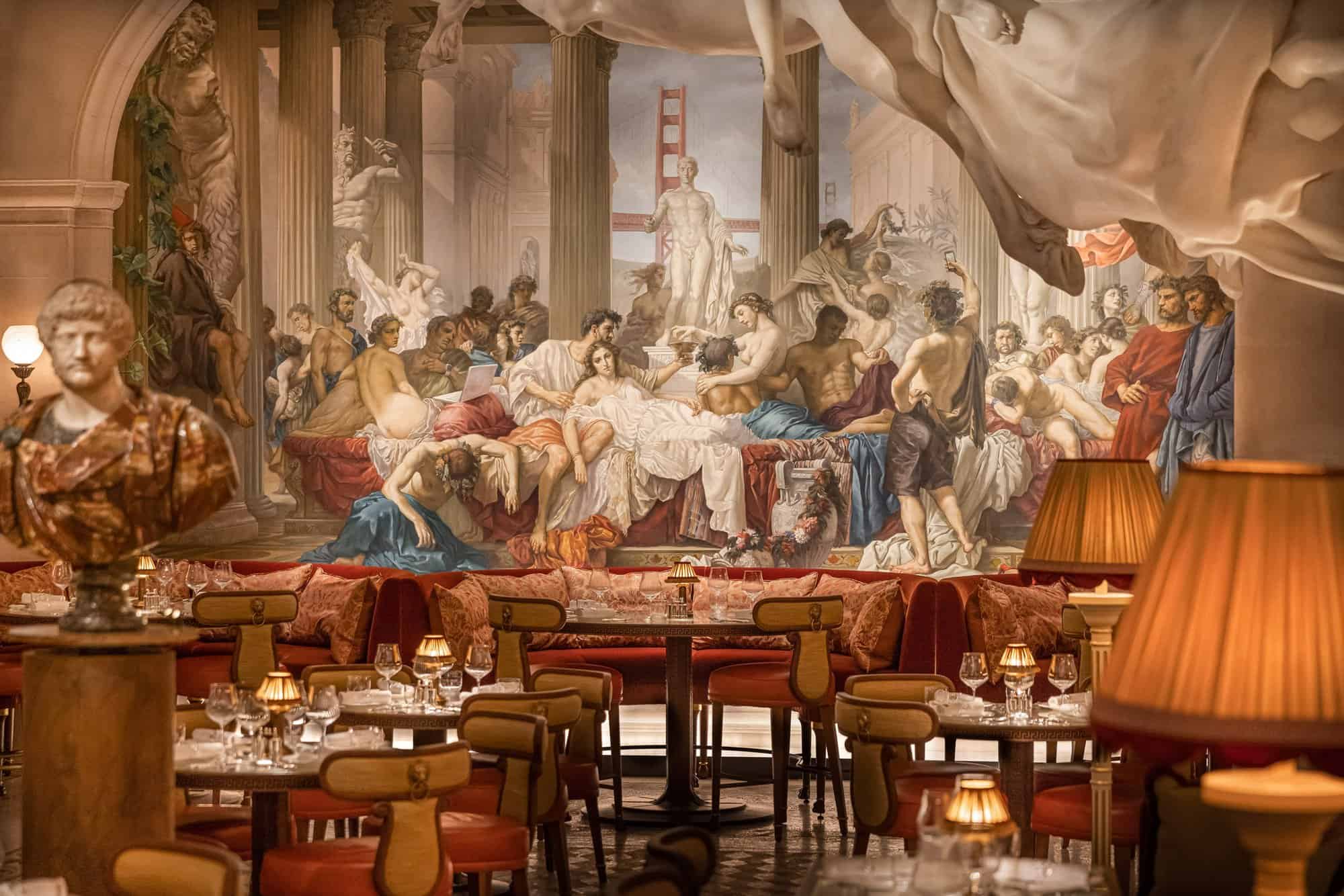
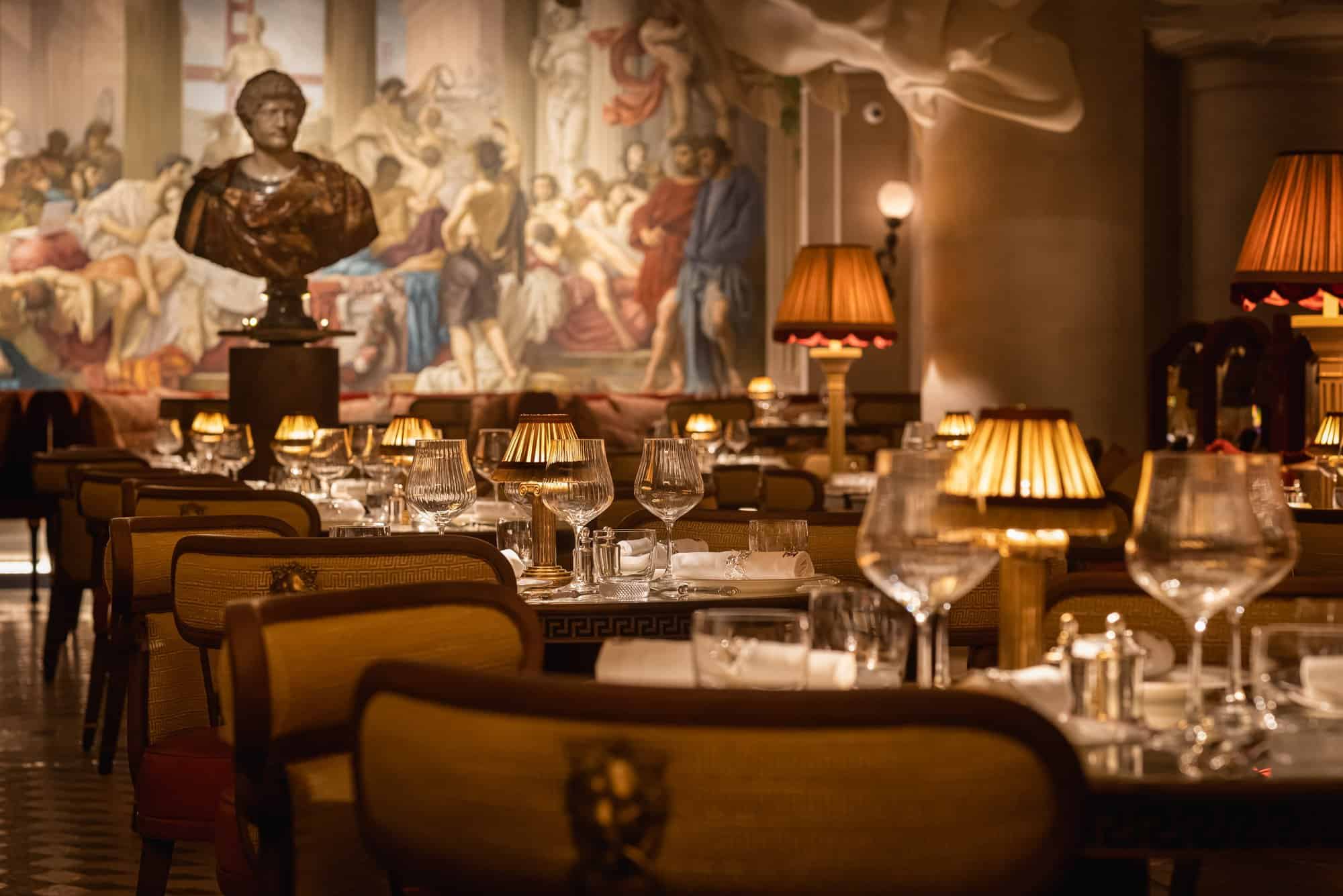
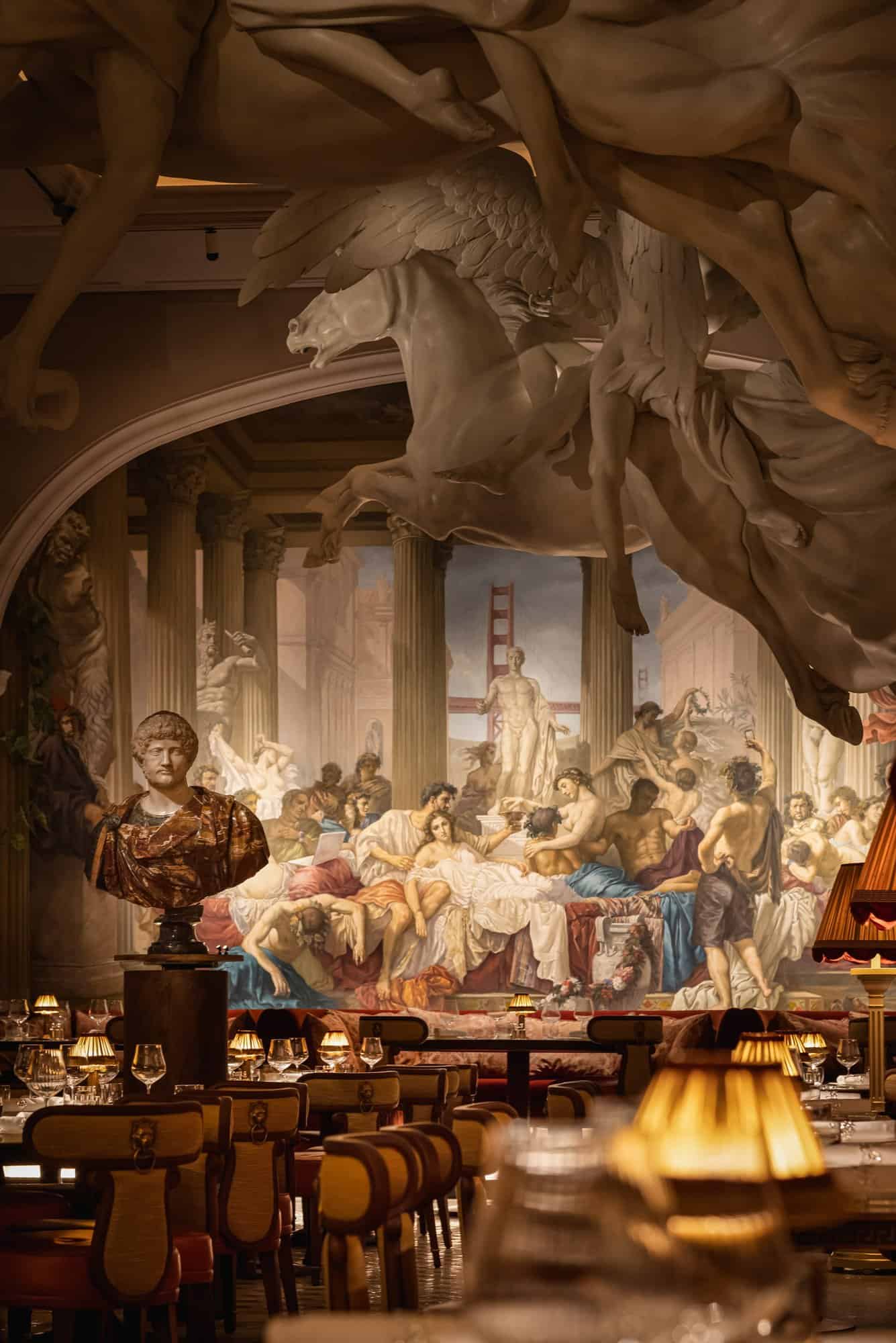
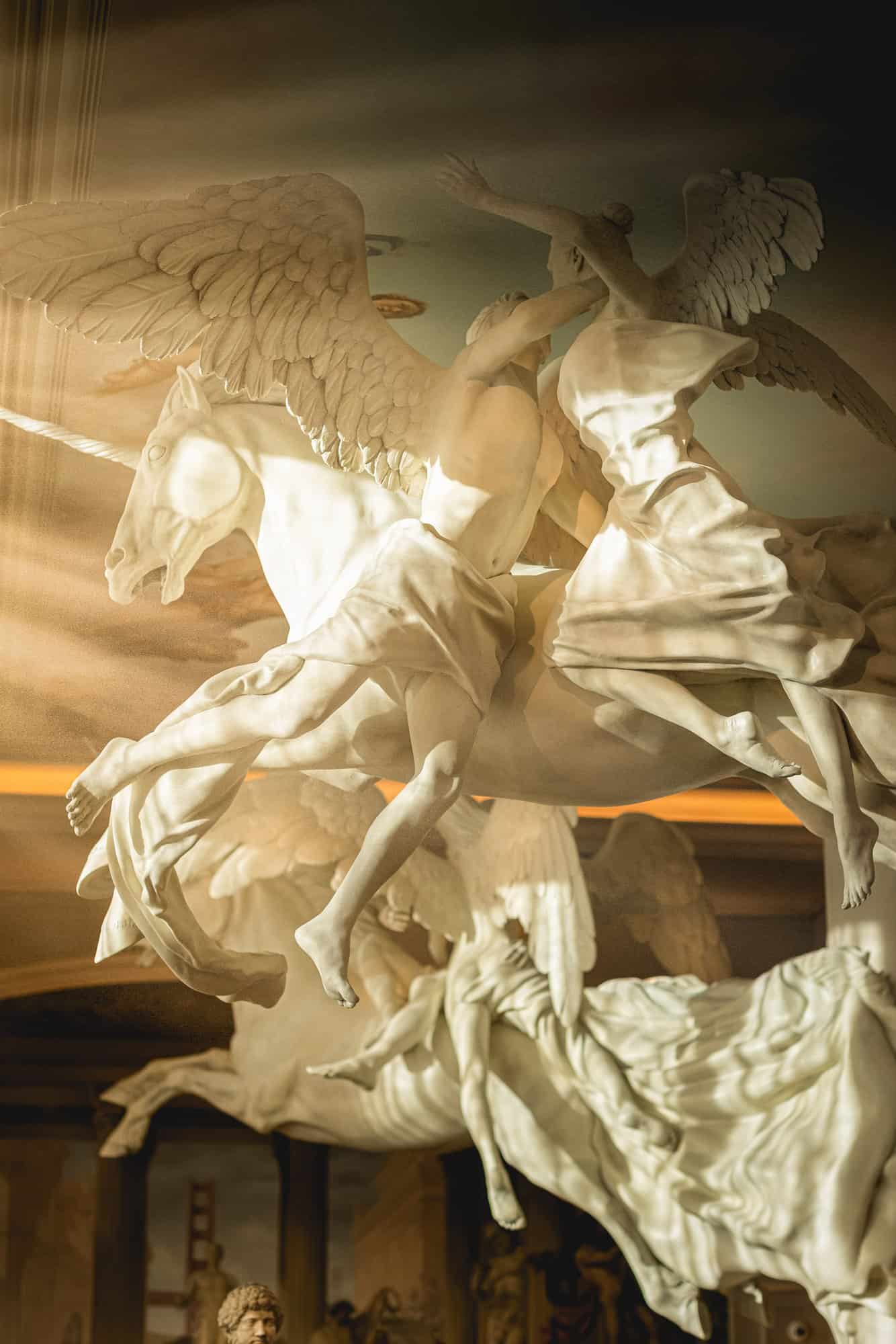
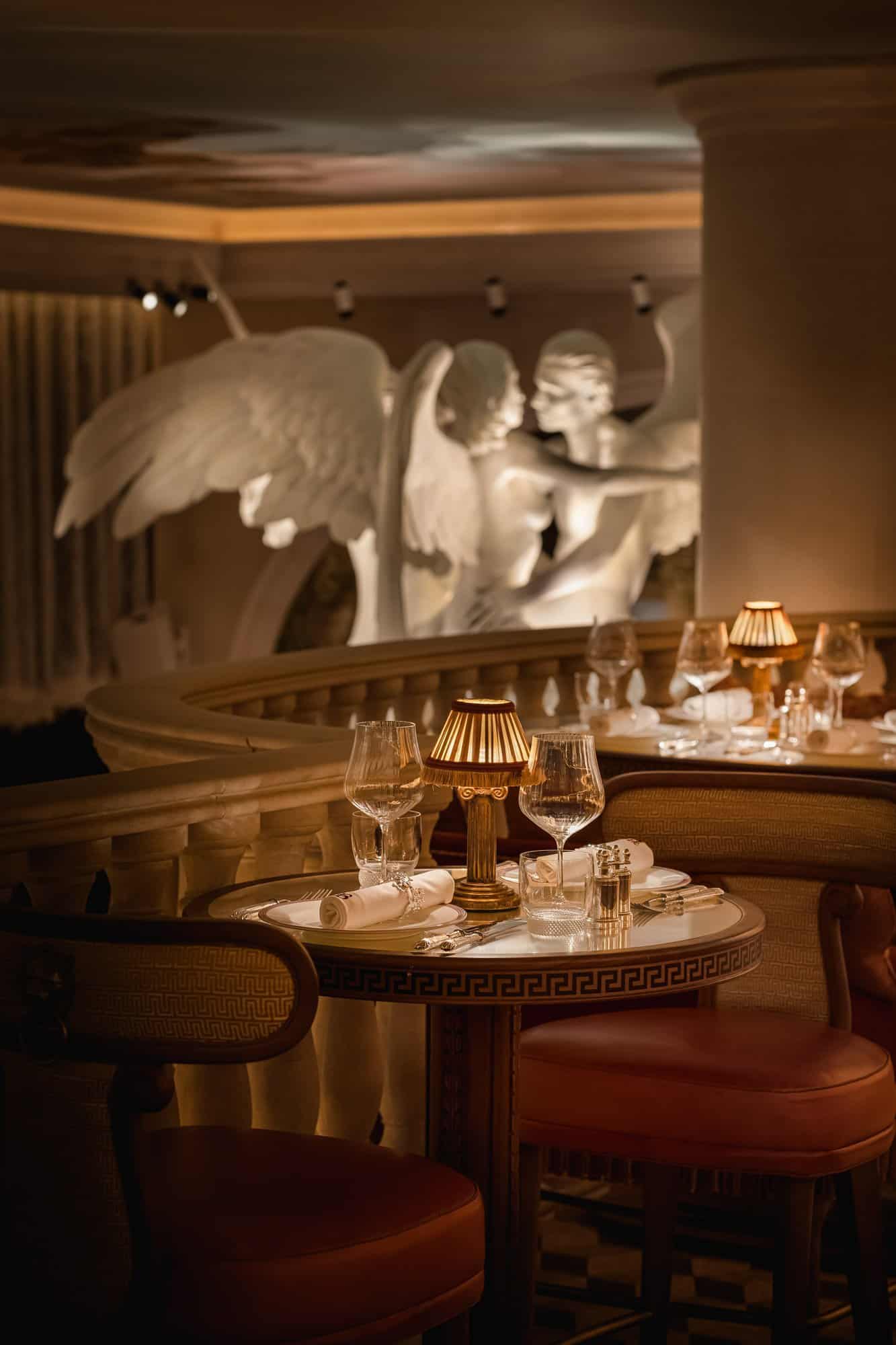
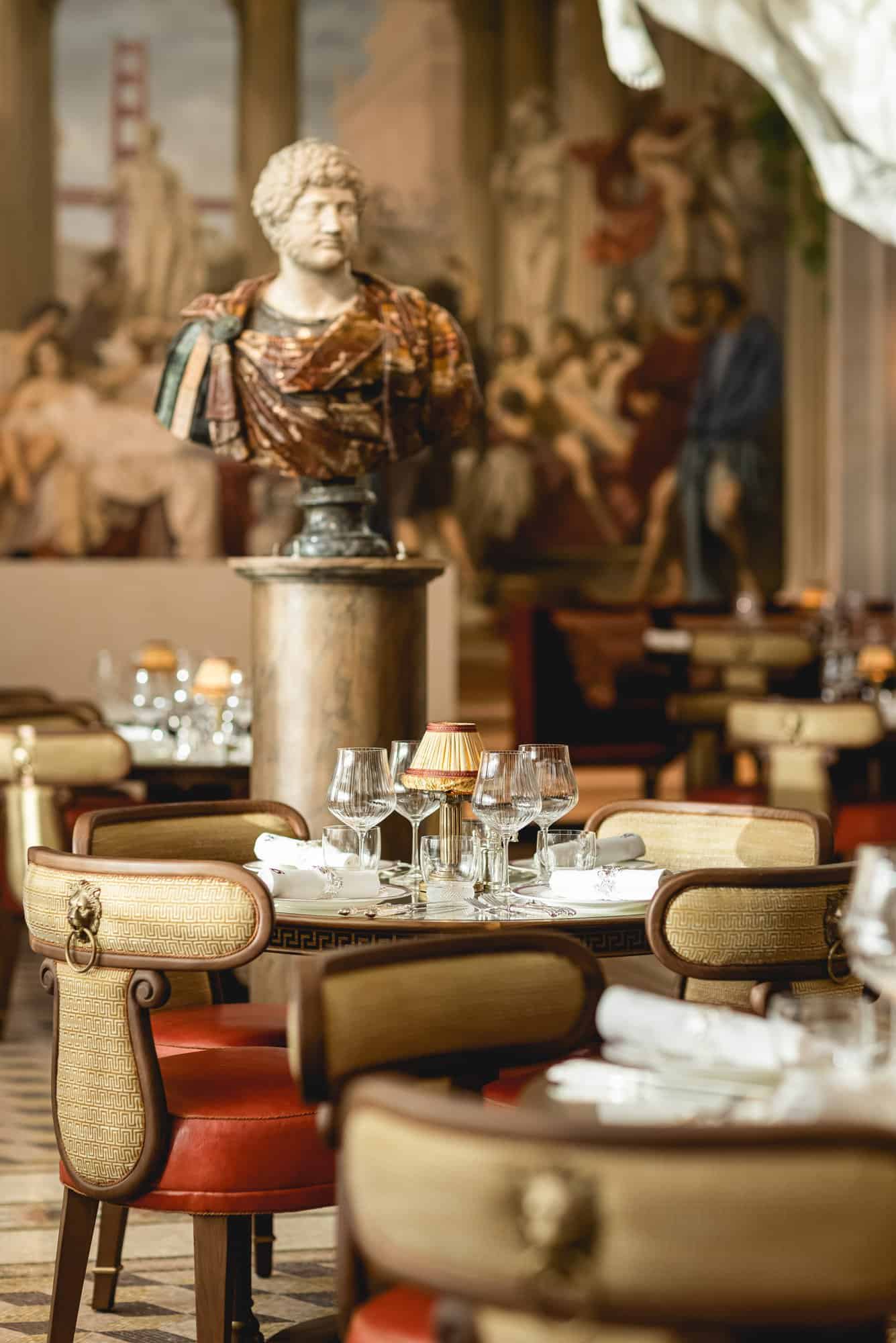
The five Hirst sculptures hang from the ceiling of the main room as if flying through the painted sky: a winged lion, a unicorn ridden by a pair of winged lovers, a second unicorn, Medusa with her crown of serpents, and Bacchus himself. Their pale, smooth forms float above the red leather chairs and velvet banquettes, catching the light from the coves and the columns around them. Across the back wall, Gary Myatt, who also painted murals at Annabel’s, has reinterpreted Thomas Couture’s 1847 painting Romans in their Decadence as an immense banquet scene framed by a stone arch. Myatt’s classically dressed revellers lounge among the colonnades much as Couture painted them, but some are using laptops and holding up iPhones, and the Golden Gate Bridge rises between the columns behind them, a sly joke on modern wealth and its pleasures. In front of the murals, Roman and Greek busts in coloured marble stand on plinths among the tables, part of a collection of period and modern classical art that runs through the whole restaurant.
Gold leaf, mosaics and the onyx bar
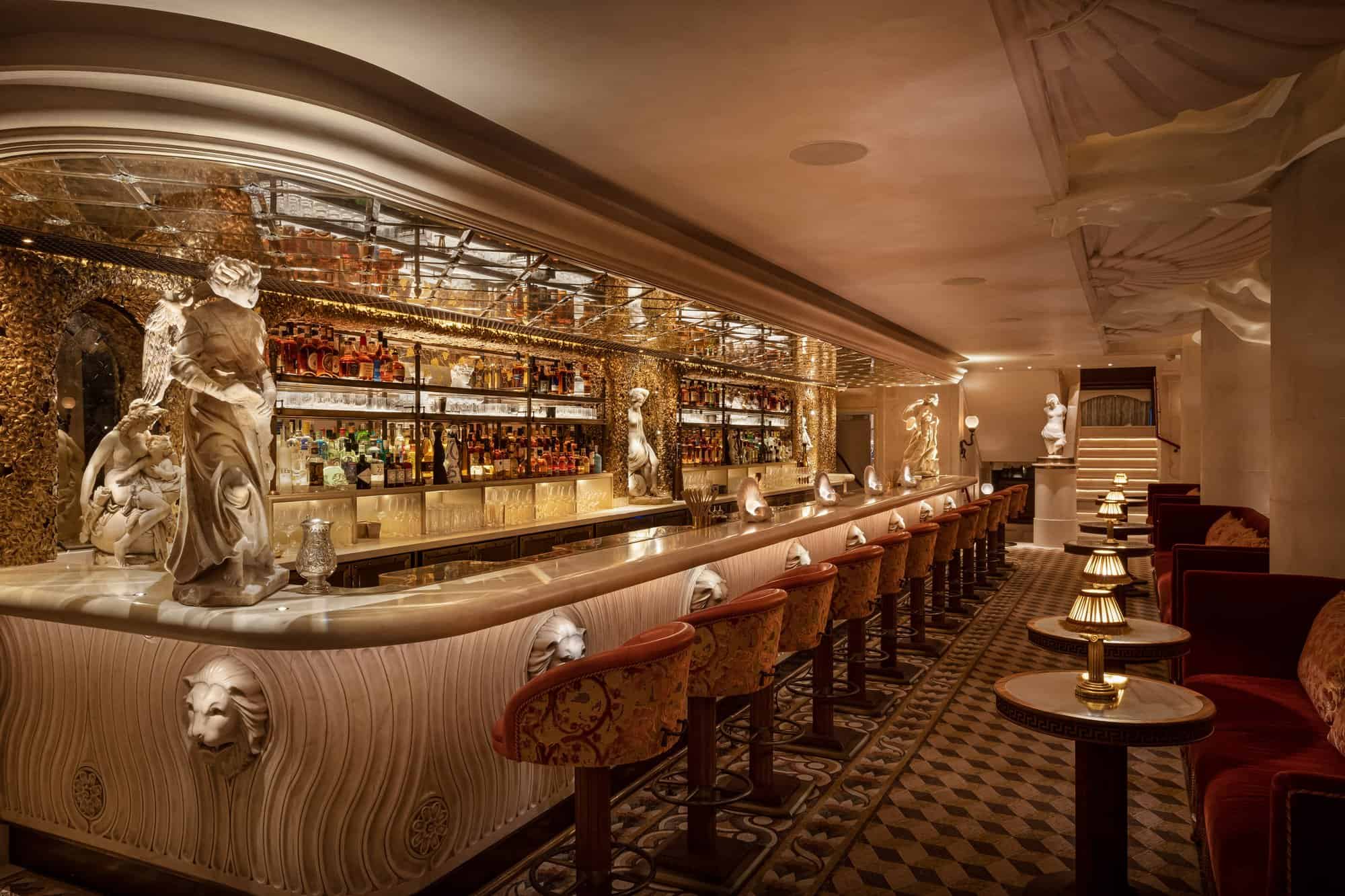
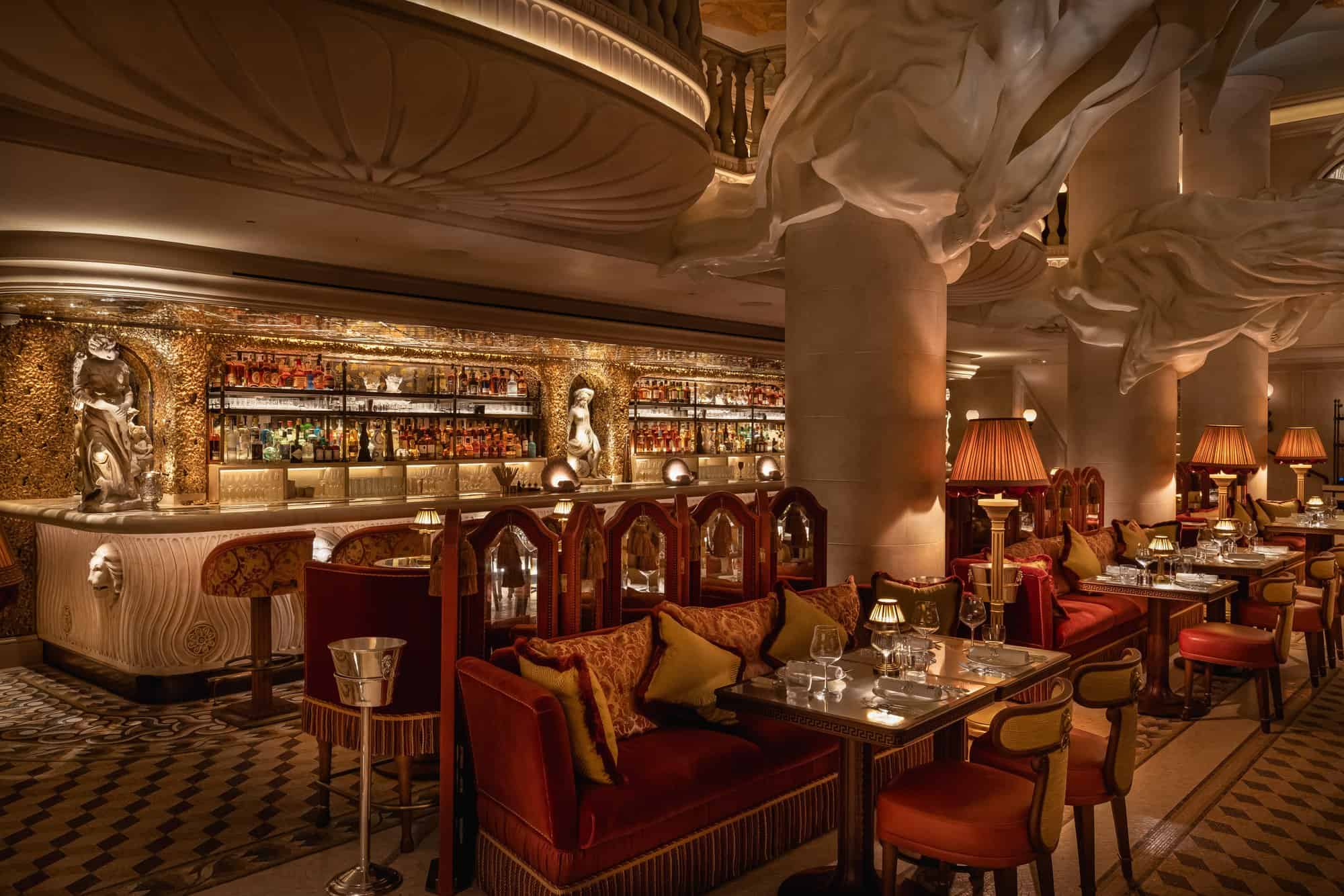
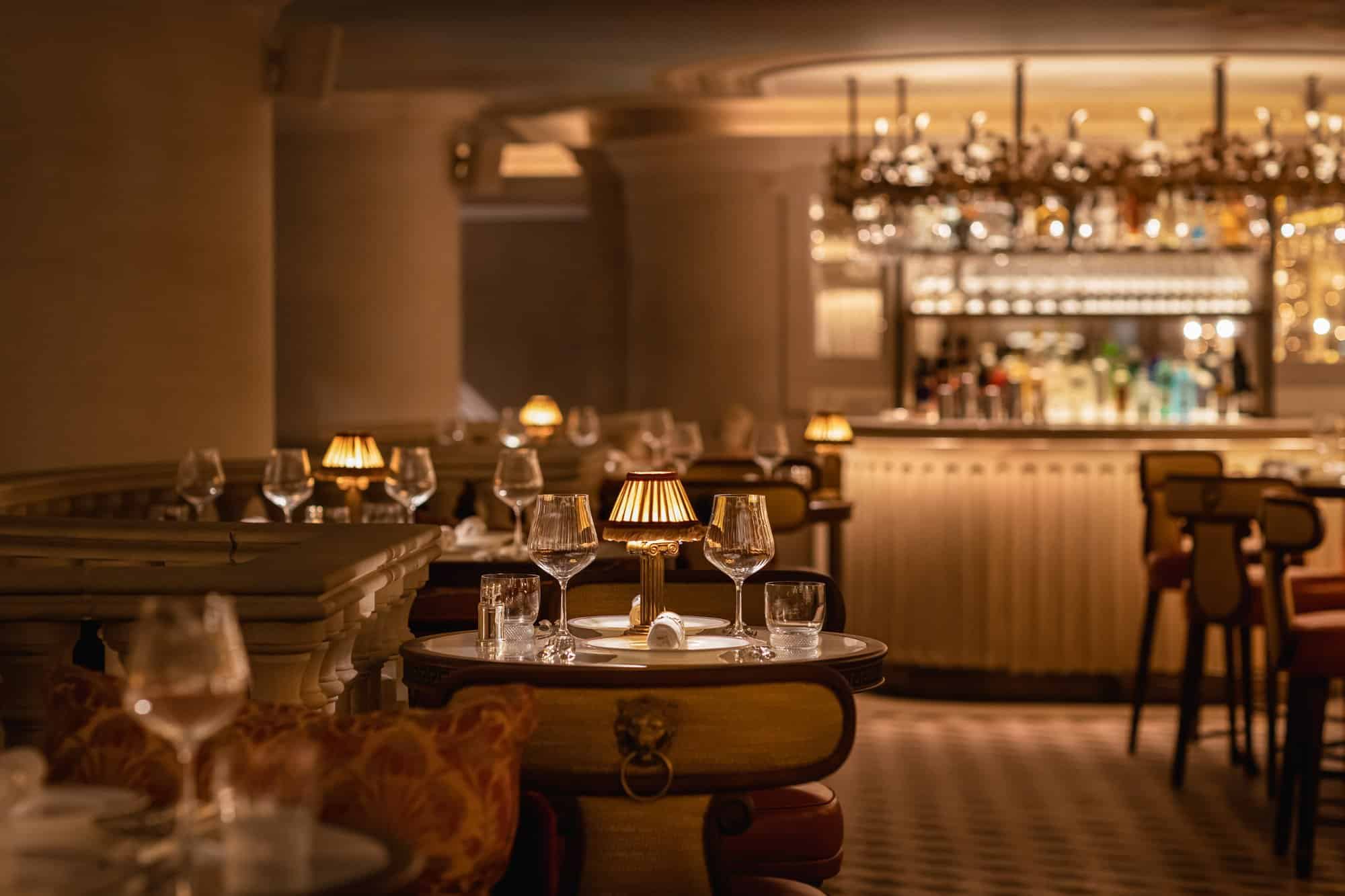
The materials are as lavish as the imagery. More than 300 books of 24-carat gold leaf were used across the interiors, and the Italian mosaic company Sicis made the floors of the restaurant, bar and private club in multicoloured marble mosaic, custom-designed and inspired by the houses of ancient Rome, handcrafted at its Ravenna headquarters and assembled on site. The long, curved bar has a fluted stone front set with carved lion heads, and statues line its counter; above it, Tony Sandles Glass made a canopy of diamond-shaped silver-leaf mirrors over the backlit onyx bar, as well as bevelled silver-leaf mirror panels set into burgundy velvet screens that separate the bar from the dining room and the slightly distressed gilded mirror tops of the bistro tables. Tillys Interiors produced a bespoke café curtain system with twisted uprights, cast brass flame finials and LED strips hidden inside the rods, while Design & Visual cast the stone-effect balustrade of the mezzanine, in three curving bays with a separate balustrade around the DJ booth, in Jesmonite matched to Portland stone samples chosen by the designers.
The Garden of the Hesperides, Hades and Artemis
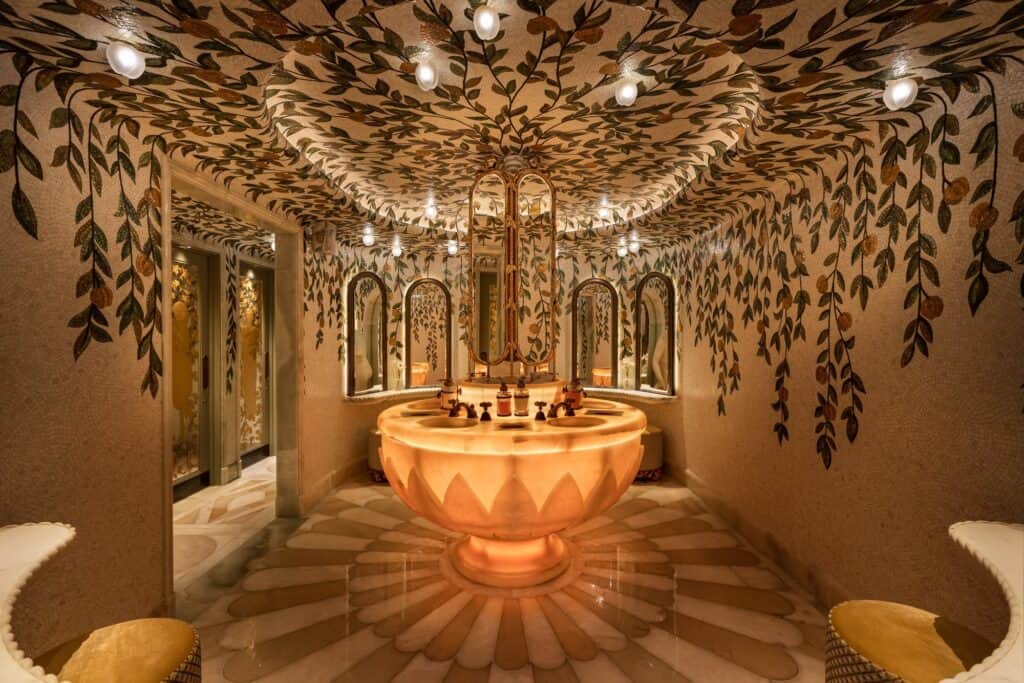
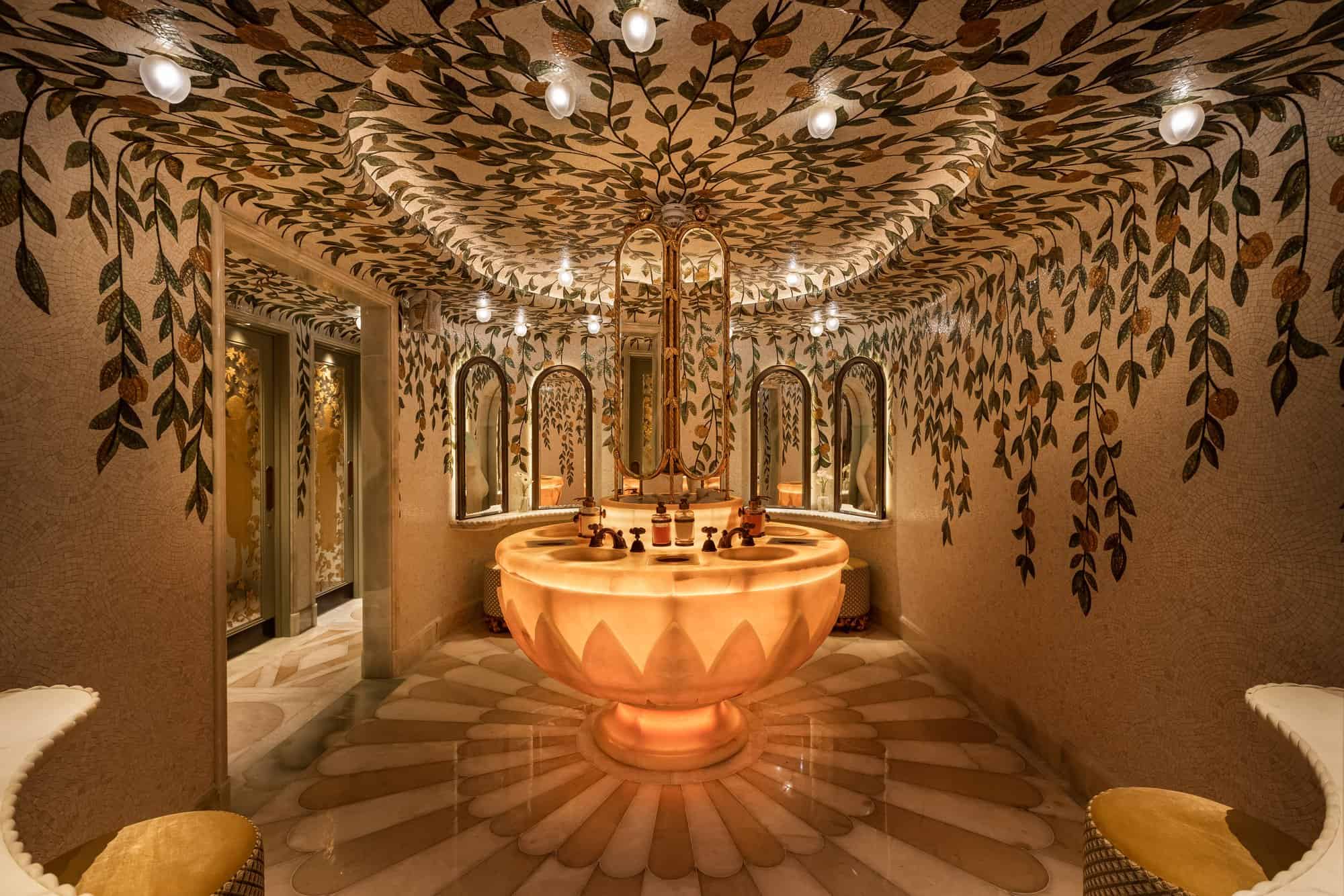
Beyond the main room, different spaces pay tribute to different figures and places of Greek and Roman myth. The ladies’ restroom recreates the Garden of the Hesperides, where golden apples grow: more than 400,000 tiles cover its walls and domed ceiling with glass mosaic branches heavy with golden fruit, and a glowing onyx basin stands at its centre on a radiating marble floor. The men’s restroom, in contrast, is the underworld of Hades, with black and white marble mosaics and high-gloss black fittings. On the mezzanine, beside the DJ booth, the private dining room Artemis looks out over Berkeley Square and brings its guests eye to eye with the Hirst sculptures, and hidden at the back of the building is Apollo’s Muse, a members’ club that opened the following year and takes its inspiration from the gallery of the Villa Albani in Rome. The kitchen, led by the chef Athinagoras Kostakos, serves Greek and Italian dishes designed to be shared and finished with some theatre at the table, and the wine list runs to more than 650 references, served by staff in togas.
Photography and credits
The gallery above opens with the main dining room in daylight, Hirst’s unicorn and its winged lovers flying beneath the painted ceiling, followed by Gary Myatt’s mural seen through its stone arch in the evening and the long bar with its lion heads and mirrored canopy. Then come Hirst’s Medusa against the clouds, a marble bust among the tables, the Garden of the Hesperides restroom with its mosaic branches and onyx basin, and the velvet banquettes beneath the mezzanine. The second half shows the mural by day, with its laptop, phone and Golden Gate Bridge, the upper level with its red banquette and gilded wall, the dining tables with their busts and lamps, a quiet table by the balustrade and the second bar, and four portrait views of the sculptures and busts. All sixteen photographs are by Johnny Stephens Photography, as published by Dezeen, on the Bacchanalia website and in the photographer’s own portfolio.
Bacchanalia gallery
Explore more on Archtene
- More projects by Martin Brudnizki Design Studio
- More projects in London
- More Restaurant Interior projects